TEKS ELAR 6.5
Knowledge and Skills Statement (Standard Cluster)
The student uses metacognitive skills to both develop and deepen comprehension of increasingly complex texts.
Texas Essential Knowledge and Skills for English Language Arts and Reading
Cluster contents
Student Expectations in This Statement
6.5 is a knowledge and skills statement. These are the student expectations under it.
- 6.5.A
establish purpose for reading assigned and self-selected text
- 6.5.B
generate questions about text before, during, and after reading to deepen understanding and gain information
- 6.5.C
make, correct, or confirm predictions using text features, characteristics of genre, and structures
- 6.5.D
create mental images to deepen understanding
- 6.5.E
make connections to personal experiences, ideas in other texts, and society
- 6.5.F
make inferences and use evidence to support understanding
- 6.5.G
evaluate details read to determine key ideas
- 6.5.H
synthesize information to create new understanding
- 6.5.I
monitor comprehension and make adjustments such as re-reading, using background knowledge, asking questions, and annotating when understanding breaks down.
Teacher's field guide
What This Cluster Means
What Students Need to Do
- Students read with a goal and track whether the text makes sense. They ask questions, revise predictions, make connections, infer from evidence, identify key ideas, and combine learning across texts.
What Mastery Looks Like
- A student reads with a clear purpose and notices when meaning breaks down. They identify key ideas, support inferences with relevant evidence, combine ideas across texts, and explain how a reading strategy improved understanding.
Common Misconceptions
- Students may treat a prediction as a random guess rather than using clues from the text. They may copy one detail as the key idea or make an inference without evidence. They also may keep reading when confused instead of stopping and choosing a repair strategy.
How to Assess It
- Give students two short passages on the same topic. Ask them to state a purpose, make one supported inference, name a shared key idea, and explain one repair strategy they used.
Lesson moves
Ways to Teach It
Give pairs a printed article and sticky notes to mark predictions, questions, connections, key details, and places where meaning breaks down.
Ask students to write: Which idea changed after reading, and which two details caused the change?
Play Evidence Match: teams pair inference cards with supporting sentence strips, then reject one weak match and explain why.
Compare a cafeteria menu with a nutrition article, then write one lunch recommendation using details from both sources.
Free download
Printable 6.5 Worksheet
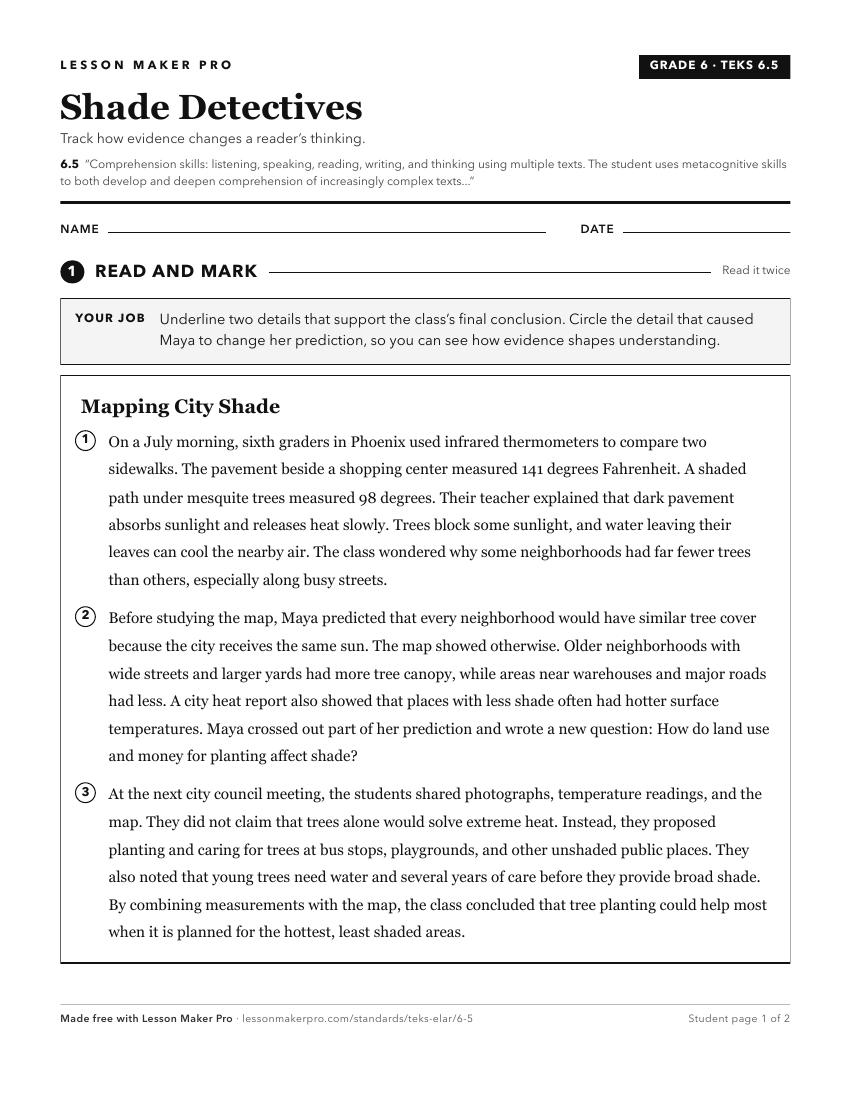
A ready-to-print activity worksheet aligned to 6.5, with an answer key for the teacher on its own page. No account needed.
PDF, US Letter, prints cleanly in black and white.
Download the worksheetKeep exploring
Related Standards
Turn this cluster into a lesson
Grade, subject, topic, and the complete cluster are prefilled. Create one free, no account needed.
Also for this cluster:Make a WorksheetMake a QuizMake a Sub Lesson