TEKS ELAR 3.1.E
The Standard
develop social communication such as conversing politely in all situations.
Texas Essential Knowledge and Skills for English Language Arts and Reading
Teacher's field guide
What This Standard Means
What Students Need to Do
- Students hold polite conversations in different settings. They listen, take turns, choose respectful words, and adjust their tone for classmates, adults, and unfamiliar people.
What Mastery Looks Like
- Students greet others, take turns, listen, and respond to what was said. They use respectful words and an appropriate tone when asking questions, disagreeing, or joining a conversation.
Common Misconceptions
- Students may think polite conversation only means saying “please” and “thank you.” They may interrupt, use the same tone with everyone, or treat disagreement as an argument.
How to Assess It
- Give pairs this prompt: “Your partner chose a game you dislike. Respond politely, ask one question, and suggest another option.” Listen for tone, turn-taking, and respectful words.
Lesson moves
Ways to Teach It
Give pairs situation cards and props, then have them act out polite conversations with a classmate, teacher, guest, or younger student.
Ask students to write two respectful ways to disagree, then discuss how word choice and tone affect the listener.
Play Conversation Relay, where students earn a point for greeting, listening, asking a follow-up question, and closing politely.
Practice ordering from a classroom café menu, with students taking turns as customers and servers using polite requests and responses.
Free download
Printable 3.1.E Worksheet
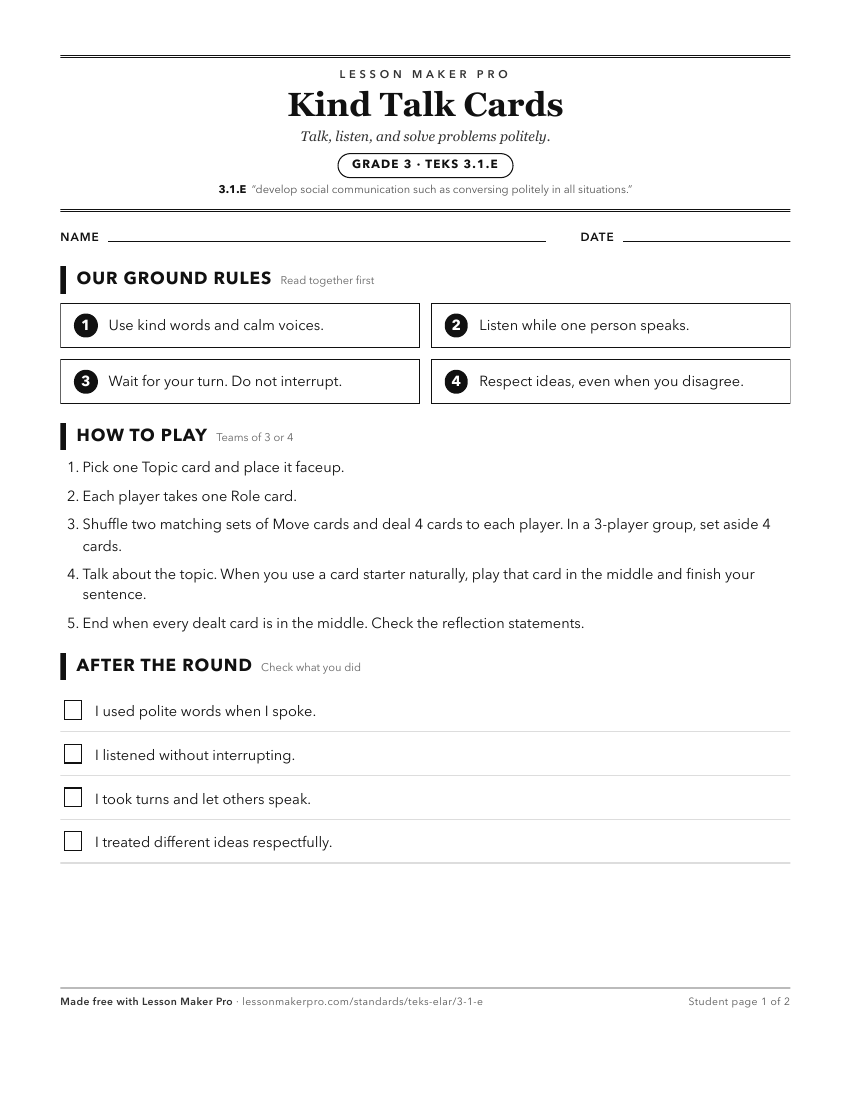
A ready-to-print activity worksheet aligned to 3.1.E, with an answer key for the teacher on its own page. No account needed.
PDF, US Letter, prints cleanly in black and white.
Download the worksheetKeep exploring
Related Standards
- 1.1.E
develop social communication such as introducing himself/herself and others, relating experiences to a classmate, and expressing needs and feelings.
- 2.1.E
develop social communication such as distinguishing between asking and telling.
- K.1.E
develop social communication such as introducing himself/herself, using common greetings, and expressing needs and wants.
- 5.1.C
give an organized presentation employing eye contact, speaking rate, volume, enunciation, natural gestures, and conventions of language to communicate ideas eff...
Turn this exact standard into a lesson
Grade, subject, topic, and the complete standard are prefilled. Create one free, no account needed.
Also for this standard:Make a WorksheetMake a QuizMake a Sub Lesson