TEKS ELAR 2.2.C.vi
The Standard
spelling words with prefixes, including un-, re-, and dis-, and inflectional endings, including -s, -es, -ed, -ing, -er, and -est
Texas Essential Knowledge and Skills for English Language Arts and Reading · The student develops word structure knowledge through phonological awareness, print concepts, phonics, and morphology to communicate, decode, and spell.
Teacher's field guide
What This Standard Means
What Students Need to Do
- Students identify the base word, then add a beginning or ending that changes meaning, tense, number, or degree. They spell the completed word correctly and use it in a sentence.
What Mastery Looks Like
- Given a base word and a clue, a student correctly writes words such as unhappy, reread, disagree, boxes, jumped, running, faster, and tallest. The student can explain the meaning added by each word part.
Common Misconceptions
- Students may attach an ending without checking the final letters, producing runing, makeing, or boxs. They may spell -ed only as heard, such as jumpt, or choose a beginning whose meaning does not fit. Some also remove letters from the base word when no change is needed.
How to Assess It
- Exit ticket: Write the correct word for each clue: read again, not fair, more fast, and two boxes. Use one answer in a sentence.
Lesson moves
Ways to Teach It
Give pairs letter tiles and base-word cards; students build new words, circle the added part, and record any changed letters.
Ask how reread and unread differ, then have students explain each meaning and use both words in sentences.
Play Affix Match: students pair base-word cards with clue cards, write the completed word, and earn a point for correct spelling.
Use a classroom notice or menu; students hunt for words with added beginnings or endings and explain how each addition changes meaning.
Free download
Printable 2.2.C.vi Worksheet
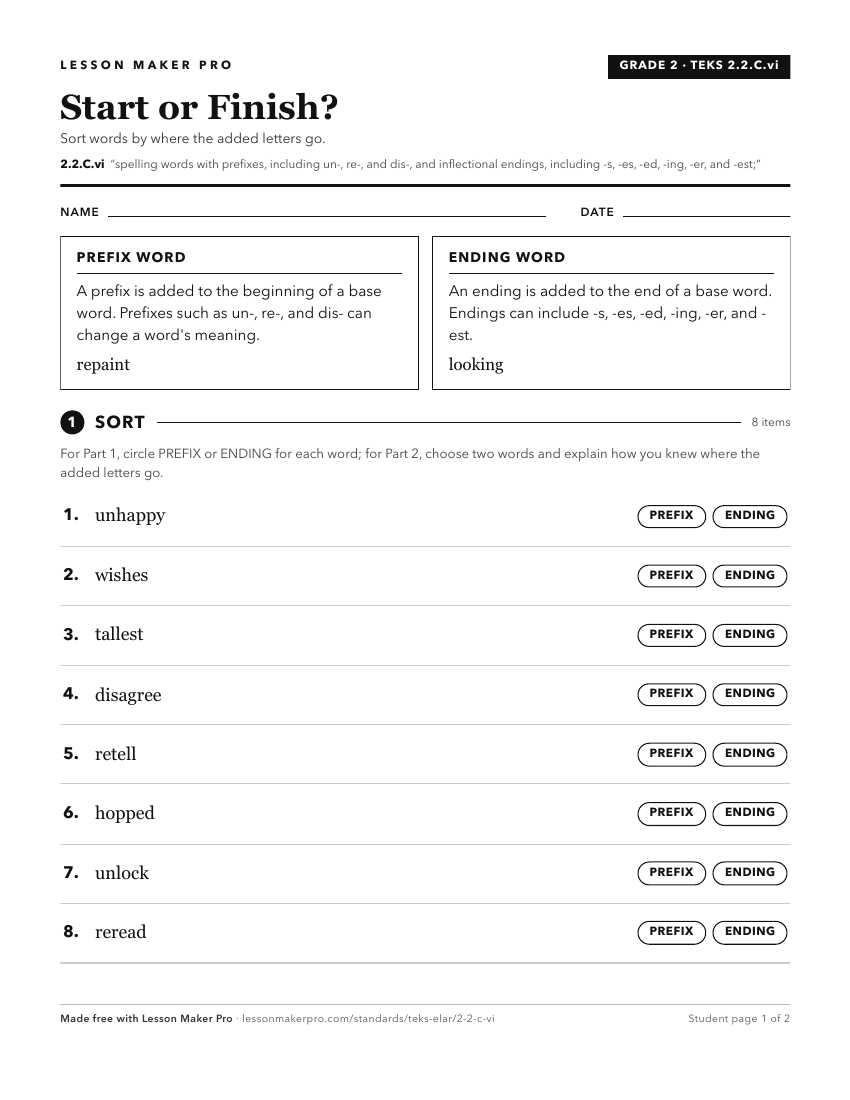
A ready-to-print activity worksheet aligned to 2.2.C.vi, with an answer key for the teacher on its own page. No account needed.
PDF, US Letter, prints cleanly in black and white.
Download the worksheetKeep exploring
Related Standards
- 1.2.B.v
decoding words with inflectional endings, including -ed, -s, and -es; and
- 1.3.C
identify the meaning of words with the affixes -s, -ed, and -ing; and
- 2.2.B.vi
decoding words with prefixes, including un-, re-, and dis-, and inflectional endings, including -s, -es, -ed, -ing, -er, and -est; and
- 5.2.B.v
spelling words using knowledge of prefixes; and
Turn this exact standard into a lesson
Grade, subject, topic, and the complete standard are prefilled. Create one free, no account needed.
Also for this standard:Make a WorksheetMake a QuizMake a Sub Lesson