South Dakota ELA 9-10.W.3
Standard Cluster
Write narratives or other creative texts (e.g., poetry, digital composition, graphic stories, memoirs) to develop real or imagined experiences or events using effective technique and voice, well-chosen details, and well-structured event sequences. Engage and orient the reader by setting out a problem, situation, or observation, establishing one or multiple point(s) of view, and introducing a narrator and/or characters; create a smooth progression of experiences or events. Use narrative or literary techniques or poetic devices, such as dialogue, pacing, rhythm, description, reflection, and multiple plot lines, to develop experiences, events, and/or characters. Use a variety of techniques to sequence events so that they build on one another to create a coherent whole. Use strong, effective word choice and figurative language to convey a vivid picture of the experiences, events, setting, and/or characters. Establish a clear voice. Provide a conclusion (when appropriate to the genre) that follows from and reflects on what is experienced, observed, or resolved over the course of the narrative or creative text.
South Dakota English Language Arts Standards (2025)
Cluster contents
Standards in This Cluster
9-10.W.3 is a cluster heading. These are the individual standards under it.
- 9-10.W.3.b
Use narrative or literary techniques or poetic devices, such as dialogue, pacing, rhythm, description, reflection, and multiple plot lines, to develop experienc...
- 9-10.W.3.d
Use strong, effective word choice and figurative language to convey a vivid picture of the experiences, events, setting, and/or characters.
- 9-10.W.3.e
Establish a clear voice.
- 9-10.W.3.f
Provide a conclusion (when appropriate to the genre) that follows from and reflects on what is experienced, observed, or resolved over the course of the narrati...
Teacher's field guide
What This Cluster Means
What Students Need to Do
- Students write a story, memoir, poem, or graphic story about a real or imagined experience. They choose a point of view, arrange events so each one leads to the next, and use details and voice to help readers picture what happens.
What Mastery Looks Like
- A student opens with a situation that gives readers a reason to keep going. Dialogue, description, or pacing develops the people and events, and the ending shows what changed.
Common Misconceptions
- Students may switch point of view without meaning to or list events without showing why they matter. Some add many adjectives instead of one telling detail, then end with a sudden sentence such as 'It was all a dream.'
How to Assess It
- Ask students to write eight sentences about missing a bus. Look for a clear point of view, one telling detail, events that build on each other, and an ending that shows a change.
Lesson moves
Ways to Teach It
Give pairs six paper cards showing events in a lost-phone story; have them order the cards and add a turning point.
Write a cafeteria argument twice, once from each student's view, then underline the words that change the reader's sympathy.
Play a pacing swap: expand a two-sentence bike crash into six sentences, then condense a slow morning into one.
Turn a real or invented job interview mix-up into a short personal essay with one line of dialogue and a reflective ending.
Free download
Printable 9-10.W.3 Worksheet
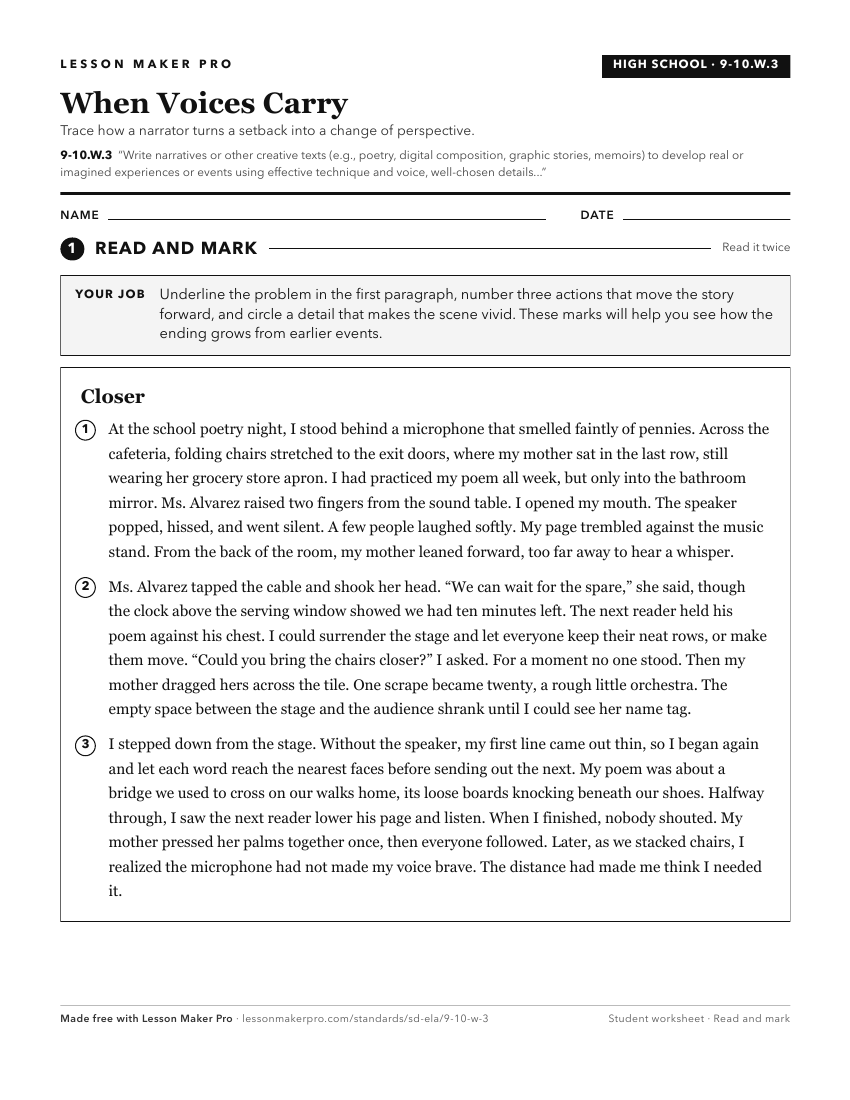
A ready-to-print activity worksheet aligned to 9-10.W.3, with an answer key for the teacher on its own page. No account needed.
PDF, US Letter, prints cleanly in black and white.
Download the worksheetKeep exploring
Related Standards
- 6.W.3
Write narratives and other creative texts (e.g. poetry, graphic stories, digital compositions, memoirs) to develop real or imagined experiences or events using ...
- 11-12.W.3
Write narratives or other creative texts (e.g., poetry, digital composition, graphic stories, memoirs) to develop real or imagined experiences or events using e...
- 7.W.3
Write narratives and other creative texts (e.g. poetry, graphic stories, digital composition, memoirs) to develop real or imagined experiences or events using e...
- 8.W.3
Write narratives and other creative texts (e.g., poetry, digital composition, graphic stories, memoirs) to develop real or imagined experiences or events using ...
Turn this cluster into a lesson
Grade, subject, topic, and the complete cluster are prefilled. Create one free, no account needed.
Also for this cluster:Make a WorksheetMake a QuizMake a Sub Lesson