South Dakota ELA 8.W.3
Standard Cluster
Write narratives and other creative texts (e.g., poetry, digital composition, graphic stories, memoirs) to develop real or imagined experiences or events using effective technique, relevant descriptive details, and well-structured event sequences. Engage and orient the reader by establishing a context and point of view and introducing a narrator and/or characters; organize an event sequence that unfolds naturally and logically. Use narrative and literary techniques, such as dialogue, pacing, rhythm, description, and reflection, to develop experiences, events, and/or characters. Use a variety of transition words, phrases, and clauses to convey sequence, signal shifts from one time frame or setting to another and show the relationships among experiences and events. Use precise words and phrases, relevant descriptive details, and sensory and figurative language to capture the action and convey experiences and events. Provide a conclusion that follows from and reflects on the narrated experiences or events (when appropriate to genre).
South Dakota English Language Arts Standards (2025)
Cluster contents
Standards in This Cluster
8.W.3 is a cluster heading. These are the individual standards under it.
- 8.W.3.b
Use narrative and literary techniques, such as dialogue, pacing, rhythm, description, and reflection, to develop experiences, events, and/or characters.
- 8.W.3.d
Use precise words and phrases, relevant descriptive details, and sensory and figurative language to capture the action and convey experiences and events.
- 8.W.3.e
Provide a conclusion that follows from and reflects on the narrated experiences or events (when appropriate to genre).
Teacher's field guide
What This Cluster Means
What Students Need to Do
- Students create a story, memoir, poem, or graphic story about something real or imagined. They choose a narrator, set the scene, and move events forward with details, dialogue, and clear time cues. They write an ending that fits what happened.
What Mastery Looks Like
- A reader can tell who is speaking, where the action starts, and why one event leads to the next. The writer slows a key moment with dialogue or sensory detail, makes a jump in time clear, and closes with a fitting thought or image.
Common Misconceptions
- Students often list events without showing a key moment, or add dialogue that repeats the narration. They may switch narrators without warning, use “then” for every shift, or end with a moral unrelated to what happened.
How to Assess It
- Write a short scene about missing a bus. Show who is telling it and where, include a sound or smell and one line of dialogue, signal a time jump, and end with a fitting thought.
Lesson moves
Ways to Teach It
Give pairs cards reading “bag gone,” “bus checked,” “driver called,” and “bag found”; have them order events and write a first-person opening.
Write two endings for a broken trophy scene, one with regret and one with relief; discuss which details would make each ending believable.
Write “Then I waited. Then the phone rang. Then I ran outside” on the board; race to replace “then” with time or place cues.
Use a real school-day mishap, such as a lost notebook, to make a six-panel comic with time cues and a final reflection.
Free download
Printable 8.W.3 Worksheet
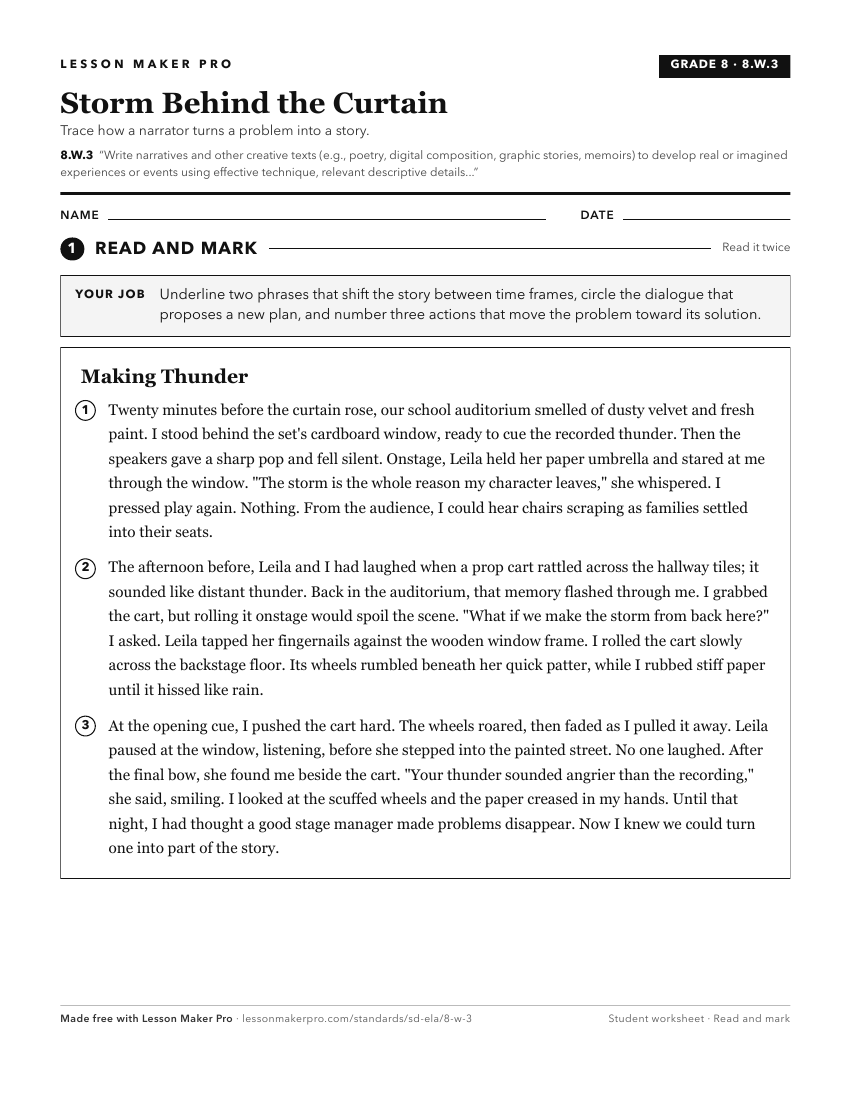
A ready-to-print activity worksheet aligned to 8.W.3, with an answer key for the teacher on its own page. No account needed.
PDF, US Letter, prints cleanly in black and white.
Download the worksheetKeep exploring
Related Standards
- 6.W.3
Write narratives and other creative texts (e.g. poetry, graphic stories, digital compositions, memoirs) to develop real or imagined experiences or events using ...
- 5.W.3
Write narratives (story, poetry, or drama) to develop real or imagined experiences or events using effective technique, relevant descriptive details, and clear ...
- 7.W.3
Write narratives and other creative texts (e.g. poetry, graphic stories, digital composition, memoirs) to develop real or imagined experiences or events using e...
Turn this cluster into a lesson
Grade, subject, topic, and the complete cluster are prefilled. Create one free, no account needed.
Also for this cluster:Make a WorksheetMake a QuizMake a Sub Lesson