South Dakota ELA 8.W.3.b
The Standard
- 8.W.3
- Write narratives and other creative texts (e.g., poetry, digital composition, graphic stories, memoirs) to develop real or imagined experiences or events using effective technique, relevant descriptive details, and well-structured event sequences.
Use narrative and literary techniques, such as dialogue, pacing, rhythm, description, and reflection, to develop experiences, events, and/or characters.
South Dakota English Language Arts Standards (2025)
Teacher's field guide
What This Standard Means
What Students Need to Do
- Students turn a basic event into a scene a reader can picture. They use what characters say, notice, and think, plus sentence length, to shape the mood and speed.
What Mastery Looks Like
- A reader can tell what a character wants from what they say and do. The writer slows down a turning point, moves quickly through less important action, and ends with a thought tied to what happened.
Common Misconceptions
- Students may write dialogue that repeats facts the reader already knows or label a feeling instead of showing it. They may give every action equal space, burying the turning point.
How to Assess It
- Exit ticket: Expand 'I opened the door. My brother was inside.' into five sentences with dialogue, a pause before the reveal, and a final thought.
Lesson moves
Ways to Teach It
Give pairs six sentence strips from a flat scene; have them reorder the strips, add a whispered line, and read both versions aloud.
Ask, 'What could a character say to show fear without saying afraid?' Have students write one line and explain their choice.
Play a pacing swap: students rewrite 'The dog ran away' as a slow, tense moment, then as a fast summary.
Ask students to write about a missed bus or late ride using one sound, one short sentence, and a final thought about the day.
Free download
Printable 8.W.3.b Worksheet
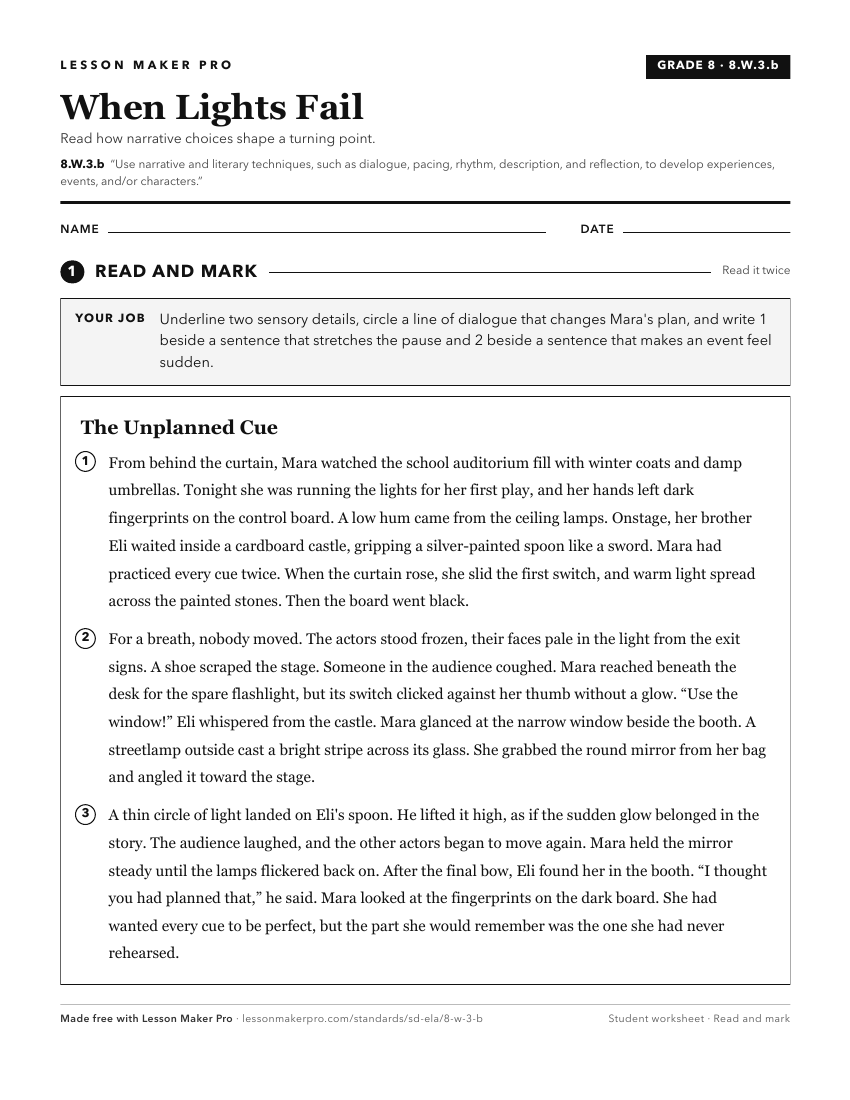
A ready-to-print activity worksheet aligned to 8.W.3.b, with an answer key for the teacher on its own page. No account needed.
PDF, US Letter, prints cleanly in black and white.
Download the worksheetKeep exploring
Related Standards
- 7.W.3.b
Use narrative and literary techniques, such as dialogue, pacing, rhythm, description, and poetic devices to develop experiences, events, and/or characters.
- 6.W.3.b
Use literary and narrative techniques, such as dialogue, pacing, rhythm, description, and poetic devices to develop experiences, events, and/or characters.
- 3.W.3.b
Use narrative techniques, such as dialogue and descriptions of actions, thoughts, and feelings to develop experiences and events or show the response of charact...
Turn this exact standard into a lesson
Grade, subject, topic, and the complete standard are prefilled. Create one free, no account needed.
Also for this standard:Make a WorksheetMake a QuizMake a Sub Lesson