South Dakota ELA 6.W.3.b
The Standard
- 6.W.3
- Write narratives and other creative texts (e.g. poetry, graphic stories, digital compositions, memoirs) to develop real or imagined experiences or events using effective technique, relevant descriptive details, and well-structured event sequences.
Use literary and narrative techniques, such as dialogue, pacing, rhythm, description, and poetic devices to develop experiences, events, and/or characters.
South Dakota English Language Arts Standards (2025)
Teacher's field guide
What This Standard Means
What Students Need to Do
- Students write scenes that show what happens and what a character feels or wants. They use dialogue, description, sentence length, and repeated words or sounds to shape the pace and mood.
What Mastery Looks Like
- A reader can tell what a character wants without being told outright. Dialogue reveals relationships, details make the setting clear, and short sentences speed up action. Repeated words or sounds add meaning rather than fill space.
Common Misconceptions
- Students may write dialogue that repeats what the narrator already said. They may pile on adjectives, keep every sentence the same length, or add rhyme that distracts from the scene.
How to Assess It
- Ask students to write six lines about a character who hears a crash. Require two lines of dialogue, one sensory detail, and a short sentence that speeds up the action.
Lesson moves
Ways to Teach It
Pass around a key, receipt, and button; students pick one and write a scene using its texture to reveal a character's reaction.
Ask, "How would your character speak when hiding a broken phone from a friend?" Have students write three lines of dialogue.
Play Pace Swap: students rewrite "She crossed the room" once in three clipped sentences and once in one slow, detailed sentence.
Have students turn a bus delay announcement into a first-person scene with overheard dialogue and a repeated sound, such as a ticking clock.
Free download
Printable 6.W.3.b Worksheet
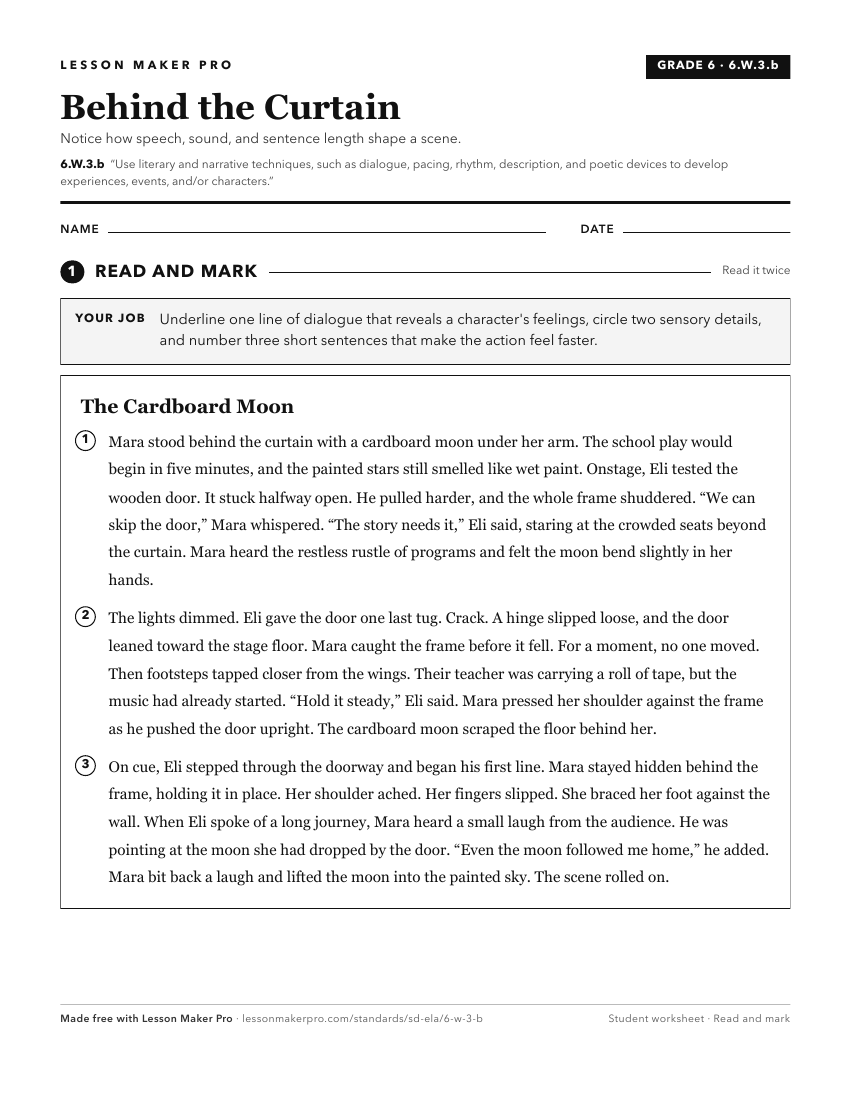
A ready-to-print activity worksheet aligned to 6.W.3.b, with an answer key for the teacher on its own page. No account needed.
PDF, US Letter, prints cleanly in black and white.
Download the worksheetKeep exploring
Related Standards
- 7.W.3.b
Use narrative and literary techniques, such as dialogue, pacing, rhythm, description, and poetic devices to develop experiences, events, and/or characters.
- 3.W.3.b
Use narrative techniques, such as dialogue and descriptions of actions, thoughts, and feelings to develop experiences and events or show the response of charact...
- 8.W.3.b
Use narrative and literary techniques, such as dialogue, pacing, rhythm, description, and reflection, to develop experiences, events, and/or characters.
Turn this exact standard into a lesson
Grade, subject, topic, and the complete standard are prefilled. Create one free, no account needed.
Also for this standard:Make a WorksheetMake a QuizMake a Sub Lesson