South Dakota ELA 3.W.3.b
The Standard
- 3.W.3
- Write narratives (e.g. story, poetry, drama) to develop real and imagined experiences or events using descriptive details, and clear event sequences.
Use narrative techniques, such as dialogue and descriptions of actions, thoughts, and feelings to develop experiences and events or show the response of characters to situations.
South Dakota English Language Arts Standards (2025)
Teacher's field guide
What This Standard Means
What Students Need to Do
- Students write a scene in which something happens to a character. They use what the character says, does, and thinks to show how the character reacts.
What Mastery Looks Like
- A reader can tell how the character feels from specific words and actions, not just a label like “sad.” The character’s response fits what happened and helps the scene move forward.
Common Misconceptions
- Students may list events without showing anyone’s reaction. They may name a feeling but give no clues to it, or add dialogue that has little to do with the scene.
How to Assess It
- Exit ticket: Write four sentences about a child who loses a library book. Include one line of dialogue, one action, and one thought that shows the child’s reaction.
Lesson moves
Ways to Teach It
Give pairs paper puppets and a lost-key scenario card; have them act out the moment, then write three lines showing a character’s reaction.
Read a short scene where a child spills juice; ask, “What could the child say and do to show embarrassment?”
Play Reaction Swap: students write a response to missing the bus, trade papers, and rewrite the response to show relief instead.
Have students write a scene about finding the wrong lunch in their bag, using a spoken line and a reaction they might have.
Free download
Printable 3.W.3.b Worksheet
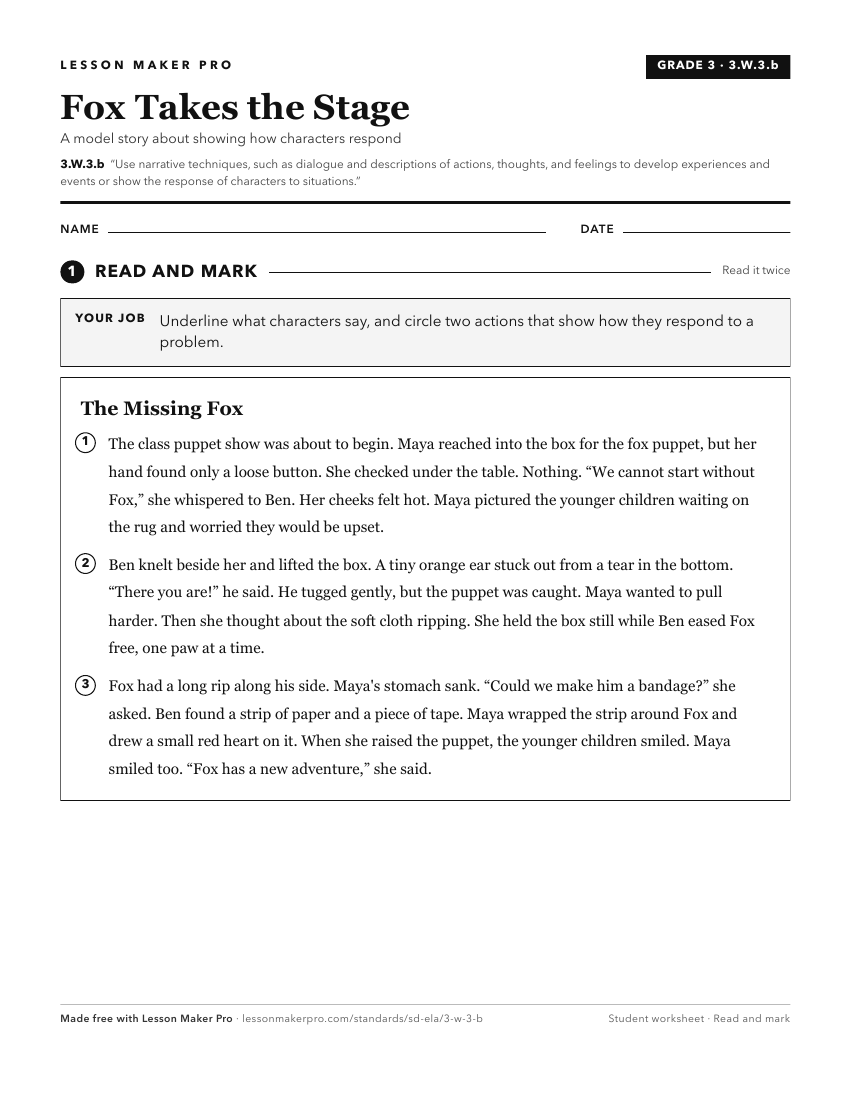
A ready-to-print activity worksheet aligned to 3.W.3.b, with an answer key for the teacher on its own page. No account needed.
PDF, US Letter, prints cleanly in black and white.
Download the worksheetKeep exploring
Related Standards
- 7.W.3.b
Use narrative and literary techniques, such as dialogue, pacing, rhythm, description, and poetic devices to develop experiences, events, and/or characters.
- 4.W.3.b
Use narrative techniques, such as dialogue and description to develop experiences and events or show the responses of characters to situations.
- 8.W.3.b
Use narrative and literary techniques, such as dialogue, pacing, rhythm, description, and reflection, to develop experiences, events, and/or characters.
Turn this exact standard into a lesson
Grade, subject, topic, and the complete standard are prefilled. Create one free, no account needed.
Also for this standard:Make a WorksheetMake a QuizMake a Sub Lesson