South Dakota ELA 4.W.3.b
The Standard
- 4.W.3
- Write narratives (e.g., story, poetry, drama) to develop real and imagined experiences or events using effective technique, descriptive details, and clear event sequences.
Use narrative techniques, such as dialogue and description, to develop experiences and events or show the responses of characters to situations.
South Dakota English Language Arts Standards (2025)
Teacher's field guide
What This Standard Means
What Students Need to Do
- Students write a scene in which something happens and a character reacts. They use what the character says, does, and notices to help readers picture the moment.
What Mastery Looks Like
- A reader can tell how the character feels without being told directly. The dialogue sounds like something that character would say, and the details fit the event.
Common Misconceptions
- Students may write 'she was scared' but give no clue about how she acts. They may add dialogue that does not reveal anything, or list details that do not fit the scene.
How to Assess It
- Prompt: A character opens a lunchbox and finds a note from a friend. Write four sentences with one line of dialogue and two details that show the character's reaction.
Lesson moves
Ways to Teach It
Pass around a bag holding a rubber duck; students feel it, then write dialogue and two details showing a character's reaction.
Write two versions of a character facing a spelling bee: one that names the fear and one that shows it through speech and action.
Play reaction swap: give students an emotion card and have them revise 'Sam opened the door' using dialogue and a physical detail.
Use a late school bus as the event; write a short scene showing how two classmates react through what they say and do.
Free download
Printable 4.W.3.b Worksheet
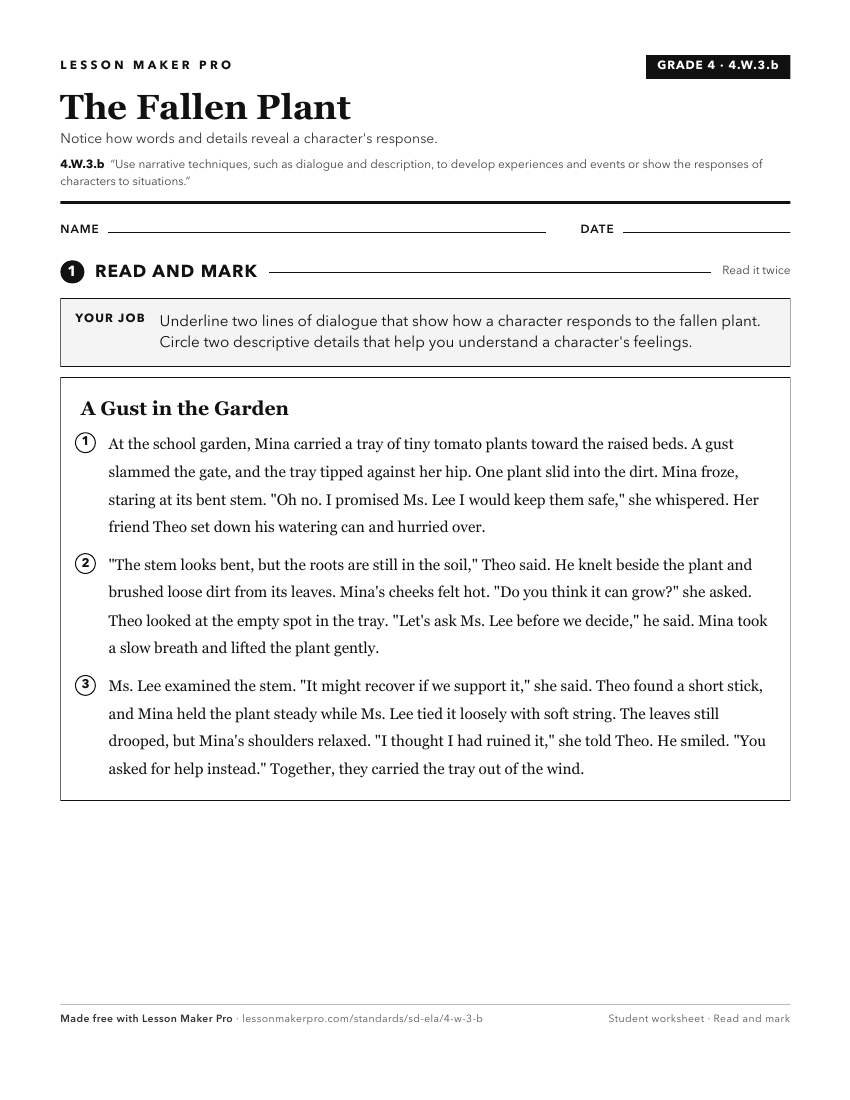
A ready-to-print activity worksheet aligned to 4.W.3.b, with an answer key for the teacher on its own page. No account needed.
PDF, US Letter, prints cleanly in black and white.
Download the worksheetKeep exploring
Related Standards
- 7.W.3.b
Use narrative and literary techniques, such as dialogue, pacing, rhythm, description, and poetic devices to develop experiences, events, and/or characters.
- 3.W.3.b
Use narrative techniques, such as dialogue and descriptions of actions, thoughts, and feelings to develop experiences and events or show the response of charact...
- 8.W.3.b
Use narrative and literary techniques, such as dialogue, pacing, rhythm, description, and reflection, to develop experiences, events, and/or characters.
Turn this exact standard into a lesson
Grade, subject, topic, and the complete standard are prefilled. Create one free, no account needed.
Also for this standard:Make a WorksheetMake a QuizMake a Sub Lesson