South Dakota ELA 1.RF.3
Standard Cluster
Decode and encode using grade-level phonics and word analysis skills. Differentiate between long and short vowel sounds in regularly spelled one-syllable words. Recognize and apply the sound-letter correspondences for consonants, vowels, consonant digraphs and consonant blends in isolation. Decode and encode one-syllable words with regular spelling patterns, including CVC, CCVC, CVCC, CVVC, CVCe in context. Decode common vowel teams to represent long vowel sounds in words. Read and understand words with inflectional endings in context and recognize how these endings change the meaning or tense of words. Recognize that every syllable in a word must contain a vowel sound and use this knowledge to determine syllable count in printed words. Decode two-syllable words by breaking them into syllables and applying phonics patterns in open and closed syllables. Read and spell grade-appropriate high-frequency words.
South Dakota English Language Arts Standards (2025)
Cluster contents
Standards in This Cluster
1.RF.3 is a cluster heading. These are the individual standards under it.
- 1.RF.3.a
Differentiate between long and short vowel sounds in regularly spelled one-syllable words.
- 1.RF.3.b
Recognize and apply the sound-letter correspondences for consonants, vowels, consonant digraphs and consonant blends in isolation.
- 1.RF.3.c
Decode and encode one-syllable words with regular spelling patterns, including CVC, CCVC, CVCC, CVVC, CVCe in context.
- 1.RF.3.d
Decode common vowel teams to represent long vowel sounds in words.
- 1.RF.3.e
Read and understand words with inflectional endings in context and recognize how these endings change the meaning or tense of words.
- 1.RF.3.g
Decode two-syllable words by breaking them into syllables and applying phonics patterns in open and closed syllables.
- 1.RF.3.h
Read and spell grade-appropriate high-frequency words.
Teacher's field guide
What This Cluster Means
What Students Need to Do
- Students use letter sounds, digraphs, and blends to read and spell words. They tell short vowels from long vowels, including silent e and vowel teams. They read word endings, split two-syllable words, and read and spell common words such as said.
What Mastery Looks Like
- A student reads and spells ship, stop, nest, rain, and cake without guessing from pictures. They read jumped in a sentence and explain that the action already happened. They split robot after ro and rabbit after rab, then read and spell said.
Common Misconceptions
- Students may read cap and cape alike or give boat two syllables because it has two vowel letters. They may skip the s in stop or treat sh in ship as two sounds. They may read jumped as jump or spell said as sed.
How to Assess It
- Ask students to read cap, cape, boat, ship, stop, rabbit, jumped, and said aloud. Then have them spell ship and said, split rabbit into syllables, and tell what -ed means in jumped.
Lesson moves
Ways to Teach It
Give pairs letter tiles for rabbit and robot; have them build each word, slide one counter per vowel sound, and split it.
Write 'The dog jumps' and 'The dog jumped' on the board, then ask, 'Which sentence happened earlier? How do you know?'
Play a word-sort relay: hand out cat, stop, nest, rain, and cake cards for students to place under matching letter-pattern labels.
Give students a printed lunch menu with milk, toast, and cake; have them circle and read the words, then spell one.
Free download
Printable 1.RF.3 Worksheet
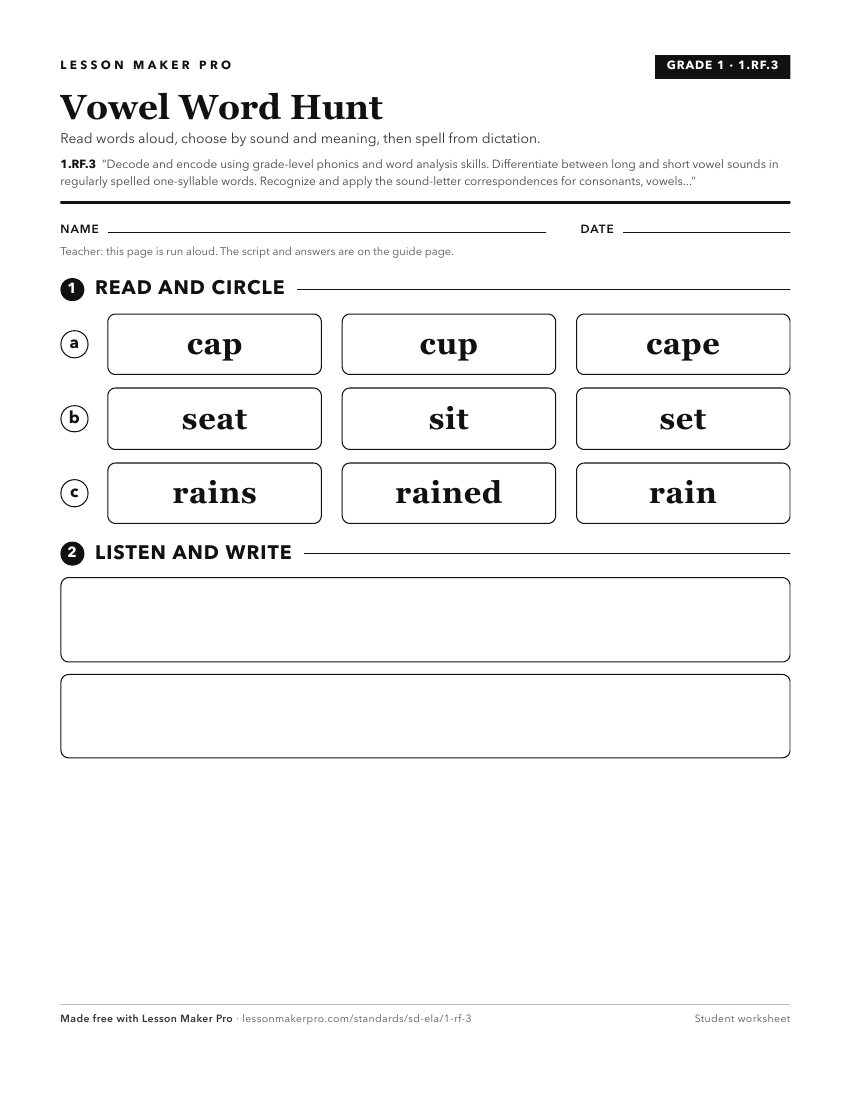
A ready-to-print activity worksheet aligned to 1.RF.3, with an answer key for the teacher on its own page. No account needed.
PDF, US Letter, prints cleanly in black and white.
Download the worksheetKeep exploring
Related Standards
- 2.RF.3
Know and apply grade-level phonics and word analysis skills in decoding and encoding words.
- 3.RF.3
Know and apply grade-level phonics and word analysis skills in decoding and encoding words.
- 5.RF.3
Demonstrate mastery of grade-level phonics and word analysis skills in decoding and encoding words.
- K.RF.3
Know and apply grade-level phonics and word analysis skills in decoding and encoding words.
Turn this cluster into a lesson
Grade, subject, topic, and the complete cluster are prefilled. Create one free, no account needed.
Also for this cluster:Make a WorksheetMake a QuizMake a Sub Lesson