South Dakota ELA 1.RF.3.b
The Standard
- 1.RF.3
- Decode and encode using grade-level phonics and word analysis skills.
Recognize and apply the sound-letter correspondences for consonants, vowels, consonant digraphs and consonant blends in isolation.
South Dakota English Language Arts Standards (2025)
Teacher's field guide
What This Standard Means
What Students Need to Do
- Students say the sounds shown by single consonants and vowels on cards. They say one sound for sh and both sounds in st, without using a whole word as a clue.
What Mastery Looks Like
- Given separate cards for m, a, sh, and st, a student says the sound for m and the short sound for a. They give one sound for sh and two sounds for st.
Common Misconceptions
- Students may say the letter names instead of the sounds, or add an “uh” sound after a consonant. They may sound out s and h separately in sh, or leave out one sound in st.
How to Assess It
- Show cards m, a, sh, and st. Ask students to say each sound, using the short sound for a and both sounds for st.
Lesson moves
Ways to Teach It
Give students letter tiles m, a, s, h, and t; have them say the single sounds, then build and sound out sh and st.
Write sh and st on the board and ask, “Which makes one sound, and which lets you hear both letters?”
Play sound-card bingo with m, a, sh, and st; say a sound or sound pair, and have students cover the matching card.
Show a SHOP sign and a STOP sign; students copy sh and st onto separate cards and say each group’s sounds alone.
Free download
Printable 1.RF.3.b Worksheet
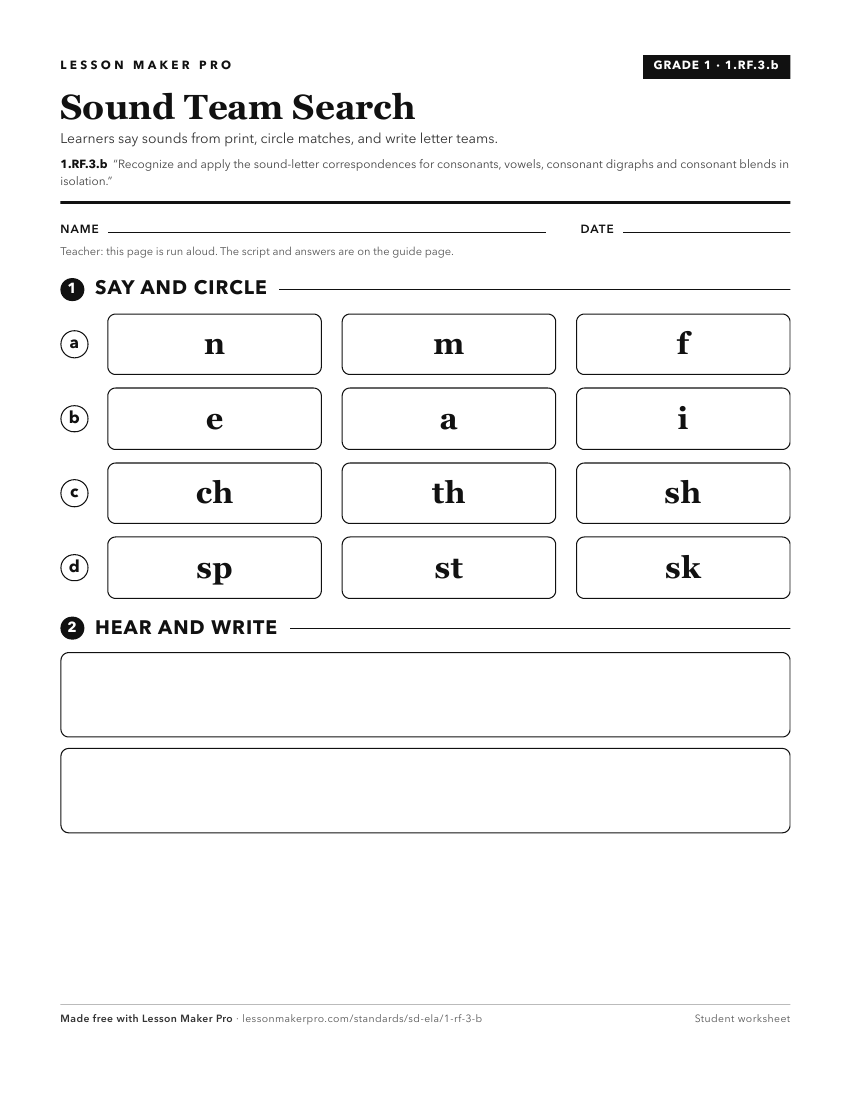
A ready-to-print activity worksheet aligned to 1.RF.3.b, with an answer key for the teacher on its own page. No account needed.
PDF, US Letter, prints cleanly in black and white.
Download the worksheetKeep exploring
Related Standards
- 1.RF.2
Demonstrate proficiency of identifying, blending, and segmenting phonemes (sounds) in spoken words.
- K.RF.3.b
Associate predictable consonant and short vowel sounds with corresponding letters.
- K.RF.1.b
Understand that letters represent individual sounds in spoken language and combine to form words.
- 2.RF.3.b
Decode and encode sound-spelling correspondences for common vowel teams including diphthongs.
Turn this exact standard into a lesson
Grade, subject, topic, and the complete standard are prefilled. Create one free, no account needed.
Also for this standard:Make a WorksheetMake a QuizMake a Sub Lesson