South Dakota ELA 1.RF.2
Standard Cluster
Demonstrate proficiency of identifying, blending, and segmenting phonemes (sounds) in spoken words. Isolate and identify individual phonemes in spoken words. Recognize initial, final and medial phonemes in spoken words. Identify common phonemes in different words (e.g., identifying the /s/ sound in "sun" and "sand"). Distinguish between similar phonemes (e.g., /p/ and /b/). Categorize words based on shared phonemes (e.g., sorting words with the same initial sound). Categorize words with different phonemes in specified positions (e.g., initial, medial, final). Blend phonemes together to form words. Segment spoken words into individual phonemes. Demonstrate awareness of: Segment multisyllabic words into syllables and phonemes. Delete specified phonemes from words to create new words. Add phonemes to words to create new words. Substitute one phoneme in a word to create a new word.
South Dakota English Language Arts Standards (2025)
Cluster contents
Standards in This Cluster
1.RF.2 is a cluster heading. These are the individual standards under it.
- 1.RF.2.a
Isolate and identify individual phonemes in spoken words.
- 1.RF.2.b
Recognize initial, final and medial phonemes in spoken words.
- 1.RF.2.c
Identify common phonemes in different words (e.g., identifying the /s/ sound in "sun" and "sand").
- 1.RF.2.d
Distinguish between similar phonemes (e.g., /p/ and /b/).
- 1.RF.2.e
Categorize words based on shared phonemes (e.g., sorting words with the same initial sound).
- 1.RF.2.f
Categorize words with different phonemes in specified positions (e.g., initial, medial, final).
- 1.RF.2.g
Blend phonemes together to form words.
- 1.RF.2.h
Segment spoken words into individual phonemes. Demonstrate awareness of:
- 1.RF.2.i
Segment multisyllabic words into syllables and phonemes.
- 1.RF.2.j
Delete specified phonemes from words to create new words.
- 1.RF.2.k
Add phonemes to words to create new words.
- 1.RF.2.l
Substitute one phoneme in a word to create a new word.
Teacher's field guide
What This Cluster Means
What Students Need to Do
- Students listen to spoken words and name, blend, and separate their sounds, including first, middle, and last sounds. They sort words by sound, break longer words into syllables and sounds, and make new words by adding, removing, or changing a sound.
What Mastery Looks Like
- A student can tap the three sounds in map, name its middle sound, and blend those sounds back into map. They can hear that pat and bat start differently. They can split sunset into two syllables, say its sounds, and change /m/ in map to /t/ to make tap.
Common Misconceptions
- Some students count letters instead of sounds, so they count sh as two sounds in ship. Others mix up middle and last sounds or hear /p/ and /b/ as the same sound. Some remove a whole syllable when asked to remove one sound.
How to Assess It
- Say, "Listen to map. Tell me each sound. What is the middle sound? Change /m/ to /t/. What word do you get?"
Lesson moves
Ways to Teach It
Give students three counters, say "map," and have them slide one for each sound; then ask them to change /m/ to /t/.
Ask partners, "Do pat and bat start alike?" Have them say both words slowly and explain what they hear.
Play last sound sort: say "cat," "hat," "sun," and "pan"; students place each picture under a cat or sun picture.
At coat pickup, point to a coat, cap, and bag; ask which two names start with the same sound.
Free download
Printable 1.RF.2 Worksheet
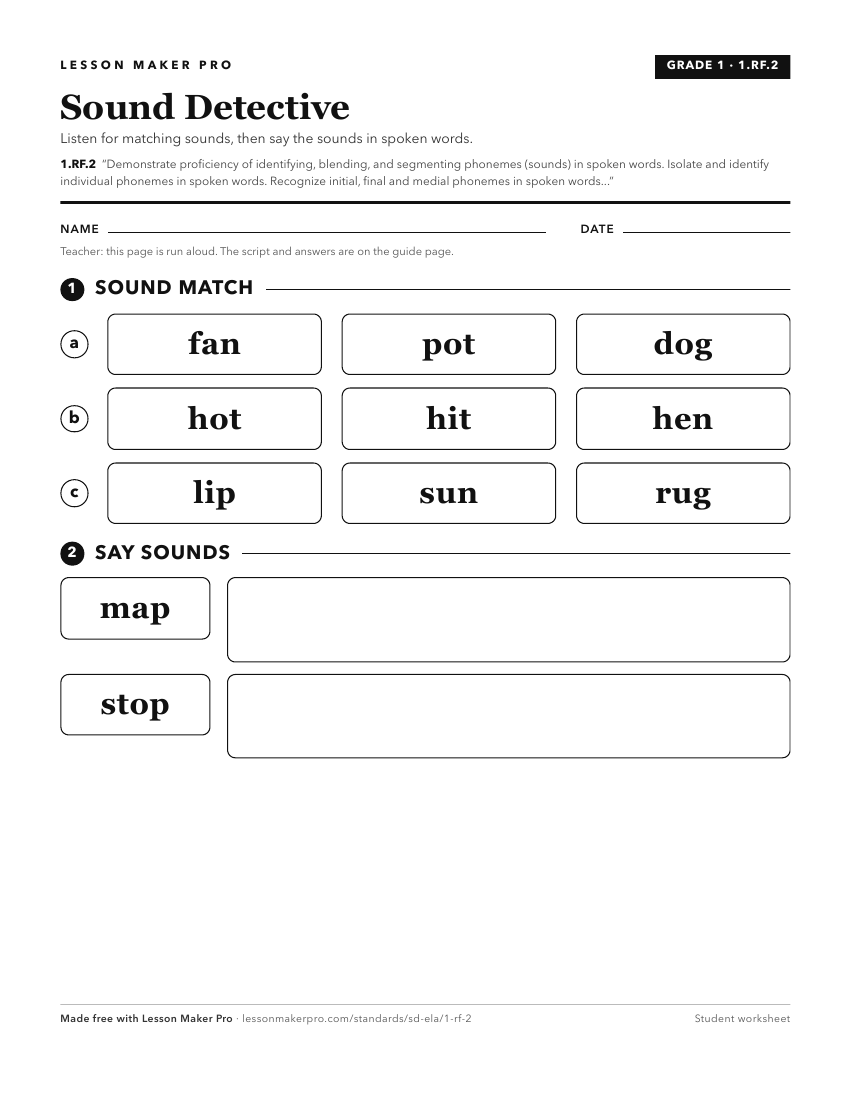
A ready-to-print activity worksheet aligned to 1.RF.2, with an answer key for the teacher on its own page. No account needed.
PDF, US Letter, prints cleanly in black and white.
Download the worksheetKeep exploring
Related Standards
Turn this cluster into a lesson
Grade, subject, topic, and the complete cluster are prefilled. Create one free, no account needed.
Also for this cluster:Make a WorksheetMake a QuizMake a Sub Lesson