South Dakota ELA 3.RF.3
Standard Cluster
Know and apply grade-level phonics and word analysis skills in decoding and encoding words. Decode and encode advanced vowel patterns, including vowel digraphs and diphthongs. Identify and understand the meanings of common prefixes and derivational suffixes. Recognize words with common Greek and Latin affixes to enhance vocabulary and word recognition skills. Apply knowledge of syllable division rules, morphemes, and phonics patterns to decode and encode multisyllabic words accurately. Apply spelling patterns and rules (e.g., doubling consonants before adding -ed or -ing, dropping silent e when adding a suffix) to spell words accurately. Read and spell grade-appropriate high-frequency words.
South Dakota English Language Arts Standards (2025)
Cluster contents
Standards in This Cluster
3.RF.3 is a cluster heading. These are the individual standards under it.
- 3.RF.3.a
Decode and encode advanced vowel patterns, including vowel digraphs and diphthongs.
- 3.RF.3.b
Identify and understand the meanings of common prefixes and derivational suffixes.
- 3.RF.3.c
Recognize words with common Greek and Latin affixes to enhance vocabulary and word recognition skills.
- 3.RF.3.d
Apply knowledge of syllable division rules, morphemes, and phonics patterns to decode and encode multisyllabic words accurately.
- 3.RF.3.f
Read and spell grade-appropriate high-frequency words.
Teacher's field guide
What This Cluster Means
What Students Need to Do
- Students read and spell words with vowel patterns, such as rain and coin. They break longer words into syllables and word parts to help them read and understand them. They use spelling rules and read common words quickly.
What Mastery Looks Like
- A student reads and spells rain, coin, hoping, and hopping accurately. They split repainting into re/paint/ing and explain that re- means again. They read and spell common words such as because and enough.
Common Misconceptions
- Students may read coin as cone or assume every vowel pair makes the same sound. They may spell hopping as hoping or keep the silent e in makeing. Some overlook how a prefix like re- changes a word's meaning.
How to Assess It
- Ask students to read coin, repainting, and telephone aloud, then spell hopping, making, and because. Have them mark the parts of repainting and explain what re- and tele- mean.
Lesson moves
Ways to Teach It
Give pairs letter tiles to build rain, coin, hopping, and hoping, then have them change hopping to hoping and read both words.
Write telephone and transport on the board; ask, “What do tele- and trans- mean, and how do they help you understand each word?”
Play a word-part relay: teams split repainting and helpful into parts, explain re- and -ful, then spell both words.
Give students a lunch menu with cheese, bread, and fruit; ask them to circle vowel teams and read the items aloud.
Free download
Printable 3.RF.3 Worksheet
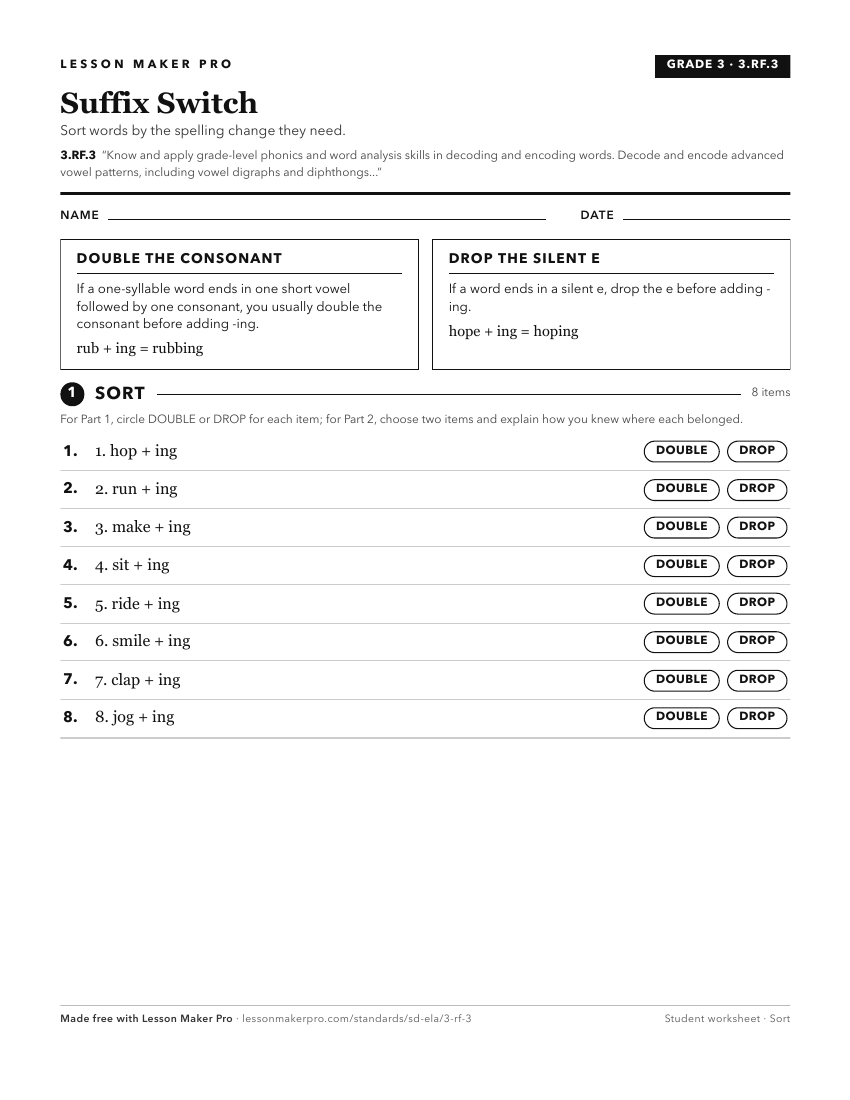
A ready-to-print activity worksheet aligned to 3.RF.3, with an answer key for the teacher on its own page. No account needed.
PDF, US Letter, prints cleanly in black and white.
Download the worksheetKeep exploring
Related Standards
- 2.RF.3
The 2nd Grade version of this standard.
- 4.RF.3
Demonstrate proficiency in grade-level phonics and word analysis skills in decoding and encoding words.
- 5.RF.3
Demonstrate mastery of grade-level phonics and word analysis skills in decoding and encoding words.
- K.RF.3
The Kindergarten version of this standard.
Turn this cluster into a lesson
Grade, subject, topic, and the complete cluster are prefilled. Create one free, no account needed.
Also for this cluster:Make a WorksheetMake a QuizMake a Sub Lesson