South Dakota ELA 2.RF.3
Standard Cluster
Know and apply grade-level phonics and word analysis skills in decoding and encoding words. Decode and encode two-syllable words with both long and short vowels, following regular phonics patterns. Decode and encode sound-spelling correspondences for common vowel teams including diphthongs. Decode vowel variants. Decode and encode words with vowel-r patterns. Decode and encode words with silent letters. Decode and encode words with common prefixes and suffixes. Decode 2-syllable words that follow all syllable patterns. Encode 2-syllable words using open syllables, closed syllables, silent e syllables, vowel-r patterns. Read and spell grade-appropriate high-frequency words.
South Dakota English Language Arts Standards (2025)
Cluster contents
Standards in This Cluster
2.RF.3 is a cluster heading. These are the individual standards under it.
- 2.RF.3.a
Decode and encode two-syllable words with both long and short vowels, following regular phonics patterns.
- 2.RF.3.b
Decode and encode sound-spelling correspondences for common vowel teams including diphthongs.
- 2.RF.3.c
Decode vowel variants.
- 2.RF.3.d
Decode and encode words with vowel-r patterns.
- 2.RF.3.e
Decode and encode words with silent letters.
- 2.RF.3.f
Decode and encode words with common prefixes and suffixes.
- 2.RF.3.g
Decode 2-syllable words that follow all syllable patterns.
- 2.RF.3.h
Encode 2-syllable words using open syllables, closed syllables, silent e syllables, vowel-r patterns.
- 2.RF.3.i
Read and spell grade-appropriate high-frequency words.
Teacher's field guide
What This Cluster Means
What Students Need to Do
- Students break two-syllable words into parts to read and spell them. They use vowel sounds and spelling patterns, including vowel teams, silent letters, prefixes, and suffixes. They also read and spell common words such as said.
What Mastery Looks Like
- They split robot, rabbit, and pancake into syllables, then read and spell each word. They read and spell coin, bird, knee, redo, and said. They read bread with a short e sound and spell jumping.
Common Misconceptions
- Some read robot with two short vowels instead of a long o in the first syllable. Others expect ea in bread to sound like the ea in bead, or pronounce the k in knee. When spelling, they may write hopeing for hoping or leave the r out of bird.
How to Assess It
- Ask students to read robot, bread, and knee aloud. Then dictate pancake, coin, bird, redo, and said for them to spell.
Lesson moves
Ways to Teach It
Give pairs cards marked ro, bot, rab, bit, pan, and cake; have them build, read, and write robot, rabbit, and pancake.
Write bread and bead on the board, then ask students to explain how ea sounds in each word.
Give students six-square bingo boards with coin, cow, bird, knee, redo, and jumping in different positions; call their spelling patterns.
Hand out a grocery list with oatmeal, pancakes, and corn; students read each item and underline the vowel spelling.
Free download
Printable 2.RF.3 Worksheet
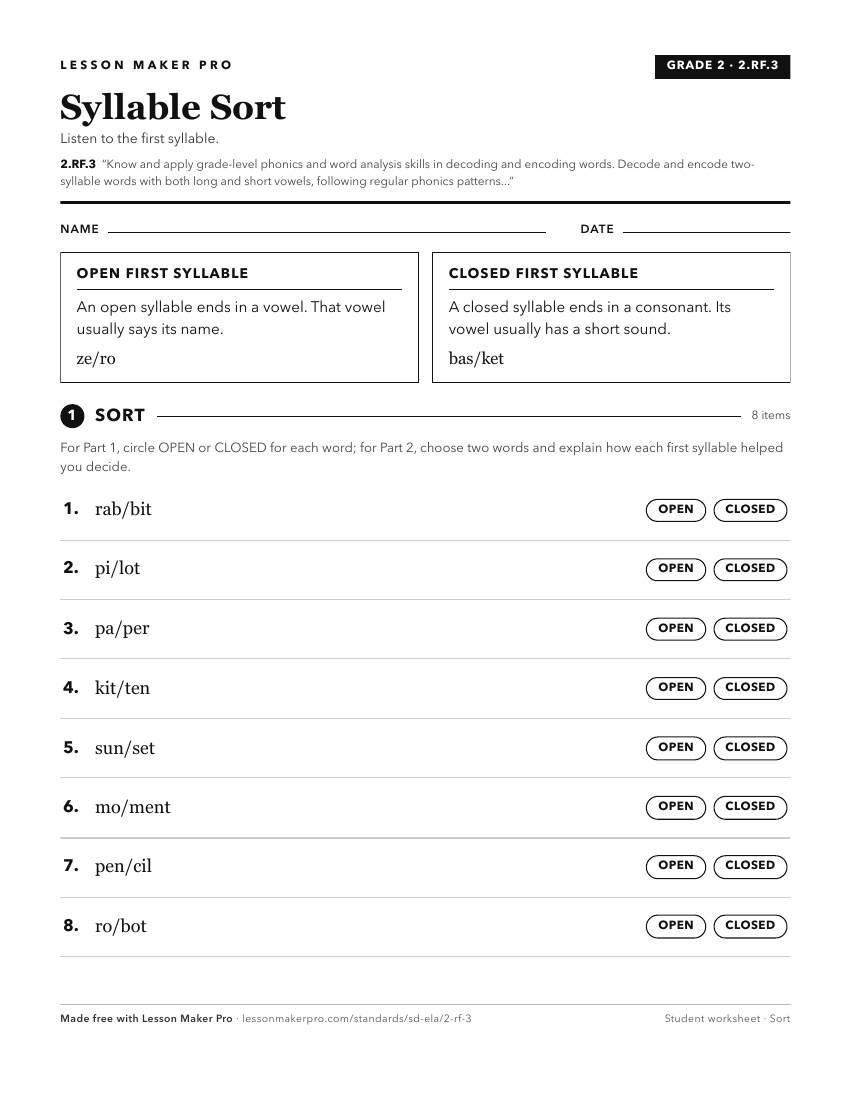
A ready-to-print activity worksheet aligned to 2.RF.3, with an answer key for the teacher on its own page. No account needed.
PDF, US Letter, prints cleanly in black and white.
Download the worksheetKeep exploring
Related Standards
- 3.RF.3
The 3rd Grade version of this standard.
- 4.RF.3
Demonstrate proficiency in grade-level phonics and word analysis skills in decoding and encoding words.
- 5.RF.3
Demonstrate mastery of grade-level phonics and word analysis skills in decoding and encoding words.
- K.RF.3
The Kindergarten version of this standard.
Turn this cluster into a lesson
Grade, subject, topic, and the complete cluster are prefilled. Create one free, no account needed.
Also for this cluster:Make a WorksheetMake a QuizMake a Sub Lesson