Oklahoma Social Studies WG.P.3
Standard Cluster
Engage in critical, active reading of primary and secondary sources related to social studies concepts. Comprehend, evaluate, and synthesize textual sources to acquire and refine knowledge in the social studies. Cite specific textual evidence to support analysis of primary and secondary sources, evaluating features such as author, date, and origin of information. Analyze information from visual, oral, digital, and interactive texts (e.g., maps, charts, images, political cartoons, videos, artwork) in order to draw conclusions and defend arguments. Apply critical reading and thinking skills to interpret, evaluate, and respond to a variety of complex texts and perspectives. Evaluate the extent to which historical or cultural perspectives affect an author’s stated or implied purpose. Evaluate the author’s point of view, potential bias, and how authors can reach different conclusions regarding the same issue. Actively listen, evaluate, and analyze a speaker’s message, asking questions while engaged in collaborative discussions about social studies topics and texts.
Oklahoma Academic Standards for Social Studies (2026)
Cluster contents
Standards in This Cluster
WG.P.3 is a cluster heading. These are the individual standards under it.
- WG.P.3.1
Comprehend, evaluate, and synthesize textual sources to acquire and refine knowledge in the social studies.
- WG.P.3.1.A
Cite specific textual evidence to support analysis of primary and secondary sources, evaluating features such as author, date, and origin of information.
- WG.P.3.1.B
Analyze information from visual, oral, digital, and interactive texts (e.g., maps, charts, images, political cartoons, videos, artwork) in order to draw conclus...
- WG.P.3.2
Apply critical reading and thinking skills to interpret, evaluate, and respond to a variety of complex texts and perspectives.
- WG.P.3.2.A
Evaluate the extent to which historical or cultural perspectives affect an author’s stated or implied purpose.
- WG.P.3.2.B
Evaluate the author’s point of view, potential bias, and how authors can reach different conclusions regarding the same issue.
- WG.P.3.2.C
Actively listen, evaluate, and analyze a speaker’s message, asking questions while engaged in collaborative discussions about social studies topics and texts.
Teacher's field guide
What This Cluster Means
What Students Need to Do
- Students read firsthand accounts and later explanations, checking who made each one, when, and why. They compare those accounts with details from maps or charts. They use evidence to defend a conclusion and ask questions when a classmate reads a source differently.
What Mastery Looks Like
- A student quotes a line, identifies its author and date, and explains how the writer's position may shape the claim. They check that claim against a map and another account. They explain why the accounts differ without assuming one must be false.
Common Misconceptions
- Students may treat a firsthand account as automatically true or dismiss a source with a clear point of view as useless. They may name a source without pointing to a specific line or map detail. They may confuse when a source was made with when the event happened.
How to Assess It
- Give students two sample cards: '1935, farm family's letter: Our field has turned to dust' and '2020, history text: Many families moved west seeking jobs.' Ask them to quote each card, name the reason for moving it gives, and explain how the writer's position might shape that account.
Lesson moves
Ways to Teach It
Give pairs a printed Dust Bowl migration map and two short accounts; have them mark where each account's claims match or miss the map.
Read a migrant's letter and a later textbook passage; ask, 'Why might these writers explain the same move differently?'
Play evidence match: groups pair claim cards about Dust Bowl migration with a quoted line or map detail that supports each claim.
Compare a city bus route map with an online rider complaint; write which travel claim the map can verify and what it cannot.
Free download
Printable WG.P.3 Worksheet
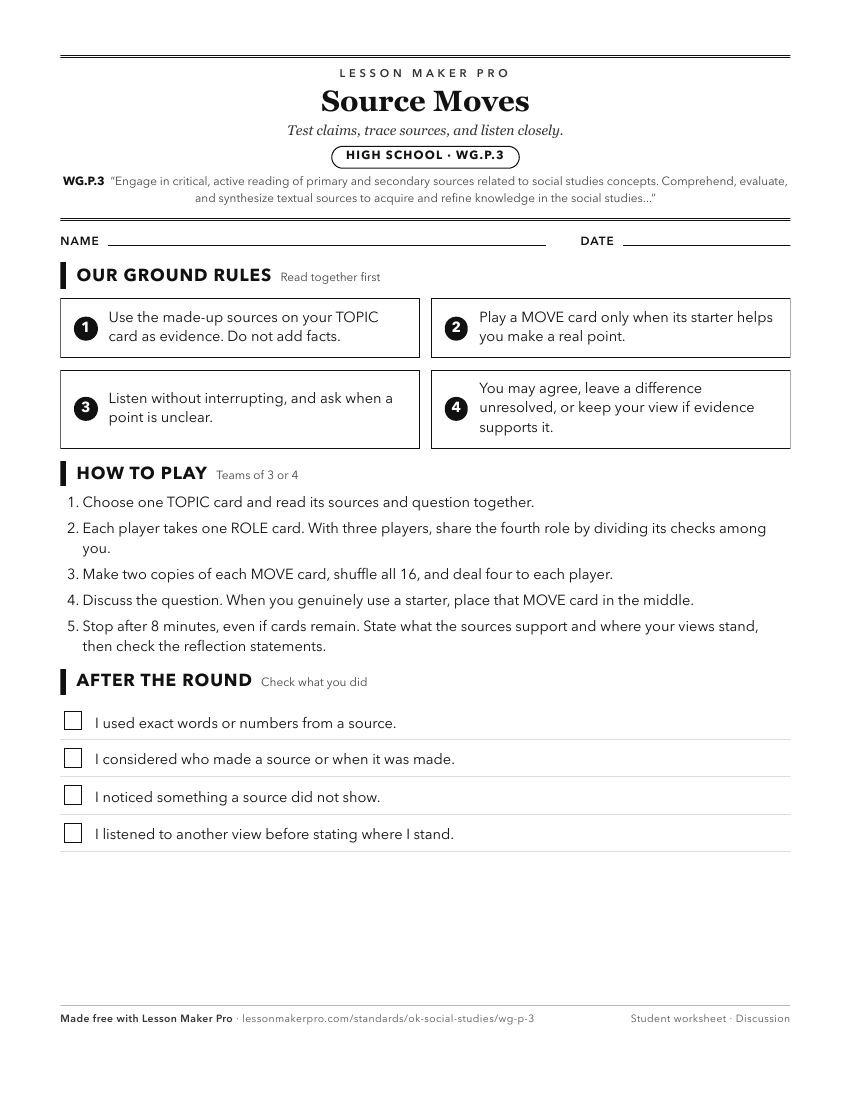
A ready-to-print activity worksheet aligned to WG.P.3, with an answer key for the teacher on its own page. No account needed.
PDF, US Letter, prints cleanly in black and white.
Download the worksheetKeep exploring
Related Standards
- 2.P.3
Engage in critical, active reading of primary and secondary sources related to social studies concepts.
- 3.P.3
Engage in critical, active reading of primary and secondary sources related to social studies concepts.
- 1.P.3
Engage in critical, active reading of primary and secondary sources related to social studies concepts.
- 4.P.3
Engage in critical, active reading of primary and secondary sources related to social studies concepts.
Turn this cluster into a lesson
Grade, subject, topic, and the complete cluster are prefilled. Create one free, no account needed.
Also for this cluster:Make a WorksheetMake a QuizMake a Sub Lesson