Oklahoma Social Studies WG.C.5.3
The Standard
- WG.C.5
- Analyze patterns of land use among the world’s people.
Examine the impact of agricultural practices (e.g., irrigation, levees, terraced farming, crop rotation, conservation, and deforestation) on the environment and quality of life.
Oklahoma Academic Standards for Social Studies (2026) · WG.C.5
Teacher's field guide
What This Standard Means
What Students Need to Do
- Students explain how farming methods change soil, water, habitats, and people's lives. They weigh benefits, such as larger harvests, against costs, such as erosion or less water downstream.
What Mastery Looks Like
- A student can explain how irrigation may increase harvests while drawing down a river. They can compare two practices and use evidence to explain which better serves both farmers and nearby communities.
Common Misconceptions
- Students may assume irrigation always saves water or that levees stop flooding everywhere. They may see forest clearing only as a way to gain farmland, missing its effects on erosion and habitats.
How to Assess It
- Exit ticket: A town builds levees to protect farms beside a river. Name one benefit, one environmental cost, and one possible effect on people downstream.
Lesson moves
Ways to Teach It
Pour water over two trays of soil, one with cardboard terraces and one without, then compare the runoff and sediment.
Give students a short account of irrigation drawing from a lake; ask who benefits, who loses water, and why.
Give pairs cards for irrigation, levees, terraces, crop rotation, cover crops, and forest clearing; match each to a soil or water effect.
Use a Mississippi River flood map to mark farms behind levees, then predict where floodwater might go instead.
Free download
Printable WG.C.5.3 Worksheet
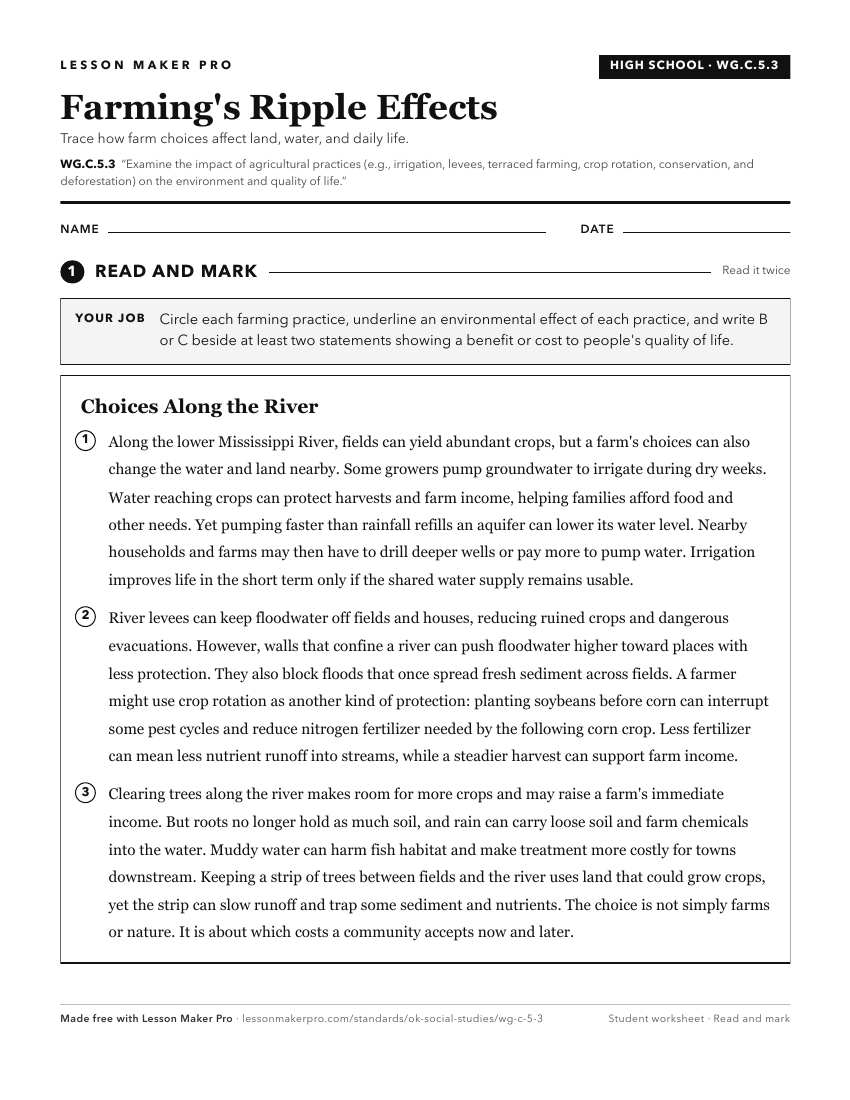
A ready-to-print activity worksheet aligned to WG.C.5.3, with an answer key for the teacher on its own page. No account needed.
PDF, US Letter, prints cleanly in black and white.
Download the worksheetKeep exploring
Related Standards
- 1.C.3.8
Identify how the physical environment of the community has been modified to meet specific needs (e.g., agricultural crops, forestry, dams).
- 7.C.4.2.C
Examine how agricultural practices in a region imprint the physical environment (e.g., desertification of the Aral Sea, terraced construction for rice farming, ...
- MWH.P.2.3.C
Evaluate the extent to which political and economic decisions have had significant impact on human and physical environments of various places and regions.
- 4.C.2.5.D
Identify ways in which economic activities can affect ecosystems (e.g., clearing forests,draining wetlands, diverting waterways) by examining present-day issues...
Turn this exact standard into a lesson
Grade, subject, topic, and the complete standard are prefilled. Create one free, no account needed.
Also for this standard:Make a WorksheetMake a QuizMake a Sub Lesson