Oklahoma Social Studies WG.C.4
Standard Cluster
Explain the political organization of space. Analyze the nature and meaning of territorial boundaries and their influence on identity, interaction, and exchange. Compare the world’s political systems of government, based on limited versus unlimited authority, including the rights and opportunities of citizens within each system. Examine changes and challenges to political/territorial arrangements, by describing the forces that shape the world’s contemporary political map, including the rise or devolution of nation-states. Evaluate how the forces of cooperation and conflict among people influence the control and management of territory and resources. Explain how international alliance networks respond to changing needs of people, places, and regions.
Oklahoma Academic Standards for Social Studies (2026)
Cluster contents
Standards in This Cluster
WG.C.4 is a cluster heading. These are the individual standards under it.
- WG.C.4.1
Analyze the nature and meaning of territorial boundaries and their influence on identity, interaction, and exchange.
- WG.C.4.2
Compare the world’s political systems of government, based on limited versus unlimited authority, including the rights and opportunities of citizens within each...
- WG.C.4.3
Examine changes and challenges to political/territorial arrangements, by describing the forces that shape the world’s contemporary political map, including the ...
- WG.C.4.4
Evaluate how the forces of cooperation and conflict among people influence the control and management of territory and resources.
- WG.C.4.5
Explain how international alliance networks respond to changing needs of people, places, and regions.
Teacher's field guide
What This Cluster Means
What Students Need to Do
- Students use maps to explain who controls territory and how borders affect identity, movement, and trade. They compare limits on government power and the rights citizens can exercise. They track how independence movements change borders and how disputes or alliances affect control of resources.
What Mastery Looks Like
- Given two dated maps, students explain a border change and its effect on residents or trade. They compare citizens' rights using evidence about elections, courts, and free speech. They explain why countries might cooperate or clash over a shared resource.
Common Misconceptions
- Students may think borders are fixed lines that affect governments but not communities or trade. They may confuse limits on a leader's power with a government's ability to act. They may assume countries in an alliance share one government or always agree.
How to Assess It
- Exit ticket: “A river crosses two countries; one has independent courts, while the other has courts controlled by its ruler. Where can citizens more effectively challenge a water treaty, and why might both countries cooperate?”
Lesson moves
Ways to Teach It
Give pairs a map with a river and two shaded language groups; have them draw a border and mark a possible trade route.
Ask: “If a new border divides a town, who might lose access to schools, markets, or family, and why?”
Give groups cards showing election rules, press rights, and court powers; have them sort governments by limits on leaders and defend one choice.
Show 1991 and current NATO membership maps; ask why a country near Russia might seek membership as its security needs change.
Free download
Printable WG.C.4 Worksheet
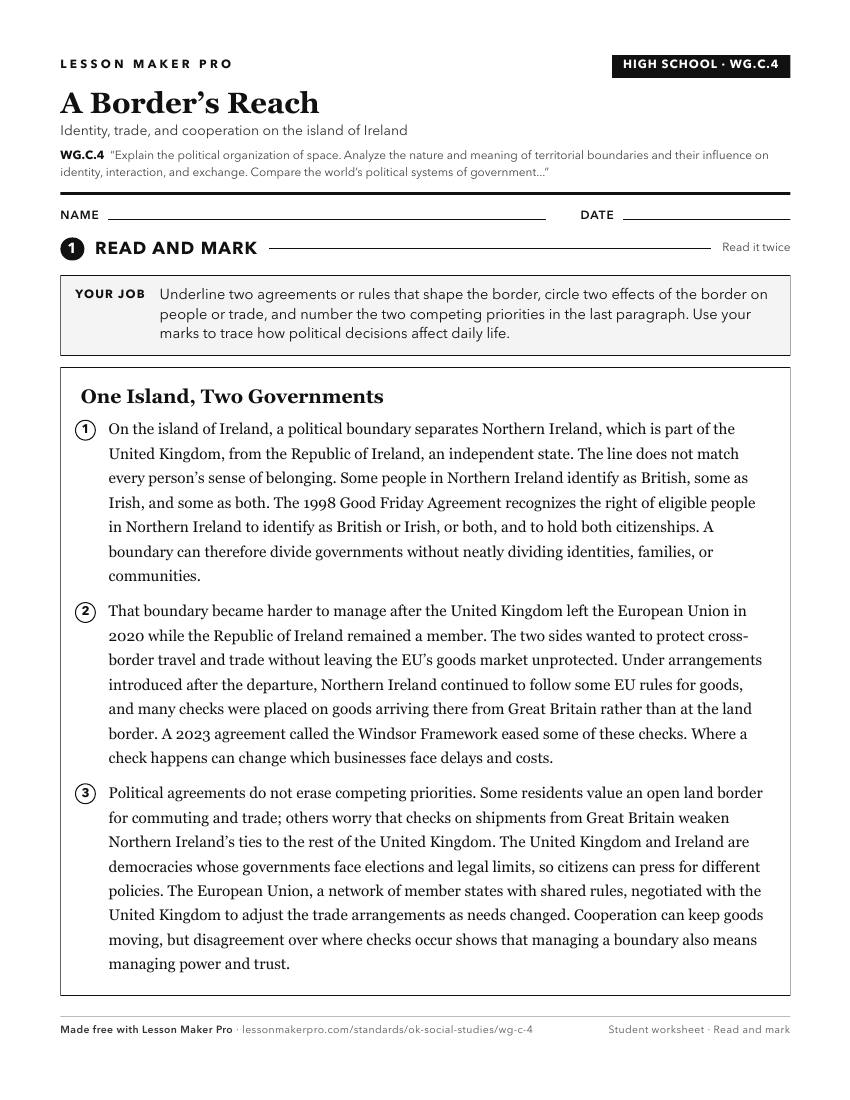
A ready-to-print activity worksheet aligned to WG.C.4, with an answer key for the teacher on its own page. No account needed.
PDF, US Letter, prints cleanly in black and white.
Download the worksheetKeep exploring
Related Standards
- 1.C.3.2
Describe the difference between physical and political maps and how each can be used to inform us about the world.
- 6.C.7.5.B
Examine how supranational organizations (e.g., Organization of American States, Arctic Council) create cooperative political, economic, defense, and cultural re...
- USG.C.1
Compare the formation of contemporary governments in terms of access, use, and justification of power.
Turn this cluster into a lesson
Grade, subject, topic, and the complete cluster are prefilled. Create one free, no account needed.
Also for this cluster:Make a WorksheetMake a QuizMake a Sub Lesson