Oklahoma Social Studies WG.C.3.2
The Standard
- WG.C.3
- Analyze the components and regional variations of cultural patterns and processes.
Describe and draw conclusions about the spatial dimensions of culture as defined by language, religion, and ethnicity.
Oklahoma Academic Standards for Social Studies (2026) · WG.C.3
Teacher's field guide
What This Standard Means
What Students Need to Do
- Students read maps showing where languages, religions, and ethnic groups are found. They compare where these patterns overlap and differ, then draw conclusions using map evidence.
What Mastery Looks Like
- A student can point to specific places on the maps to support a conclusion. They can also explain why a map does not tell them the identity of every person in a place.
Common Misconceptions
- Students may treat language, religion, and ethnicity as the same thing. They may assume that everyone inside a colored area on a map shares one identity.
How to Assess It
- Give students maps of Nigeria showing language, religion, and ethnicity. Ask: “Where do two patterns overlap, and what can you not conclude from that overlap?”
Lesson moves
Ways to Teach It
Print three maps of Nigeria showing language, religion, and ethnicity, then have pairs mark one overlap and one difference with colored pencils.
Ask: “Does a shared language mean people share a religion?” Have students use two places on the maps to explain their answer.
Play map claim check: pairs sort six claims about Nigeria into supported, contradicted, or unknown using the three maps.
Show photos of shop signs in Queens, New York, and a neighborhood language map, then ask what the signs can and cannot show.
Free download
Printable WG.C.3.2 Worksheet
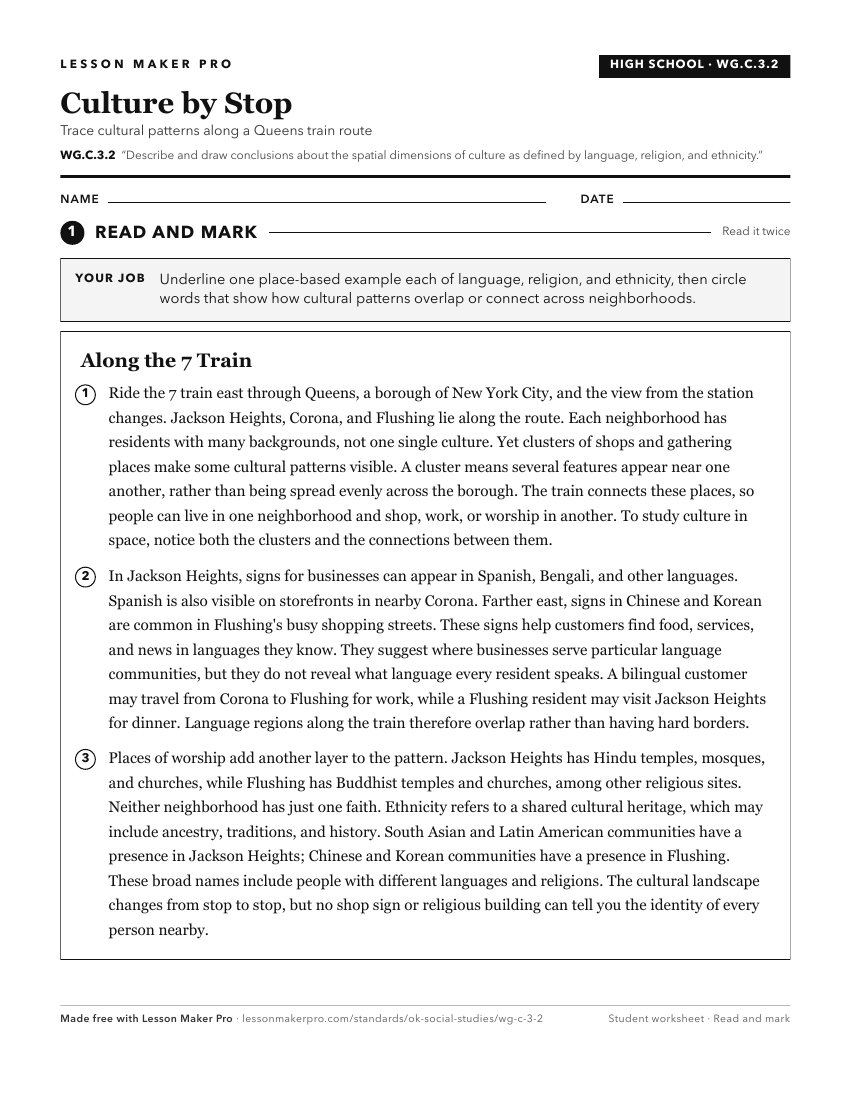
A ready-to-print activity worksheet aligned to WG.C.3.2, with an answer key for the teacher on its own page. No account needed.
PDF, US Letter, prints cleanly in black and white.
Download the worksheetKeep exploring
Related Standards
- WG.C.3.1
Compare the world’s major cultural landscapes to analyze cultural differences, cultural identity, social mores, and sets of beliefs which determine a sense of p...
- 6.C.3.2.A
Identify and describe cultural traits (e.g., language, ethnic heritage, religion, traditions, the arts) which are unique to a people and region.
- 6.C.3.2
Analyze how the characteristics of culture impact people and places.
- 7.C.5
Evaluate the development and impact of culture on the major regions and peoples of the Eastern Hemisphere.
Turn this exact standard into a lesson
Grade, subject, topic, and the complete standard are prefilled. Create one free, no account needed.
Also for this standard:Make a WorksheetMake a QuizMake a Sub Lesson