Oklahoma Social Studies USH.C.1.4
Standard Cluster
- USH.C.1
- Analyze the transformation of the United States of America through its civil rights struggles, immigrant experiences, and settlement of the American West during the Post Civil War Era.
Analyze the impact of immigration on settlement patterns in American society and economic growth. Summarize the reasons for immigration and the immigrant experiences at processing centers such as Ellis Island and Angel Island. Describe the Americanization programs which sought to integrate and assimilate immigrants (e.g., political party machines, Tammany Hall) through instruction in English and the United States of America’s system of government. Examine the rise and motivations of Nativism against a new wave of Eastern European immigrants. Describe the contributions of Chinese immigrants to the national economy and nativist opposition to their continued immigration. Explain changes in federal immigration policy including the Chinese Exclusion Act, the Gentlemen’s Agreement, and the Supreme Court’s application of the 14th Amendment.
Oklahoma Academic Standards for Social Studies (2026) · USH.C.1
Cluster contents
Standards in This Cluster
USH.C.1.4 is a cluster heading. These are the individual standards under it.
- USH.C.1.4.A
Summarize the reasons for immigration and the immigrant experiences at processing centers such as Ellis Island and Angel Island.
- USH.C.1.4.B
Describe the Americanization programs which sought to integrate and assimilate immigrants (e.g., political party machines, Tammany Hall) through instruction in ...
- USH.C.1.4.C
Examine the rise and motivations of Nativism against a new wave of Eastern European immigrants.
- USH.C.1.4.D
Describe the contributions of Chinese immigrants to the national economy and nativist opposition to their continued immigration.
- USH.C.1.4.E
Explain changes in federal immigration policy including the Chinese Exclusion Act, the Gentlemen’s Agreement, and the Supreme Court’s application of the 14th Am...
Teacher's field guide
What This Cluster Means
What Students Need to Do
- Students explain why immigrants came to the United States, where they settled, and how their work helped local economies grow. They compare experiences at Ellis Island and Angel Island. They examine English classes, political machines, prejudice, and federal policies that shaped immigrants' lives.
What Mastery Looks Like
- A student can use a map to connect Eastern European factory work with settlement in New York and Chinese farm work with settlement in California. They can explain how Tammany Hall offered help in exchange for votes, while schools taught English and civics. They can describe Chinese exclusion, limits on Japanese immigration, and the Supreme Court ruling that recognized citizenship for children born in the United States to Chinese parents.
Common Misconceptions
- Students may assume all immigrants entered through Ellis Island or faced the same screening. They may think political machines ran English classes, rather than offering help with jobs and services. Some confuse the Chinese Exclusion Act with the agreement limiting Japanese immigration, or think birthright citizenship made every immigrant a citizen.
How to Assess It
- Exit ticket: In 1912, a garment worker from Poland and a farmer from China seek entry. Name their likely processing centers and one reason their experiences might differ.
Lesson moves
Ways to Teach It
Give pairs a blank map and cards naming Eastern European factory work in New York and Chinese farm work in California; mark job sites.
Read one Ellis Island account and one Angel Island account; write which difference in screening mattered most and why.
Match cards for the Chinese Exclusion Act, Gentlemen's Agreement, and Wong Kim Ark ruling with the affected groups and outcomes.
Use an online Chinatown business directory to identify three jobs and explain why businesses cluster near customers and suppliers.
Free download
Printable USH.C.1.4 Worksheet
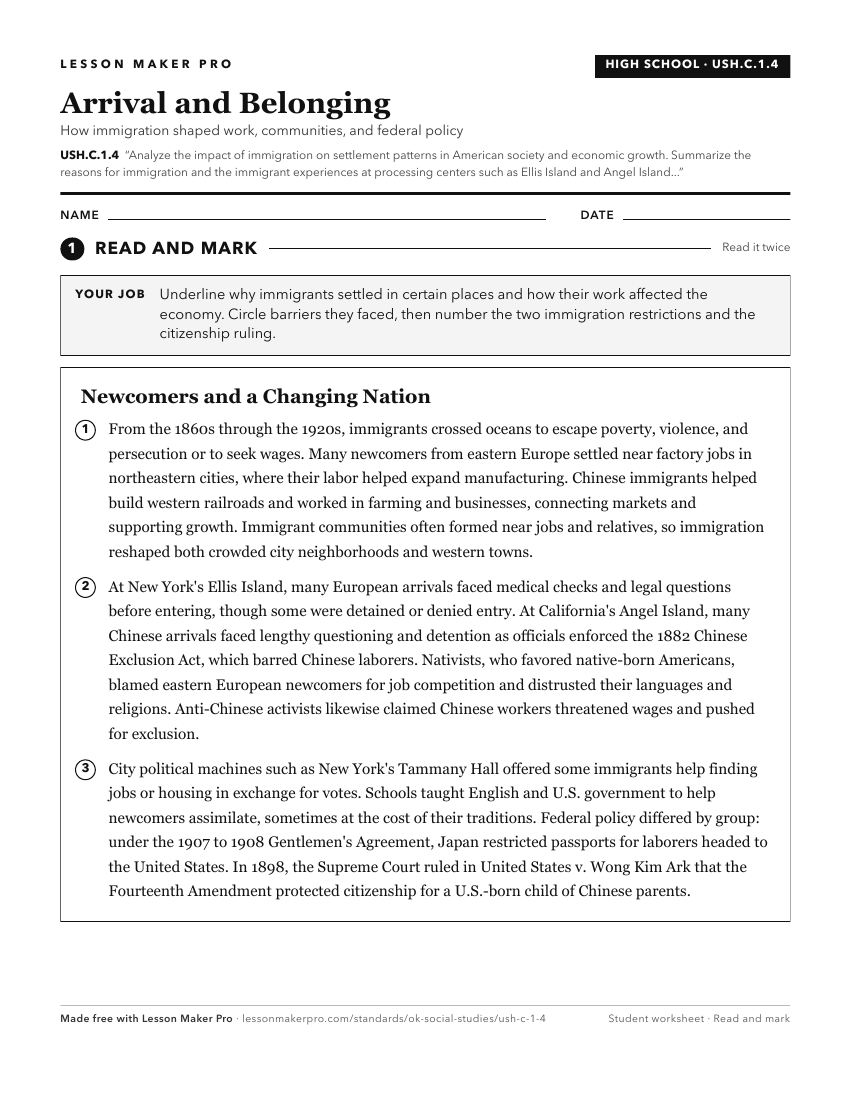
A ready-to-print activity worksheet aligned to USH.C.1.4, with an answer key for the teacher on its own page. No account needed.
PDF, US Letter, prints cleanly in black and white.
Download the worksheetKeep exploring
Related Standards
- 8.C.9.2
Analyze the territorial growth of the United States of America and the consequences of westward expansion.
- 8.C.13.5
Evaluate the impact of federal policies related to the on-going migration and settlement of the West.
- 8.C.9.1.D
Analyze the impact of the waves of immigration from Northern Europe on settlement patterns.
- 8.C.9.1
Examine multiple perspectives on the justification for and impact on westward expansion and analyze the influence of immigration.
Turn this cluster into a lesson
Grade, subject, topic, and the complete cluster are prefilled. Create one free, no account needed.
Also for this cluster:Make a WorksheetMake a QuizMake a Sub Lesson