Oklahoma Social Studies USH.C.1.4.E
The Standard
- USH.C.1
- Analyze the transformation of the United States of America through its civil rights struggles, immigrant experiences, and settlement of the American West during the Post Civil War Era.
- USH.C.1.4
- Analyze the impact of immigration on settlement patterns in American society and economic growth.
Explain changes in federal immigration policy including the Chinese Exclusion Act, the Gentlemen’s Agreement, and the Supreme Court’s application of the 14th Amendment.
Oklahoma Academic Standards for Social Studies (2026) · USH.C.1.4
Teacher's field guide
What This Standard Means
What Students Need to Do
- Students compare a law restricting Chinese immigration with an agreement limiting Japanese labor immigration. They explain how the Supreme Court applied the 14th Amendment to people living in the United States and to children born there.
What Mastery Looks Like
- Students identify the Chinese Exclusion Act as a ban on Chinese laborers entering the country. They describe the Gentlemen’s Agreement as a deal restricting Japanese labor immigration. They use Yick Wo to explain equal protection for noncitizens and Wong Kim Ark to explain birthright citizenship.
Common Misconceptions
- Students may think the Chinese Exclusion Act barred every Chinese person, rather than targeting laborers. They may mistake the Gentlemen’s Agreement for a law passed by Congress. Some assume a child born in the United States to Chinese immigrants could not be a citizen.
How to Assess It
- For an exit ticket, match three people to the policy or ruling that applies: a Chinese laborer seeking entry in 1882, a Japanese laborer seeking entry in 1908, and a U.S.-born child of Chinese immigrants in 1898. Explain one match.
Lesson moves
Ways to Teach It
Groups sort dated cards for the exclusion law, Yick Wo, Wong Kim Ark, and the Gentlemen’s Agreement, then label each entry, rights, or citizenship.
Write two sentences explaining how Wong Kim Ark and the Chinese Exclusion Act could affect members of the same family differently.
Play scenario match: pair a Chinese laborer, Japanese laborer, and U.S.-born child of Chinese parents with the policy or ruling affecting each.
Show a current visa application and a U.S. birth certificate; have students mark which concerns entry and which supports a citizenship claim.
Free download
Printable USH.C.1.4.E Worksheet
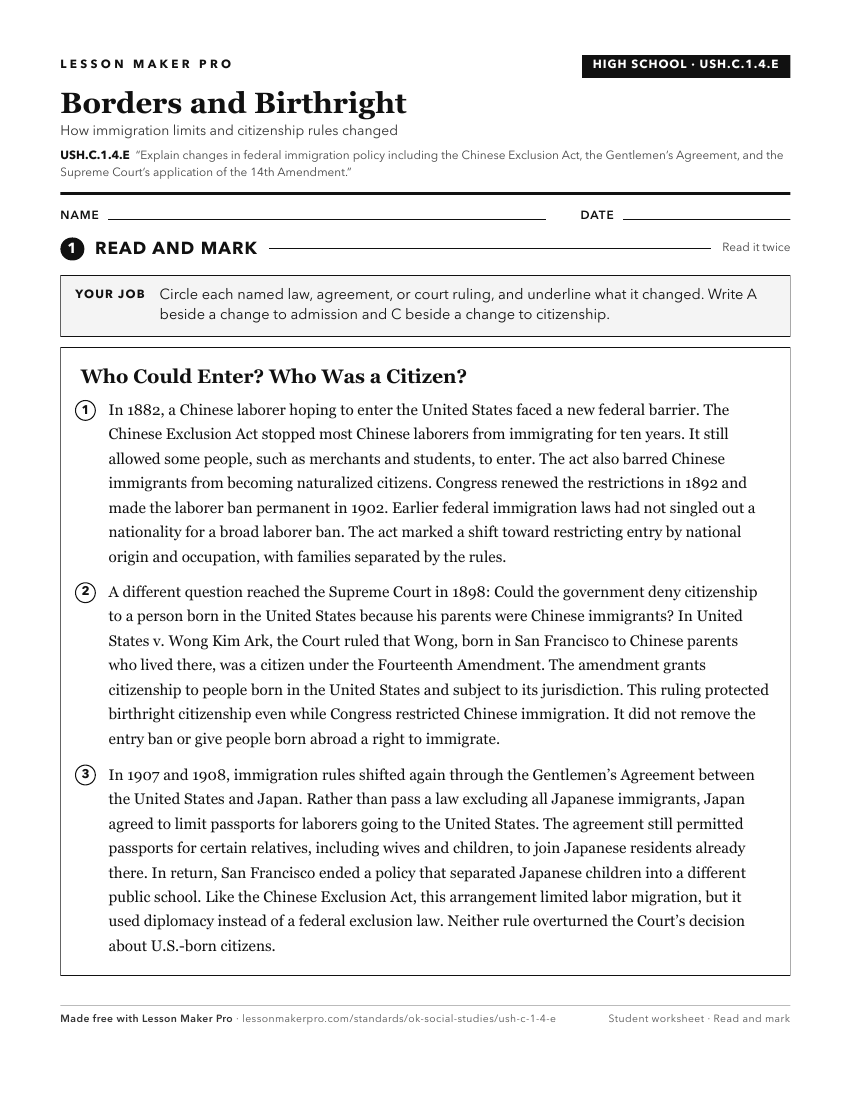
A ready-to-print activity worksheet aligned to USH.C.1.4.E, with an answer key for the teacher on its own page. No account needed.
PDF, US Letter, prints cleanly in black and white.
Download the worksheetKeep exploring
Related Standards
- USH.C.7.3.C
Describe the changing immigration policy, with emphasis on how the Immigration Act of 1965 began to transform American society through removal of an origins quo...
- 8.C.13.2.A
Explain the impact of the 13th, 14th, and 15th Amendments on the status of formerly enslaved persons, as well as the relationship of the federal government to t...
- OKH.C.8.1.A
Examine judicial interpretation of the equal protection clause of the 14th Amendment.
- USH.C.1.4.A
Summarize the reasons for immigration and the immigrant experiences at processing centers such as Ellis Island and Angel Island.
Turn this exact standard into a lesson
Grade, subject, topic, and the complete standard are prefilled. Create one free, no account needed.
Also for this standard:Make a WorksheetMake a QuizMake a Sub Lesson