Oklahoma Social Studies USH.C.1.3.C
The Standard
- USH.C.1
- Analyze the transformation of the United States of America through its civil rights struggles, immigrant experiences, and settlement of the American West during the Post Civil War Era.
- USH.C.1.3
- Analyze the causes and effects of the continuing westward migration and territorial growth after the Civil War.
Examine American Indian perspectives on westward expansion and the end of the Indian Wars in the late nineteenth century, including the events at Wounded Knee Massacre, as expressed by leaders such as Red Cloud, Quanah Parker, and Chief Joseph, while also examining the federal government’s goals of territorial expansion and national development.
Oklahoma Academic Standards for Social Studies (2026) · USH.C.1.3
Teacher's field guide
What This Standard Means
What Students Need to Do
- Students compare how American Indian leaders described threats to their lands and communities with the federal government's plans for settlement, railroads, and growth. They explain how these conflicts led to forced moves and violence, including the killing of Lakota people at Wounded Knee.
What Mastery Looks Like
- A student can explain how Red Cloud, Quanah Parker, and Chief Joseph responded to different pressures on their nations. They can name a federal goal, support a comparison with a source, and explain why Wounded Knee is called a massacre rather than a battle.
Common Misconceptions
- Students may picture western land as empty or assume all Native nations responded in the same way. Some call Wounded Knee a battle between equal forces or assume Native communities disappeared after 1890.
How to Assess It
- On an exit ticket, ask: “How did one federal expansion goal conflict with the concerns of Red Cloud, Quanah Parker, or Chief Joseph? Why is Wounded Knee called a massacre?”
Lesson moves
Ways to Teach It
Give pairs maps of Lakota, Comanche, and Nez Perce homelands; have them trace railroad routes and mark Wounded Knee.
Read short excerpts from Red Cloud and Chief Joseph; ask, “What did each want the federal government to stop or honor?”
Give teams dated cards for Red Cloud’s War, Quanah Parker’s surrender, Chief Joseph’s flight, and Wounded Knee; have them order the cards.
Compare a nineteenth-century railroad map with a current highway map; ask whose homelands the routes cross.
Free download
Printable USH.C.1.3.C Worksheet
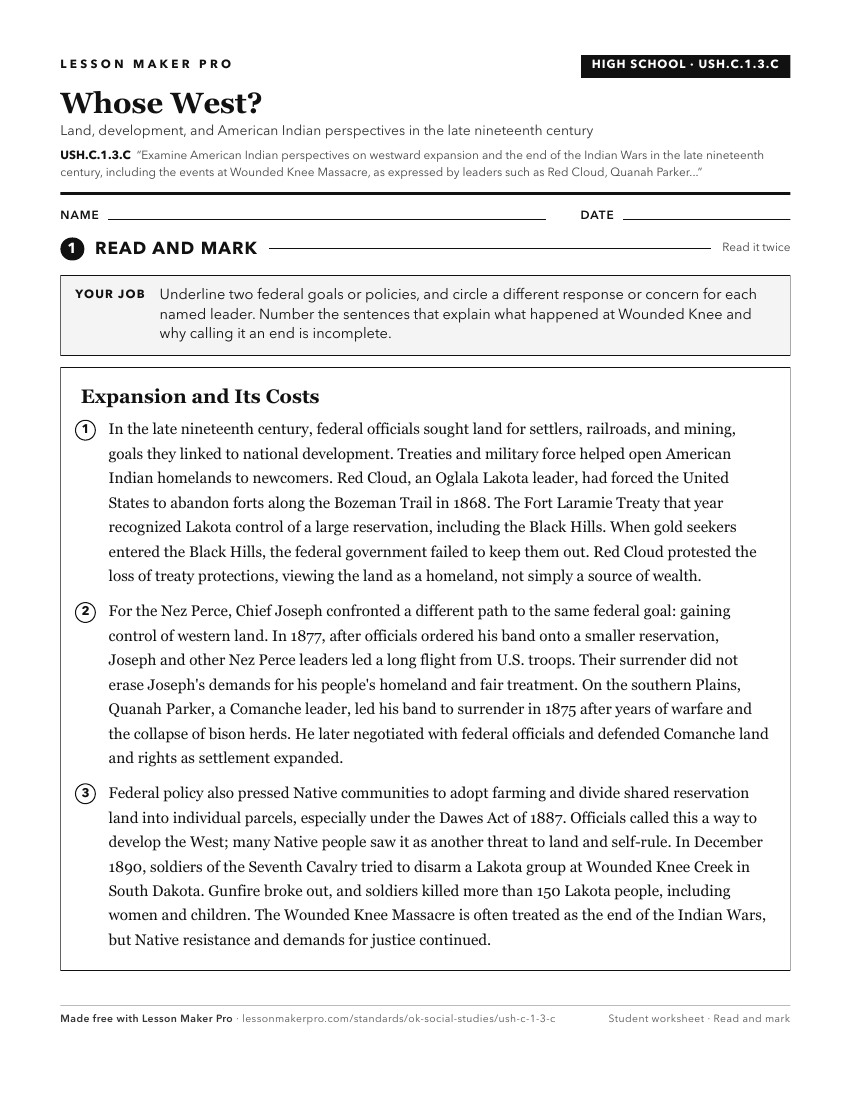
A ready-to-print activity worksheet aligned to USH.C.1.3.C, with an answer key for the teacher on its own page. No account needed.
PDF, US Letter, prints cleanly in black and white.
Download the worksheetKeep exploring
Related Standards
- OKH.C.6.2
Examine government policies impacting American Indian identity, culture, economy, Tribal government, and sovereignty.
- 8.C.5.1.C
Examine Washington’s attempt to develop a cohesive American Indian policy through treaties, assimilation, and the delineation of Tribal lands.
- OKH.C.3.1.E
Examine the purpose for western military posts, such as Fort Sill, and the role of military regiments, such as the Buffalo Soldiers, in implementing Indian poli...
- OKH.C.3.1
Examine the impact of the Civil War and Reconstruction Treaties on American Indian peoples, territories, and Tribal sovereignty.
Turn this exact standard into a lesson
Grade, subject, topic, and the complete standard are prefilled. Create one free, no account needed.
Also for this standard:Make a WorksheetMake a QuizMake a Sub Lesson