Oklahoma Social Studies USG.P.3.1
Standard Cluster
- USG.P.3
- Engage in critical, active reading of primary and secondary sources related to social studies concepts.
Comprehend, evaluate, and synthesize textual sources to acquire and refine knowledge in the social studies. Cite specific textual evidence to support analysis of primary and secondary sources, evaluating features such as author, date, and origin of information. Analyze information from visual, oral, digital, and interactive texts (e.g., maps, charts, images, political cartoons, videos, artwork) in order to draw conclusions and defend arguments.
Oklahoma Academic Standards for Social Studies (2026) · USG.P.3
Cluster contents
Standards in This Cluster
USG.P.3.1 is a cluster heading. These are the individual standards under it.
- USG.P.3.1.A
Cite specific textual evidence to support analysis of primary and secondary sources, evaluating features such as author, date, and origin of information.
- USG.P.3.1.B
Analyze information from visual, oral, digital, and interactive texts (e.g., maps, charts, images, political cartoons, videos, artwork) in order to draw conclus...
Teacher's field guide
What This Cluster Means
What Students Need to Do
- Students read an original document and a later account, check who made each and when, and cite specific words to support a claim. They use a chart, image, or video to test or refine that claim.
What Mastery Looks Like
- A student cites the 26th Amendment and a history article to explain how the voting age changed. They identify each source's creator and date, read a youth turnout chart accurately, and separate the right to vote from actual turnout.
Common Misconceptions
- Students may call a recent article a primary source because it describes an old event. They may think a turnout chart explains why people voted, or leave out who made a source and when.
How to Assess It
- Hand out the 26th Amendment, a short history article, and a labeled youth turnout chart. Ask: "What changed in voting law, and what does the chart show about participation? Cite a detail from each source and name one limit of the chart."
Lesson moves
Ways to Teach It
Give pairs printed copies of the 26th Amendment, a history article, and a youth turnout chart; have them highlight evidence in three colors.
Ask: "Does the 26th Amendment guarantee that young adults vote? Use its wording and a turnout chart to defend your answer."
Run a source-sort relay with an amendment excerpt, a history article, and a turnout chart; teams label each source's creator, date, and limits.
Open a state voter registration page and a candidate's campaign video; students record each publisher, date, and one claim the source supports.
Free download
Printable USG.P.3.1 Worksheet
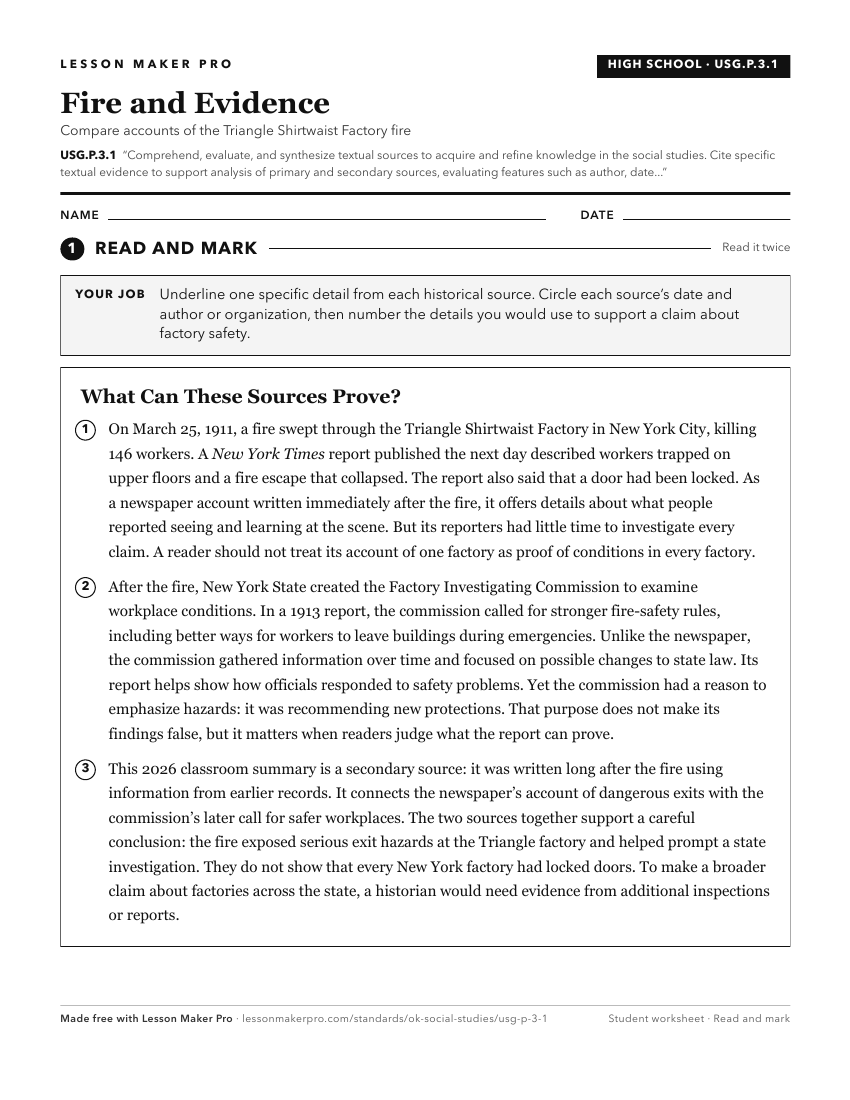
A ready-to-print activity worksheet aligned to USG.P.3.1, with an answer key for the teacher on its own page. No account needed.
PDF, US Letter, prints cleanly in black and white.
Download the worksheetKeep exploring
Related Standards
- 8.P.3.1
Comprehend, evaluate, and synthesize textual sources to acquire and refine knowledge in the social studies.
- 4.P.3.1
Comprehend, evaluate, and synthesize textual sources to acquire and refine knowledge in the social studies.
- 7.P.3.1
Comprehend, evaluate, and synthesize textual sources to acquire and refine knowledge in the social studies.
- E.P.3.1
Comprehend, evaluate, and synthesize textual sources to acquire and refine knowledge in the social studies.
Turn this cluster into a lesson
Grade, subject, topic, and the complete cluster are prefilled. Create one free, no account needed.
Also for this cluster:Make a WorksheetMake a QuizMake a Sub Lesson