Oklahoma Social Studies E.P.3.1
Standard Cluster
- E.P.3
- Engage in critical, active reading of primary and secondary sources related to social studies concepts.
Comprehend, evaluate, and synthesize textual sources to acquire and refine knowledge in the social studies. Cite specific textual evidence to support analysis of primary and secondary sources, evaluating features such as author, date, and origin of information. Analyze information from visual, oral, digital, and interactive texts (e.g., maps, charts, images, political cartoons, videos, artwork) in order to draw conclusions and defend arguments.
Oklahoma Academic Standards for Social Studies (2026) · E.P.3
Cluster contents
Standards in This Cluster
E.P.3.1 is a cluster heading. These are the individual standards under it.
- E.P.3.1.A
Cite specific textual evidence to support analysis of primary and secondary sources, evaluating features such as author, date, and origin of information.
- E.P.3.1.B
Analyze information from visual, oral, digital, and interactive texts (e.g., maps, charts, images, political cartoons, videos, artwork) in order to draw conclus...
Teacher's field guide
What This Cluster Means
What Students Need to Do
- Students read written sources and study maps, charts, images, and other media. They check who made each source and when, then use details from more than one source to support a conclusion.
What Mastery Looks Like
- A student can make a claim using a quoted phrase and a specific detail from a map or image. They explain how each source's creator, date, or purpose affects what it can tell us.
Common Misconceptions
- Students may treat a photograph as a complete record of an event or assume an older source is always more reliable. They may cite a source's title instead of pointing to evidence within it.
How to Assess It
- Show an excerpt from Frederick Douglass's 1852 Fourth of July speech and an 1860 census map of slavery. Ask: What does each reveal about slavery, and what does each leave out? Cite a phrase and a mapped detail, and consider who made each source and when.
Lesson moves
Ways to Teach It
Give pairs a printed Douglass speech excerpt and a slavery map; have them circle evidence and label each source's creator and date.
Ask, 'Why might a census map and Douglass's speech tell different parts of slavery's story?' Require one detail from each.
Set out newspaper, map, cartoon, and chart cards; teams match claims to evidence and reject one unsupported claim.
Print a city budget summary and spending chart; students check the publisher and year, then defend a claim about spending priorities.
Free download
Printable E.P.3.1 Worksheet
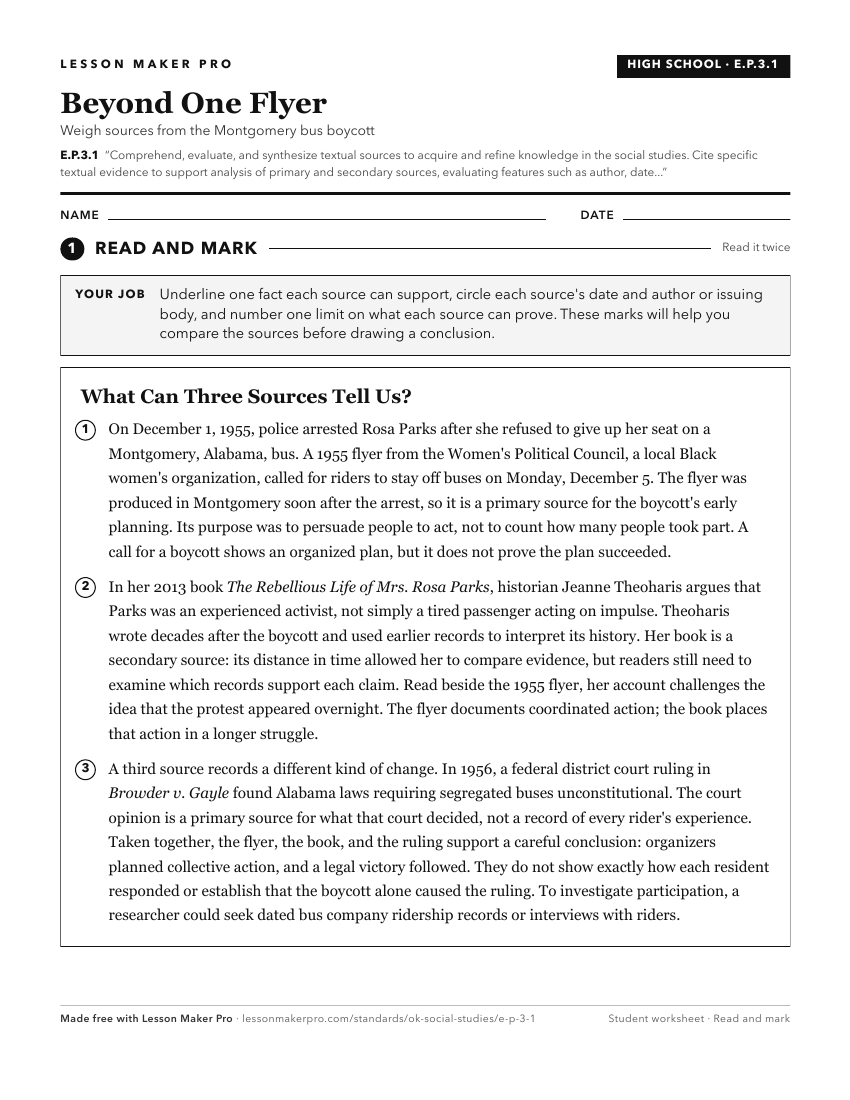
A ready-to-print activity worksheet aligned to E.P.3.1, with an answer key for the teacher on its own page. No account needed.
PDF, US Letter, prints cleanly in black and white.
Download the worksheetKeep exploring
Related Standards
- 8.P.3.1
Comprehend, evaluate, and synthesize textual sources to acquire and refine knowledge in the social studies.
- OKH.P.3.1
Comprehend, evaluate, and synthesize textual sources to acquire and refine knowledge in the social studies.
- 1.P.3.1
Comprehend, evaluate, and synthesize textual sources to acquire and refine knowledge in the social studies.
- 3.P.3.1
Comprehend, evaluate, and synthesize textual sources to acquire and refine knowledge in the social studies.
Turn this cluster into a lesson
Grade, subject, topic, and the complete cluster are prefilled. Create one free, no account needed.
Also for this cluster:Make a WorksheetMake a QuizMake a Sub Lesson