Oklahoma Social Studies TOT.C.11.2
The Standard
Explain why it is important for current and future generations to learn from the Shoah through eye-witness accounts and survivors’ testimony.
Oklahoma Academic Standards for Social Studies (2026)
Teacher's field guide
What This Standard Means
What Students Need to Do
- Students listen to or read accounts from people who witnessed the Shoah. They explain what these accounts reveal about people’s experiences and why future generations need to hear them.
What Mastery Looks Like
- A student uses a detail from a survivor’s account to explain something a timeline alone cannot show. They place the account in its historical setting and explain why preserving it matters.
Common Misconceptions
- Students may think one survivor’s experience represents everyone’s. They may treat a speaker’s later reflection as something the speaker witnessed at the time, or assume testimony needs no historical context.
How to Assess It
- Play a short survivor testimony clip. Ask students to write one detail the speaker witnessed and two sentences explaining why that account should be preserved for future generations.
Lesson moves
Ways to Teach It
Give students a printed testimony excerpt and a timeline; have them mark what the speaker witnessed and place the account in time.
After a short survivor clip, ask: What does the speaker tell us that a timeline cannot, and what background helps us understand the account?
Make cards with testimony excerpts, historical facts, and later reflections; have pairs sort them and explain one choice.
Use an online museum testimony archive to draft a two-sentence exhibit label explaining why that recorded voice matters for future visitors.
Free download
Printable TOT.C.11.2 Worksheet
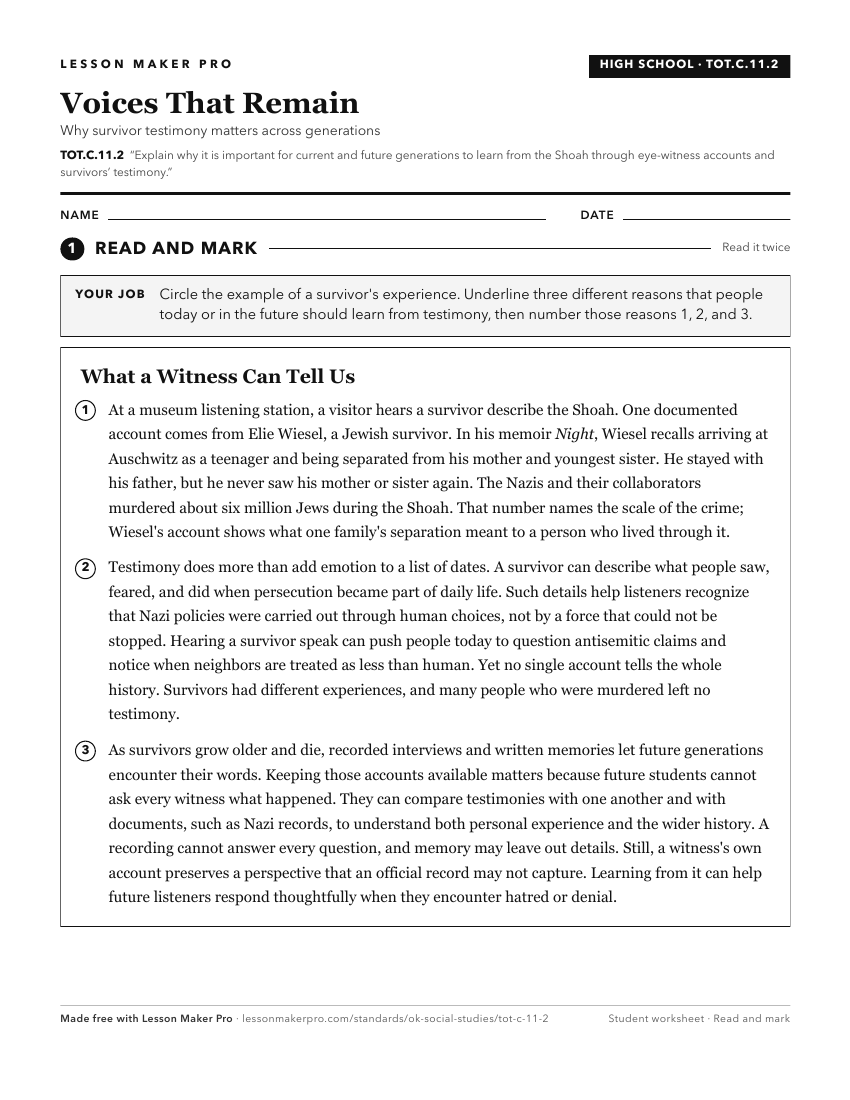
A ready-to-print activity worksheet aligned to TOT.C.11.2, with an answer key for the teacher on its own page. No account needed.
PDF, US Letter, prints cleanly in black and white.
Download the worksheetKeep exploring
Related Standards
- 2.C.2.1
Compare perspectives of people in the past to people in the present and explain the importance of considering multiple viewpoints.
- MWH.C.6.6.D
Summarize world responses including religious, political, and humanitarian resistance movements to the Shoah resulting in the Nuremberg Trials and the increased...
- TOT.C.7.11
Explain the effect of the Eichmann Trial on policy concerning crimes against humanity, capital punishment, accountability, the testimony of survivors, and ackno...
- MWH.C.6.6.C
Examine the effects of the Shoah through eyewitness accounts from victims, survivors, liberators, and perpetrators.
Turn this exact standard into a lesson
Grade, subject, topic, and the complete standard are prefilled. Create one free, no account needed.
Also for this standard:Make a WorksheetMake a QuizMake a Sub Lesson