Oklahoma Social Studies TOT.C.7.11
The Standard
Explain the effect of the Eichmann Trial on policy concerning crimes against humanity, capital punishment, accountability, the testimony of survivors, and acknowledgment of the international community.
Oklahoma Academic Standards for Social Studies (2026)
Teacher's field guide
What This Standard Means
What Students Need to Do
- Students explain how the trial shaped debate about prosecuting crimes against humanity and holding individuals responsible. They describe why survivor testimony mattered and why Eichmann’s execution raised questions about capital punishment. They also examine international recognition of Nazi crimes and objections to Israel’s seizure of Eichmann in Argentina.
What Mastery Looks Like
- A student can use the verdict and survivor testimony to explain how the trial brought Nazi crimes before a wider audience. They can explain why Israel executed Eichmann while capital punishment remained contested. They can describe Argentina’s objection without claiming that it excused Eichmann’s crimes.
Common Misconceptions
- Students may think the trial created the legal category of crimes against humanity. Some assume all countries approved of Israel’s actions in Argentina, or that Eichmann’s execution set a death penalty rule for later cases.
How to Assess It
- Ask students to write five labeled lines on crimes against humanity, capital punishment, individual accountability, survivor testimony, and international response. Each line must name one effect or debate linked to the trial.
Lesson moves
Ways to Teach It
Give pairs four printed cards with testimony, verdict, execution, and Argentina protest excerpts; have them label the policy question each raises.
Ask: Should a country use the death penalty for crimes against humanity? Write a claim using Eichmann’s case and one counterargument.
Run a claim sort: students place statements under supported, unsupported, or needs nuance, then correct the claim that the trial created international law.
Read a Reuters report on an ICC arrest warrant beside Eichmann’s verdict; list one shared accountability question and one difference.
Free download
Printable TOT.C.7.11 Worksheet
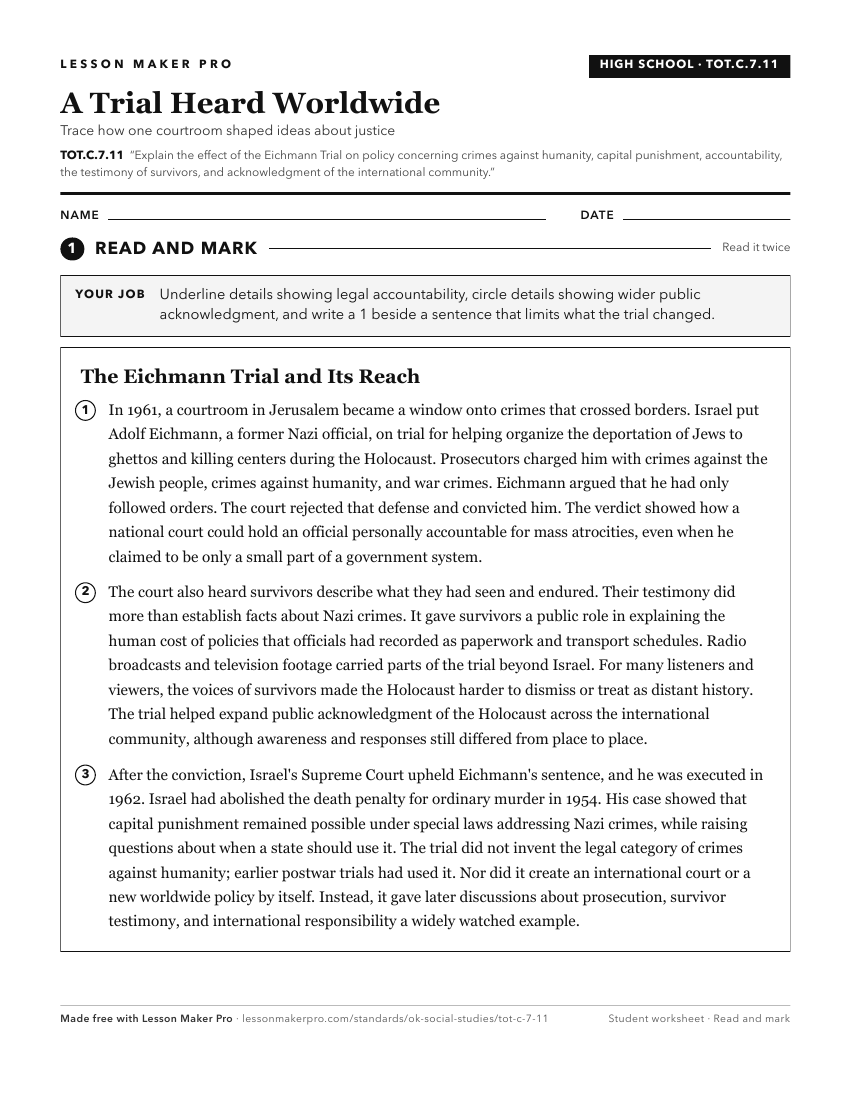
A ready-to-print activity worksheet aligned to TOT.C.7.11, with an answer key for the teacher on its own page. No account needed.
PDF, US Letter, prints cleanly in black and white.
Download the worksheetKeep exploring
Related Standards
- MWH.C.6.6.D
Summarize world responses including religious, political, and humanitarian resistance movements to the Shoah resulting in the Nuremberg Trials and the increased...
- MWH.C.6.6.C
Examine the effects of the Shoah through eyewitness accounts from victims, survivors, liberators, and perpetrators.
- USH.C.5.3.C
Examine the United States of America’s participation in the Nuremberg Trials which held Nazi leaders accountable for war crimes.
- TOT.C.7.10
Analyze the international community’s efforts to hold perpetrators responsible for their involvement in the Shoah (Holocaust) including the purpose and outcomes...
Turn this exact standard into a lesson
Grade, subject, topic, and the complete standard are prefilled. Create one free, no account needed.
Also for this standard:Make a WorksheetMake a QuizMake a Sub Lesson