Oklahoma Social Studies S.2
Standard Cluster
Examine the influence of culture and the way cultural transmission is accomplished. Describe the components of culture, including norms and values, material and non-material care. Explain the process of the social construction of the self, including the ways individuals are socialized by culture, such as sanctions. Analyze how culture influences individuals, including the mechanisms of ethnocentrism, cultural relativity, and culture shock. Describe various subcultures, counter cultures, and social movements, and explain their influence according to sociological perspectives.
Oklahoma Academic Standards for Social Studies (2026)
Cluster contents
Standards in This Cluster
S.2 is a cluster heading. These are the individual standards under it.
- S.2.1
Describe the components of culture, including norms and values, material and non-material care.
- S.2.2
Explain the process of the social construction of the self, including the ways individuals are socialized by culture, such as sanctions.
- S.2.3
Analyze how culture influences individuals, including the mechanisms of ethnocentrism, cultural relativity, and culture shock.
- S.2.4
Describe various subcultures, counter cultures, and social movements, and explain their influence according to sociological perspectives.
Teacher's field guide
What This Cluster Means
What Students Need to Do
- Students identify objects, norms, and values in a culture. They explain how rewards and penalties shape a person's sense of self, and how people respond to unfamiliar customs. They explain how subcultures, countercultures, and social movements affect society from different sociological viewpoints.
What Mastery Looks Like
- Given a school example, a student can name a physical object, an unwritten rule, a shared belief, and a sanction. They can explain culture shock without calling an unfamiliar custom wrong. They can compare how conflict theory and symbolic interactionism would explain a student protest.
Common Misconceptions
- Students may confuse values with objects or think sanctions are always punishments. They may mistake culture shock for ethnocentrism, or think understanding a custom in context means approving it. They may call any group with shared interests a counterculture, even if it rejects no wider norm.
How to Assess It
- Exit ticket: A student is teased for speaking a home language at school, then joins an organized campaign for bilingual signs. Name the sanction, explain how it might shape the student's self-image, and identify the campaign as a social movement or subculture.
Lesson moves
Ways to Teach It
Sort cards showing a phone, handshake, privacy, and detention into material culture, norms, values, and sanctions.
Discuss a visitor surprised by a host family's no-shoes rule: What might an ethnocentric response sound like, and what could the visitor ask instead?
Match a skateboard club, anti-consumerist commune, and organized school walkout to subculture, counterculture, or social movement; justify each match.
Read a school dress code and a student petition against it; explain the dispute through conflict theory and symbolic interactionism.
Free download
Printable S.2 Worksheet
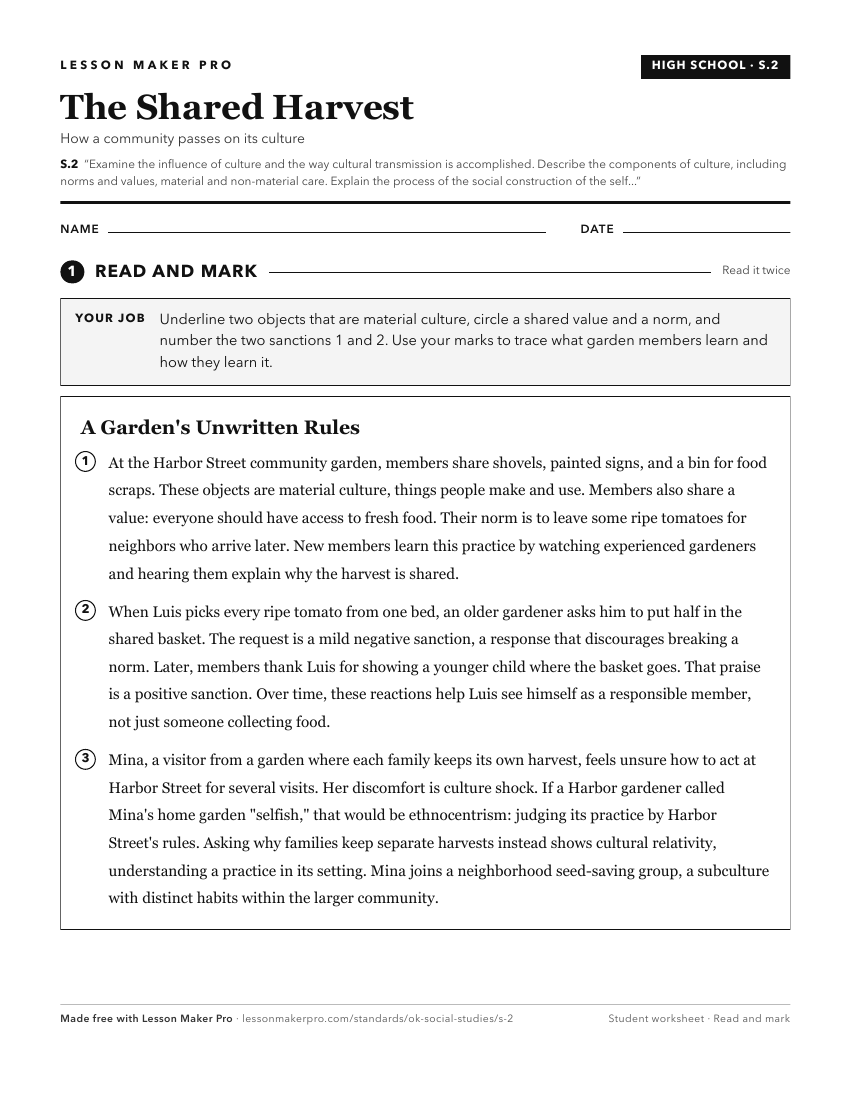
A ready-to-print activity worksheet aligned to S.2, with an answer key for the teacher on its own page. No account needed.
PDF, US Letter, prints cleanly in black and white.
Download the worksheetKeep exploring
Related Standards
- S.3.3
Analyze how culture influences individuals, including the mechanisms of ethnocentrism, cultural relativity, and culture shock.
- 4.C.2.4.B
Explain how culture can affect the ways in which people live and how culture can change over time through cultural diffusion.
- 6.C.3.2
Analyze how the characteristics of culture impact people and places.
Turn this cluster into a lesson
Grade, subject, topic, and the complete cluster are prefilled. Create one free, no account needed.
Also for this cluster:Make a WorksheetMake a QuizMake a Sub Lesson