Oklahoma Social Studies S.1.3
The Standard
- S.1
- Explain the sociological perspective and identify sociology as a scientific field of inquiry.
Evaluate the strengths and weaknesses of the major methods of sociological research, including surveys and interviews, experiments, observations, content analysis, and research ethics.
Oklahoma Academic Standards for Social Studies (2026) · S.1
Teacher's field guide
What This Standard Means
What Students Need to Do
- Students compare ways to study people and groups: surveys, interviews, experiments, observations, and analysis of posts or other records. They explain what each method can show, where it can mislead, and how to protect participants.
What Mastery Looks Like
- A student can choose a method for a research question and defend that choice. They can name a likely source of bias, say whether the method can test cause and effect, and identify a privacy or consent concern.
Common Misconceptions
- Students may assume a large survey represents everyone, even if only friends respond. They may think observations reveal motives or that counting words in posts proves what people believe. They may also think experiments always prove cause or that recording classmates needs no consent.
How to Assess It
- Exit ticket: A school wants to know whether a new lunch schedule changes cafeteria use. Choose two research methods, give one strength and one weakness of each, and name one privacy concern.
Lesson moves
Ways to Teach It
Hand pairs a five-question cafeteria survey and a five-line observation log; have them mark one possible bias and one privacy risk in each.
Have students write three sentences answering: Would an interview or an experiment better explain why students skip lunch, and what ethical limit applies?
Match five cafeteria question cards about counts, reasons, causes, behavior, and posts to survey, interview, experiment, observation, and content analysis.
Write '80% hate school lunch' beside a poll of ten friends; ask whether a newspaper could fairly print that headline.
Free download
Printable S.1.3 Worksheet
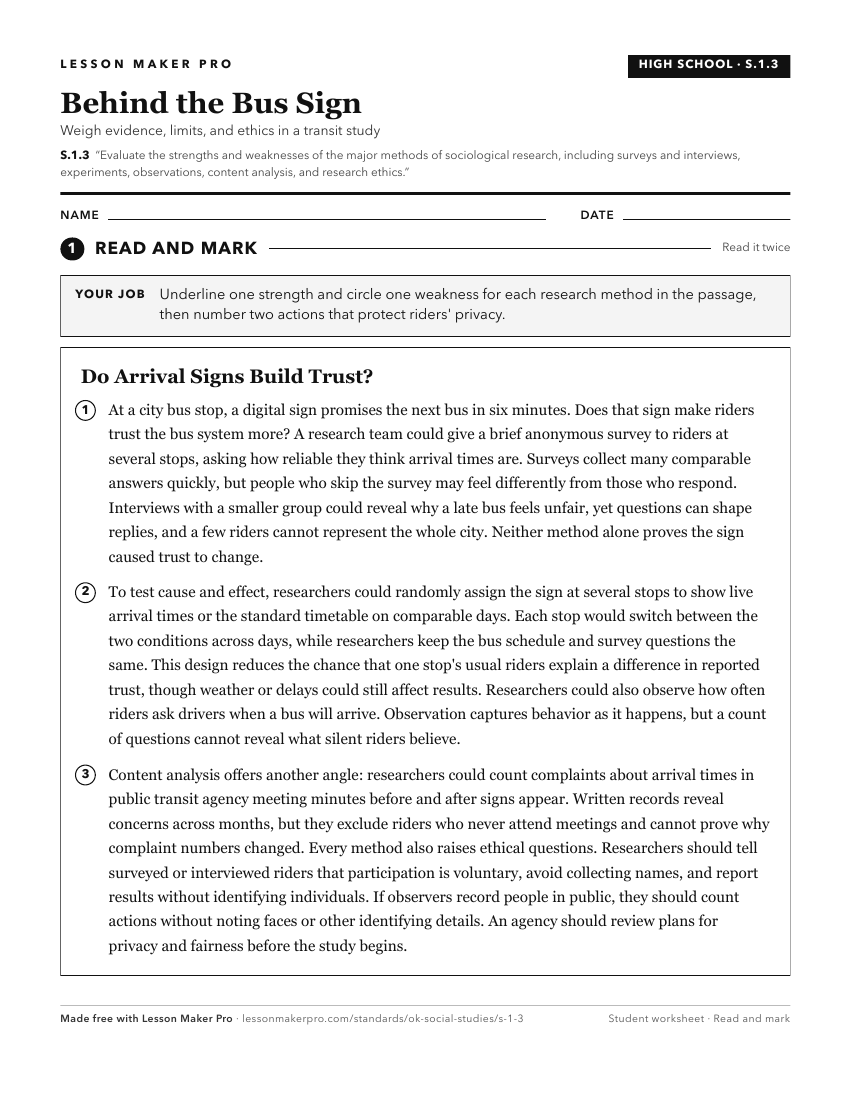
A ready-to-print activity worksheet aligned to S.1.3, with an answer key for the teacher on its own page. No account needed.
PDF, US Letter, prints cleanly in black and white.
Download the worksheetKeep exploring
Related Standards
- PS.1.3
Compare the appropriate application of experimental and non-experimental research methodologies (e.g., case study, correlation, meta-analysis, and naturalistic ...
- S.1.4
Apply the scientific method of inquiry on the study of society, including developing a hypothesis, and identifying independent and dependent variables.
- S.1.2
Identify, differentiate among, and apply the major sociological paradigms (e.g., functional analysis, conflict theory, symbolic interactionism).
- PS.1.5
Compare quantitative and qualitative research strategies including experiments, surveys, focus groups, and narratives as the foundation of research in psycholog...
Turn this exact standard into a lesson
Grade, subject, topic, and the complete standard are prefilled. Create one free, no account needed.
Also for this standard:Make a WorksheetMake a QuizMake a Sub Lesson