Oklahoma Social Studies S.1
Standard Cluster
Explain the sociological perspective and identify sociology as a scientific field of inquiry. Describe the development of the field of sociology as a social science, including the contributions of leading theorists within sociology. Identify, differentiate among, and apply the major sociological paradigms (e.g., functional analysis, conflict theory, symbolic interactionism). Evaluate the strengths and weaknesses of the major methods of sociological research, including surveys and interviews, experiments, observations, content analysis, and research ethics. Apply the scientific method of inquiry on the study of society, including developing a hypothesis, and identifying independent and dependent variables.
Oklahoma Academic Standards for Social Studies (2026)
Cluster contents
Standards in This Cluster
S.1 is a cluster heading. These are the individual standards under it.
- S.1.1
Describe the development of the field of sociology as a social science, including the contributions of leading theorists within sociology.
- S.1.2
Identify, differentiate among, and apply the major sociological paradigms (e.g., functional analysis, conflict theory, symbolic interactionism).
- S.1.3
Evaluate the strengths and weaknesses of the major methods of sociological research, including surveys and interviews, experiments, observations, content analys...
- S.1.4
Apply the scientific method of inquiry on the study of society, including developing a hypothesis, and identifying independent and dependent variables.
Teacher's field guide
What This Cluster Means
What Students Need to Do
- Students explain social patterns by looking at groups and institutions, not just individual choices. They connect the work of Comte, Durkheim, Marx, Weber, and Mead to the growth of sociology and use three sociological lenses to explain everyday life. They compare research methods and plan an ethical study with a hypothesis and clear variables.
What Mastery Looks Like
- A student can explain the same school rule through functionalism, conflict theory, and symbolic interactionism. They can write a testable hypothesis and label what might influence the outcome and what they would measure. They can choose a research method, name a limit of that method, and explain how they would protect participants.
Common Misconceptions
- Students often treat individual choices as a full explanation for a social pattern. They may confuse the outcome measured with the factor that might influence it, or think an observation proves cause and effect. They may assume an anonymous survey needs no consent.
How to Assess It
- Ask students to study lunch lines: write a testable hypothesis, label two variables, choose a research method, name one limit, and explain one way to protect participants.
Lesson moves
Ways to Teach It
Give groups dated thinker and contribution cards; have them match Comte, Durkheim, Marx, Weber, and Mead, then build a timeline.
Ask why students sit with the same friends at lunch, then have students write one explanation using each of the three sociological lenses.
Post five school research questions; pairs match each to a survey, interview, experiment, observation, or content analysis and explain one tradeoff.
Use a cafeteria menu to predict whether price relates to lunch choices; label variables and draft a consent-based survey to test the prediction.
Free download
Printable S.1 Worksheet
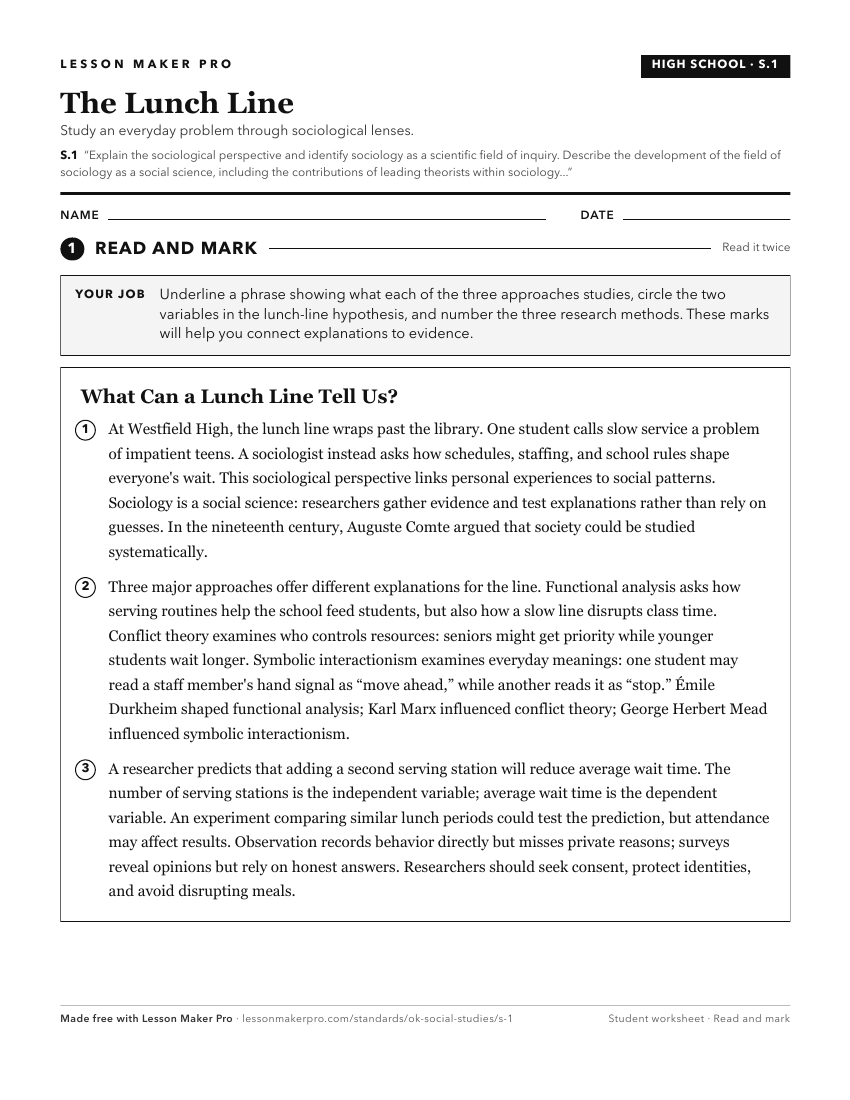
A ready-to-print activity worksheet aligned to S.1, with an answer key for the teacher on its own page. No account needed.
PDF, US Letter, prints cleanly in black and white.
Download the worksheetKeep exploring
Related Standards
Turn this cluster into a lesson
Grade, subject, topic, and the complete cluster are prefilled. Create one free, no account needed.
Also for this cluster:Make a WorksheetMake a QuizMake a Sub Lesson