Oklahoma Social Studies PS.6
Standard Cluster
Evaluate influences, perspectives, and domains of motivation and emotion. Explain biological, cognitive, and social factors that influence motivation. Compare the predominant theories of motivation including drive-reduction, self-determination, instinct, conflicts, and sensation-seeking. Explain the biological and cognitive components of emotion. Examine the influence of the social situation on individual behavior and mental processes, including persuasion, conformity and obedience. Explain how biological, cognitive, environmental, and social factors can produce or influence emotional states, and how positive or negative emotions can affect thinking and action.
Oklahoma Academic Standards for Social Studies (2026)
Cluster contents
Standards in This Cluster
PS.6 is a cluster heading. These are the individual standards under it.
- PS.6.1
Explain biological, cognitive, and social factors that influence motivation.
- PS.6.2
Compare the predominant theories of motivation including drive-reduction, self-determination, instinct, conflicts, and sensation-seeking.
- PS.6.3
Explain the biological and cognitive components of emotion.
- PS.6.4
Examine the influence of the social situation on individual behavior and mental processes, including persuasion, conformity and obedience.
- PS.6.5
Explain how biological, cognitive, environmental, and social factors can produce or influence emotional states, and how positive or negative emotions can affect...
Teacher's field guide
What This Cluster Means
What Students Need to Do
- Students explain why people act, using body needs, thoughts, and social pressure. They compare theories of motivation using examples. They explain how body reactions, interpretations, and surroundings shape emotions, and how emotions affect choices.
What Mastery Looks Like
- A student can match a choice to drive reduction, self-determination, instinct, conflict, or sensation seeking and explain the match. They can explain why a racing heart might feel like fear in one setting and excitement in another. They can tell persuasion, conformity, and obedience apart and predict how an emotion might change a decision.
Common Misconceptions
- Students may call any enjoyable choice drive reduction, even when no need is relieved, or call a learned habit an instinct. They may think a racing heart always means fear. They may label copying friends obedience, though obedience involves an authority figure.
How to Assess It
- Exit ticket: “Friends dare Mia to jump into a cold lake. Her heart races, and she thinks everyone will laugh if she refuses.” Ask students to name one motivation theory and one social influence, explain how her body and thoughts shape her emotion, and predict how fear might affect her choice.
Lesson moves
Ways to Teach It
Have pairs check their pulse before and after stepping in place, then write two feelings someone might attach to a faster pulse.
Ask partners why a racing heart might feel like fear before a speech but excitement before a game.
Read eight short scenarios; students hold up persuasion, conformity, or obedience cards and explain one close call.
Show a snack ad; have students mark a persuasive cue, the feeling it targets, and a choice it might change.
Free download
Printable PS.6 Worksheet
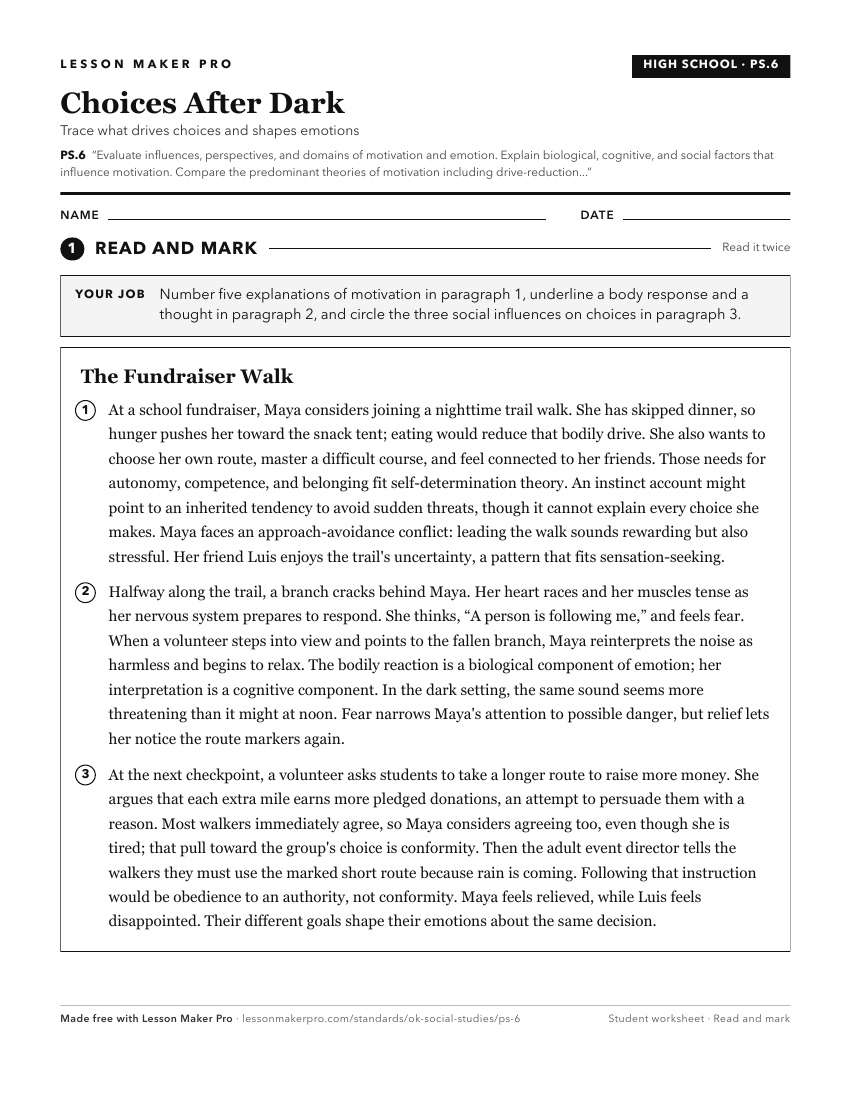
A ready-to-print activity worksheet aligned to PS.6, with an answer key for the teacher on its own page. No account needed.
PDF, US Letter, prints cleanly in black and white.
Download the worksheetKeep exploring
Related Standards
Turn this cluster into a lesson
Grade, subject, topic, and the complete cluster are prefilled. Create one free, no account needed.
Also for this cluster:Make a WorksheetMake a QuizMake a Sub Lesson