Oklahoma Social Studies PS.6.2
The Standard
- PS.6
- Evaluate influences, perspectives, and domains of motivation and emotion.
Compare the predominant theories of motivation including drive-reduction, self-determination, instinct, conflicts, and sensation-seeking.
Oklahoma Academic Standards for Social Studies (2026) · PS.6
Teacher's field guide
What This Standard Means
What Students Need to Do
- Students explain five ways psychologists account for motivation: bodily needs, choice and skill, inborn behavior, competing goals, and a desire for excitement. They compare theories using details from a person's actions.
What Mastery Looks Like
- A student can explain why eating when hungry fits drive reduction, while riding a roller coaster fits sensation seeking. They can use a short example to show how self-determination, instinct, or conflict differs from those explanations.
Common Misconceptions
- Students may think every choice is driven by a bodily need, or that self-determination means doing something alone. They may confuse a choice between two goals with sensation seeking, or assume all behavior is instinctive.
How to Assess It
- Exit ticket: Match these to the five theories: eating when hungry, practicing piano to build skill, a bird building a nest, choosing between two parties, and riding a roller coaster. Explain why hunger and the roller coaster fit different theories.
Lesson moves
Ways to Teach It
Give pairs five printed scenario cards to sort under theory labels, then ask them to write one clue on each card.
Ask students to write two sentences explaining why a roller coaster ride fits sensation seeking better than drive reduction.
Read a new scenario aloud, have partners hold up a theory card, then ask one pair to defend its choice.
Present a lunchroom choice: eat now or attend a club meeting. Have students identify the hunger drive and the competing goals.
Free download
Printable PS.6.2 Worksheet
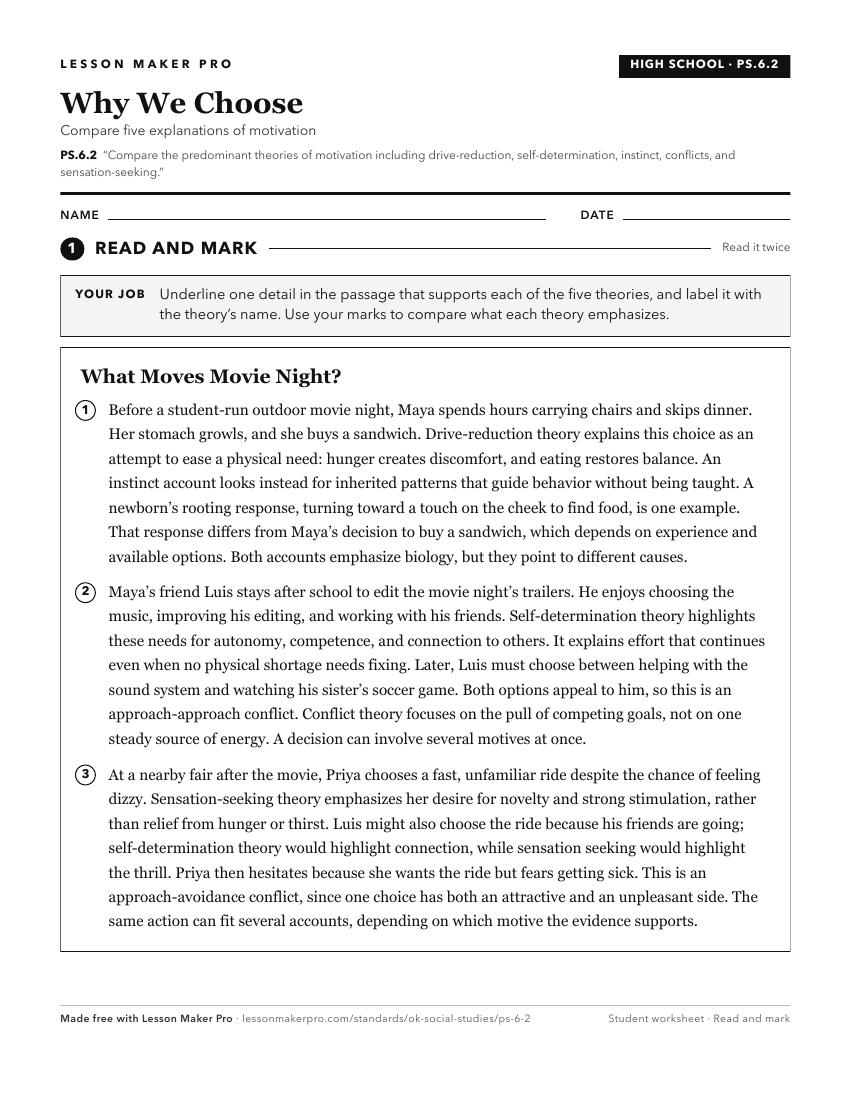
A ready-to-print activity worksheet aligned to PS.6.2, with an answer key for the teacher on its own page. No account needed.
PDF, US Letter, prints cleanly in black and white.
Download the worksheetKeep exploring
Related Standards
- PS.5.2
Examine various types of social influence, including intergroup dynamics, persuasion, attraction, aggression, and altruism.
- PS.4.2
Examine major theories of human development.
- PS.6
Evaluate influences, perspectives, and domains of motivation and emotion.
- PS.6.1
Explain biological, cognitive, and social factors that influence motivation.
Turn this exact standard into a lesson
Grade, subject, topic, and the complete standard are prefilled. Create one free, no account needed.
Also for this standard:Make a WorksheetMake a QuizMake a Sub Lesson