Oklahoma Social Studies PS.3
Standard Cluster
Describe the fundamental processes of cognition, including thinking and problem solving, memory, perception, and intelligence. Explain process involved in effective problem solving and decision making. Describe principles of perception, including personal and environmental interactions. Describe the process, organization, and factors that influence encoding, storing, retrieving and forgetting memories.
Oklahoma Academic Standards for Social Studies (2026)
Cluster contents
Standards in This Cluster
PS.3 is a cluster heading. These are the individual standards under it.
Teacher's field guide
What This Cluster Means
What Students Need to Do
- Students explain how thinking, perception, memory, and intelligence affect behavior. They describe how attention, past experience, and surroundings shape what people notice and remember. They identify a problem, compare options, make a choice, and check the result.
What Mastery Looks Like
- Given an illusion, students explain how expectations and lighting can change what they see. They trace a word from encoding to storage to retrieval and explain how weak attention or interference can cause forgetting. They compare options before choosing a solution and explain why one test score cannot define intelligence.
Common Misconceptions
- Students may assume everyone sees the same image the same way. They may think forgetting means a memory was never stored, even when a retrieval cue could help. They may mistake one test score for intelligence or choose the first solution without weighing options.
How to Assess It
- Exit ticket: A student studies beside a loud TV, blanks on a quiz, then remembers the answer after seeing a picture. Explain how attention affected encoding, why recall failed, and how the picture helped retrieval.
Lesson moves
Ways to Teach It
Read a mixed list of 12 fruits, tools, and animals; students group remembered words on paper and test recall after five minutes.
Show the duck-rabbit image without a label, then ask students how their expectations and the picture's details shaped what they saw.
Give pairs a phone lost at school card; award points for comparing calling it, retracing steps, and reporting it before choosing.
Give students a printed chart of two phone plans; have them weigh price, data limits, and coverage before choosing one.
Free download
Printable PS.3 Worksheet
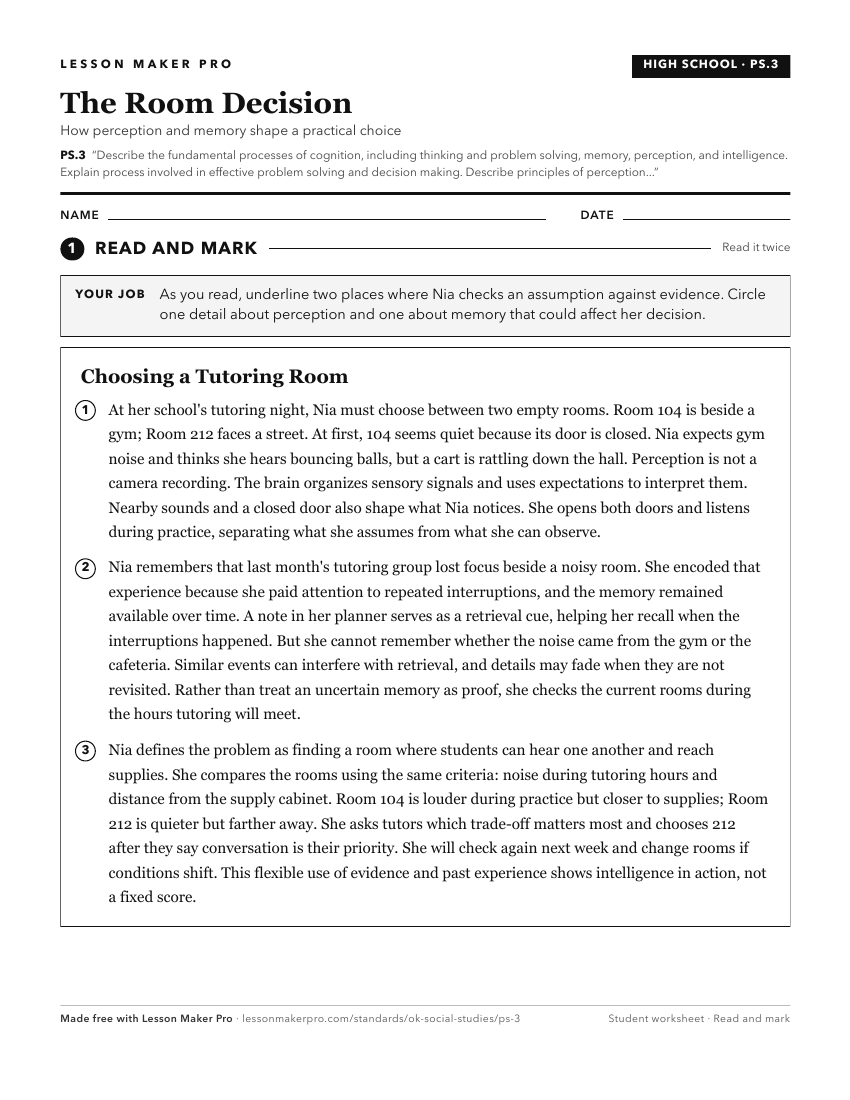
A ready-to-print activity worksheet aligned to PS.3, with an answer key for the teacher on its own page. No account needed.
PDF, US Letter, prints cleanly in black and white.
Download the worksheetKeep exploring
Related Standards
- PS.2.2
Identify and describe the structure and function of major brain systems, including the major parts of the brainstem, limbic system and cerebral cortex.
- PS.2
Investigate the structure, biochemistry, and circuitry of the brain and the nervous system to understand their roles in affecting behavior.
Turn this cluster into a lesson
Grade, subject, topic, and the complete cluster are prefilled. Create one free, no account needed.
Also for this cluster:Make a WorksheetMake a QuizMake a Sub Lesson