Oklahoma Social Studies E.P.3.2
Standard Cluster
- E.P.3
- Engage in critical, active reading of primary and secondary sources related to social studies concepts.
Apply critical reading and thinking skills to interpret, evaluate, and respond to a variety of complex texts and perspectives. Evaluate the extent to which historical or cultural perspectives affect an author’s stated or implied purpose. Evaluate the author’s point of view, potential bias, and how authors can reach different conclusions regarding the same issue. Actively listen, evaluate, and analyze a speaker’s message, asking questions while engaged in collaborative discussions about social studies topics and texts.
Oklahoma Academic Standards for Social Studies (2026) · E.P.3
Cluster contents
Standards in This Cluster
E.P.3.2 is a cluster heading. These are the individual standards under it.
- E.P.3.2.A
Evaluate the extent to which historical or cultural perspectives affect an author’s stated or implied purpose.
- E.P.3.2.B
Evaluate the author’s point of view, potential bias, and how authors can reach different conclusions regarding the same issue.
- E.P.3.2.C
Actively listen, evaluate, and analyze a speaker’s message, asking questions while engaged in collaborative discussions about social studies topics and texts.
Teacher's field guide
What This Cluster Means
What Students Need to Do
- Read two accounts of the same issue and check each writer’s claims and evidence. Explain how the writer’s time, culture, and interests shape their purpose and conclusions. Listen to classmates, ask questions, and respond with evidence.
What Mastery Looks Like
- Given two accounts of removal, a student cites a line from each to explain the writers’ different purposes and conclusions. They identify a possible bias tied to each writer’s position and ask a classmate a question about the evidence.
Common Misconceptions
- Students may call a source biased simply because they disagree with it. They may treat a writer’s stated purpose as the only purpose, or assume two accounts describe different events because their conclusions differ.
How to Assess It
- Give students short excerpts from Jackson’s 1830 message and a Cherokee petition. Ask: “What does each writer want readers to believe about removal? Cite a detail from each excerpt and write one question you would ask someone who disagrees.”
Lesson moves
Ways to Teach It
Print sentence strips from Jackson’s 1830 message and a Cherokee petition; pairs sort claims and evidence by source, then label each writer’s purpose.
Ask, “How did each writer’s position shape what they left out?” Partners cite a line, listen to the reply, and ask one follow-up question.
Play claim-match: teams pair claims about removal with evidence cards, then explain why one card supports a claim better than another.
Use two school phone policy editorials; students identify each writer’s stake, evidence, and proposed action before writing their own recommendation.
Free download
Printable E.P.3.2 Worksheet
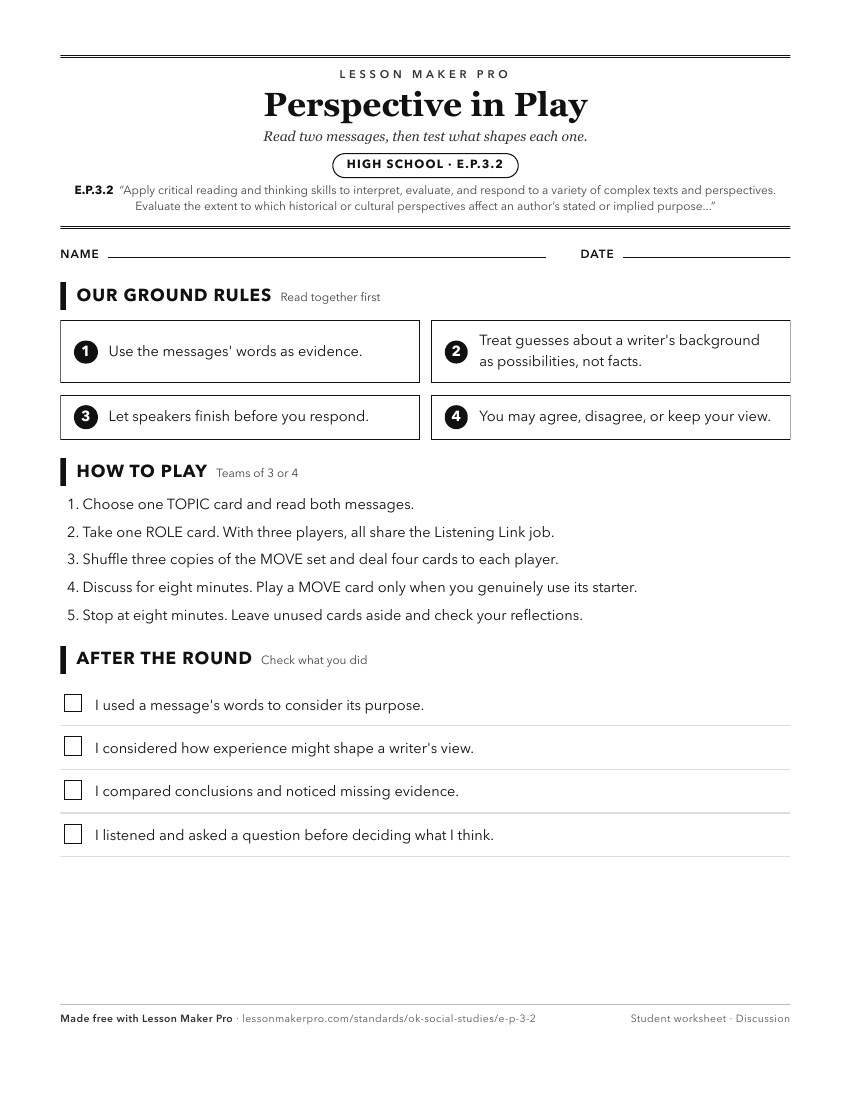
A ready-to-print activity worksheet aligned to E.P.3.2, with an answer key for the teacher on its own page. No account needed.
PDF, US Letter, prints cleanly in black and white.
Download the worksheetKeep exploring
Related Standards
- 6.P.3.2
Apply critical reading and thinking skills to interpret, evaluate, and respond to a variety of complex texts and perspectives.
- 4.P.3.2
Apply critical reading and thinking skills to interpret, evaluate, and respond to a variety of complex texts and perspectives.
- 5.P.3.2
Apply critical reading and thinking skills to interpret, evaluate, and respond to a variety of complex texts and perspectives.
- 3.P.3.2
Apply critical reading and thinking skills to interpret, evaluate, and respond to a variety of complex texts and perspectives.
Turn this cluster into a lesson
Grade, subject, topic, and the complete cluster are prefilled. Create one free, no account needed.
Also for this cluster:Make a WorksheetMake a QuizMake a Sub Lesson