Oklahoma Social Studies E.P.3.2.B
The Standard
- E.P.3
- Engage in critical, active reading of primary and secondary sources related to social studies concepts.
- E.P.3.2
- Apply critical reading and thinking skills to interpret, evaluate, and respond to a variety of complex texts and perspectives.
Evaluate the author’s point of view, potential bias, and how authors can reach different conclusions regarding the same issue.
Oklahoma Academic Standards for Social Studies (2026) · E.P.3.2
Teacher's field guide
What This Standard Means
What Students Need to Do
- Students identify an author’s position and use details from the source to explain what may shape it. They compare two authors on the same issue and explain why their conclusions differ.
What Mastery Looks Like
- A student can point to an author’s role, evidence, and word choices to support an explanation of their perspective. They can explain a possible bias without assuming the author is wrong.
Common Misconceptions
- Students may think bias means a claim is false. They may assume an author’s job proves bias without checking the source, or think a calm tone means a source is neutral.
How to Assess It
- Give students these lines: Superintendent: “A 9 a.m. start may improve attendance.” Parent with a 7 a.m. shift: “A 9 a.m. start makes morning care harder.” Ask: “What concern shapes each view, and why might the authors reach different conclusions?”
Lesson moves
Ways to Teach It
Have students highlight evidence and loaded words in two short letters about later school start times, then label each author’s role.
Ask, “Why might a student and a parent read the same school start time data differently?” Require one detail from each letter.
Give pairs four quotes about later start times and four author descriptions; have them match each quote and defend one match.
Compare a city budget memo and a bus rider’s letter about a fare increase; have students list whose costs each source emphasizes.
Free download
Printable E.P.3.2.B Worksheet
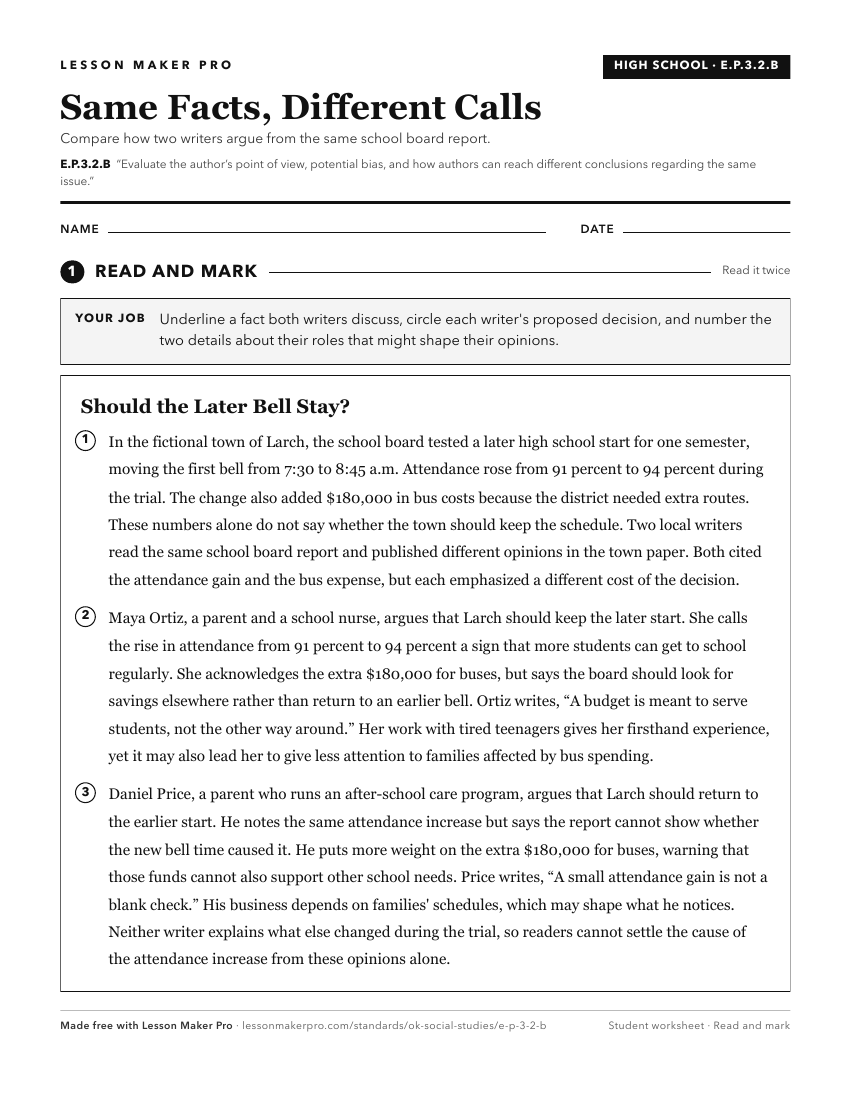
A ready-to-print activity worksheet aligned to E.P.3.2.B, with an answer key for the teacher on its own page. No account needed.
PDF, US Letter, prints cleanly in black and white.
Download the worksheetKeep exploring
Related Standards
- WG.P.3.2.B
Evaluate the author’s point of view, potential bias, and how authors can reach different conclusions regarding the same issue.
- OKH.P.3.2.B
Evaluate the author’s point of view, potential bias, and how authors can reach different conclusions regarding the same issue.
- USH.P.3.2.B
Evaluate the author’s point of view, potential bias, and how authors can reach different conclusions regarding the same issue.
- MWH.P.3.2.B
Evaluate the author’s point of view, potential bias, and how authors can reach different conclusions regarding the same issue.
Turn this exact standard into a lesson
Grade, subject, topic, and the complete standard are prefilled. Create one free, no account needed.
Also for this standard:Make a WorksheetMake a QuizMake a Sub Lesson