Oklahoma Social Studies 3.P.3.2
Standard Cluster
- 3.P.3
- Engage in critical, active reading of primary and secondary sources related to social studies concepts.
Apply critical reading and thinking skills to interpret, evaluate, and respond to a variety of complex texts and perspectives. Determine the author’s purpose, including what the author wants to answer, explain, or describe in informational texts. Locate facts (e.g., who, what, where, when, why, how) to demonstrate an understanding of key details in a text. Ask and answer questions to clarify information and engage in collaborative discussions about appropriate topics in social studies.
Oklahoma Academic Standards for Social Studies (2026) · 3.P.3
Cluster contents
Standards in This Cluster
3.P.3.2 is a cluster heading. These are the individual standards under it.
- 3.P.3.2.A
Determine the author’s purpose, including what the author wants to answer, explain, or describe in informational texts.
- 3.P.3.2.B
Locate facts (e.g., who, what, where, when, why, how) to demonstrate an understanding of key details in a text.
- 3.P.3.2.C
Ask and answer questions to clarify information and engage in collaborative discussions about appropriate topics in social studies.
Teacher's field guide
What This Cluster Means
What Students Need to Do
- Students read social studies texts and find details about who, what, where, when, why, and how. They explain what the writer wants to answer, explain, or describe. They compare viewpoints and ask classmates questions when something is unclear.
What Mastery Looks Like
- A student points to a sentence that supports an answer. They can explain why the writer wrote the text, notice when two people describe an event differently, and ask a question that would help clear up a detail.
Common Misconceptions
- Students may treat a writer's opinion as a fact or assume two accounts must match in every detail. They may name the topic, such as a bridge, instead of saying what the writer wants to explain. They may guess why something happened without finding support in the text.
How to Assess It
- Read: “On Tuesday, the town opened a footbridge over Pine Creek so children can walk to school safely.” Name who opened it and where it is, explain what the writer wants readers to understand, and write one question you would ask to learn more.
Lesson moves
Ways to Teach It
Give pairs a printed town notice and six labeled cards; students cut out details and sort them under who, what, where, when, why, and how.
Read a town notice and a resident's letter about a new park; ask, “What does each writer want readers to think, and why?”
Play a question-card relay using a short article about a school garden; teams underline the sentence that answers each card.
Bring in a local bus schedule; students identify its purpose, find a stop and time, and ask a partner one question it cannot answer.
Free download
Printable 3.P.3.2 Worksheet
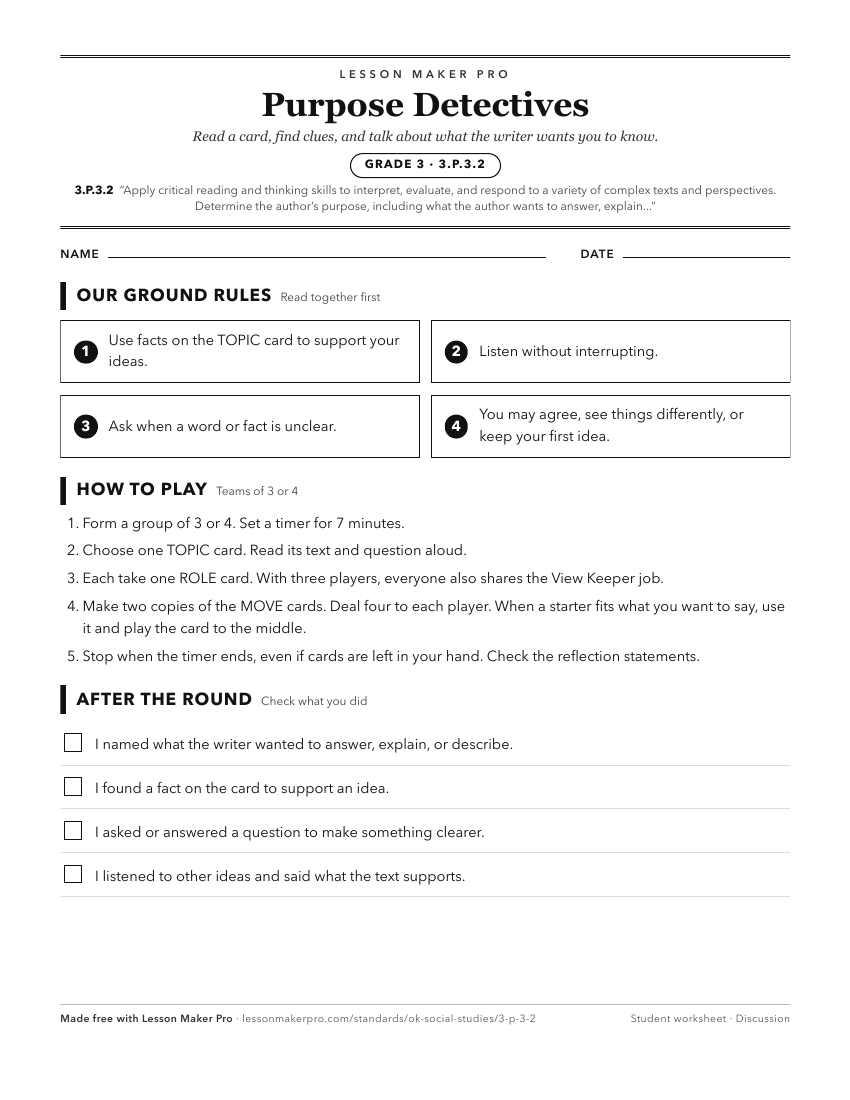
A ready-to-print activity worksheet aligned to 3.P.3.2, with an answer key for the teacher on its own page. No account needed.
PDF, US Letter, prints cleanly in black and white.
Download the worksheetKeep exploring
Related Standards
Turn this cluster into a lesson
Grade, subject, topic, and the complete cluster are prefilled. Create one free, no account needed.
Also for this cluster:Make a WorksheetMake a QuizMake a Sub Lesson