Oklahoma Social Studies 7.P.1.1
Standard Cluster
- 7.P.1
- Apply critical thinking skills to address authentic civic issues.
Demonstrate an understanding of the virtue of civil discourse to analyze and address real-world problems. Analyze why the acknowledgement of different perspectives can contribute to civil discourse and solutions to civic issues. Apply a range of deliberative and democratic procedures to discuss, make decisions, and propose action about real-world problems in and out of school. Use information to analyze how a specific problem can manifest itself in regional and global issues, describing options for solutions.
Oklahoma Academic Standards for Social Studies (2026) · 7.P.1
Cluster contents
Standards in This Cluster
7.P.1.1 is a cluster heading. These are the individual standards under it.
- 7.P.1.1.A
Analyze why the acknowledgement of different perspectives can contribute to civil discourse and solutions to civic issues.
- 7.P.1.1.B
Apply a range of deliberative and democratic procedures to discuss, make decisions, and propose action about real-world problems in and out of school.
- 7.P.1.1.C
Use information to analyze how a specific problem can manifest itself in regional and global issues, describing options for solutions.
Teacher's field guide
What This Cluster Means
What Students Need to Do
- Students use evidence to show how a school problem can also appear across a region and around the world. They consider different views, discuss options respectfully, use a fair decision process, and propose an action.
What Mastery Looks Like
- A student can use a watershed map and a global plastic waste chart to explain bottle waste at different scales. They can respond to another person's concern with evidence and explain how their group chose an action.
Common Misconceptions
- Students may think a respectful discussion means everyone must agree, or that a vote makes minority concerns irrelevant. They may assume every bottle dropped at school reaches the ocean, or suggest a fix without considering its cost.
How to Assess It
- Exit ticket: Use a watershed map and a global plastic waste chart to give one regional and one global example of the problem. Name a concern about your proposed school action and explain how the class could decide fairly.
Lesson moves
Ways to Teach It
Sort clean bottle samples into reuse, recycling, and trash bins, then mark where litter could travel on a printed local watershed map.
Ask, 'Should our school add a bottle refill station?' Have partners restate a custodian's cleaning concern and a student's access concern before replying.
Run a mock school council with student, custodian, and principal role cards; use timed turns, propose two fixes, then vote and record objections.
Read a regional river litter report and a global ocean plastic chart, then draft two sentences recommending a school bottle waste action to the principal.
Free download
Printable 7.P.1.1 Worksheet
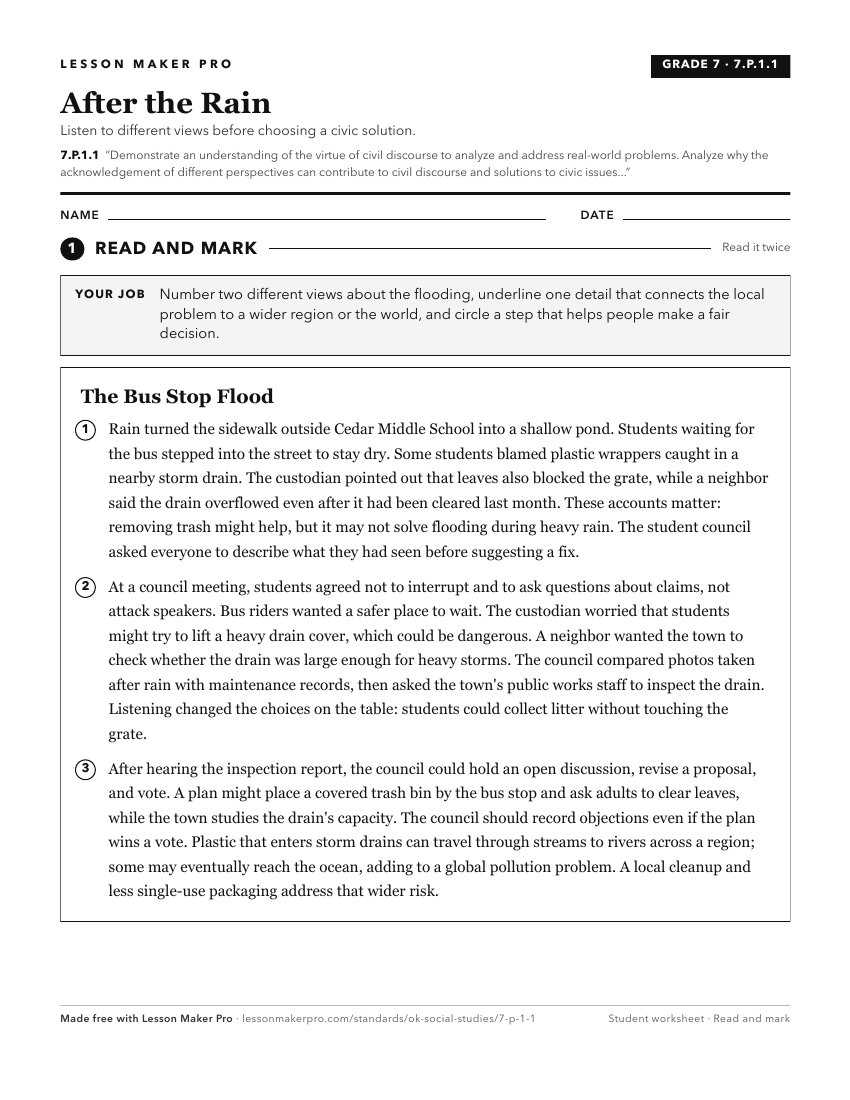
A ready-to-print activity worksheet aligned to 7.P.1.1, with an answer key for the teacher on its own page. No account needed.
PDF, US Letter, prints cleanly in black and white.
Download the worksheetKeep exploring
Related Standards
- OKH.P.1.1
Demonstrate an understanding of the virtue of civil discourse to analyze and address real- world problems.
- 2.P.1.1
The 2nd Grade version of this standard.
- AWH.P.1.1
Demonstrate an understanding of the virtue of civil discourse to analyze and address real- world problems.
- MWH.P.1.1
Demonstrate an understanding of the virtue of civil discourse to analyze and address real- world problems.
Turn this cluster into a lesson
Grade, subject, topic, and the complete cluster are prefilled. Create one free, no account needed.
Also for this cluster:Make a WorksheetMake a QuizMake a Sub Lesson