Oklahoma Social Studies 7.C.7
Standard Cluster
Examine and compare economic systems as means by which governments organize and distribute available resources, services, and goods. Explain how people organize economic systems to address basic economic questions regarding which goods and services will be produced, how they will be distributed, and who will consume them. Compare the advantages and disadvantages of the traditional, market, and command economic systems, including how government policies affect economic activities and trade relationships among nations. Evaluate how the major sectors of economic activities contribute to the development of a country or region: Extraction and harvesting of natural products (Primary Sector); Production of goods through manufacturing and construction (Secondary Sector); Businesses that provide services to consumers (Tertiary Sector); Research and intellectual services such as technology and innovation (Quaternary Sector). Compare the economic measurements of productivity which inform nations of their economic health and growth (e.g., Gross Domestic Product and Gross National Product). Distinguish between developed and developing regions by analyzing data used by geographers (e.g., the Human Development Index data, literacy rate, life expectancy, infant mortality, per capita income), Analyze the role of government to finance a nation’s development (e.g., infrastructure, social programs, and education).
Oklahoma Academic Standards for Social Studies (2026)
Cluster contents
Standards in This Cluster
7.C.7 is a cluster heading. These are the individual standards under it.
- 7.C.7.1
Explain how people organize economic systems to address basic economic questions regarding which goods and services will be produced, how they will be distribut...
- 7.C.7.2
Compare the advantages and disadvantages of the traditional, market, and command economic systems, including how government policies affect economic activities ...
- 7.C.7.3
Evaluate how the major sectors of economic activities contribute to the development of a country or region:
- 7.C.7.3.A
Extraction and harvesting of natural products (Primary Sector)
- 7.C.7.3.B
Production of goods through manufacturing and construction (Secondary Sector)
- 7.C.7.3.C
Businesses that provide services to consumers (Tertiary Sector)
- 7.C.7.3.D
Research and intellectual services such as technology and innovation (Quaternary Sector).
- 7.C.7.4
Compare the economic measurements of productivity which inform nations of their economic health and growth (e.g., Gross Domestic Product and Gross National Prod...
- 7.C.7.5
Distinguish between developed and developing regions by analyzing data used by geographers (e.g., the Human Development Index data, literacy rate, life expectan...
- 7.C.7.6
Analyze the role of government to finance a nation’s development (e.g., infrastructure, social programs, and education).
Teacher's field guide
What This Cluster Means
What Students Need to Do
- Students compare how traditional, market, and command economies decide what to produce and who gets it. They sort work into extraction, manufacturing, services, and research. They use GDP, GNP, health, education, and income data to compare places and explain how government spending and trade rules affect them.
What Mastery Looks Like
- Given a bread shortage, a student explains how each economic system might supply bread and names a drawback of each. They classify a farmer, mill worker, shop clerk, and crop scientist by sector. They distinguish GDP, output made within a country, from GNP, output made by its residents and firms, then support a claim about development with data.
Common Misconceptions
- Students may think market economies have no government rules and traditional economies never change. They may put factory workers in the primary sector or count imported goods in a country's GDP. They may assume high GDP means everyone has a high income and long life.
How to Assess It
- Exit ticket: A country taxes imported steel and spends the revenue on schools. Name one likely effect on trade and one development measure that might improve. Explain each.
Lesson moves
Ways to Teach It
Give groups cards showing a wheat farmer, mill worker, shop clerk, and crop scientist; have them sort the jobs by sector.
Ask: During a bread shortage, how would traditional, market, and command economies divide loaves, and what is one drawback of each?
Sort cards labeled 'foreign firm makes shoes here' and 'local firm makes shoes abroad' into GDP and GNP columns.
Use World Bank country profiles to compare income per person, life expectancy, and infant mortality, then recommend a tax-funded school or road project.
Free download
Printable 7.C.7 Worksheet
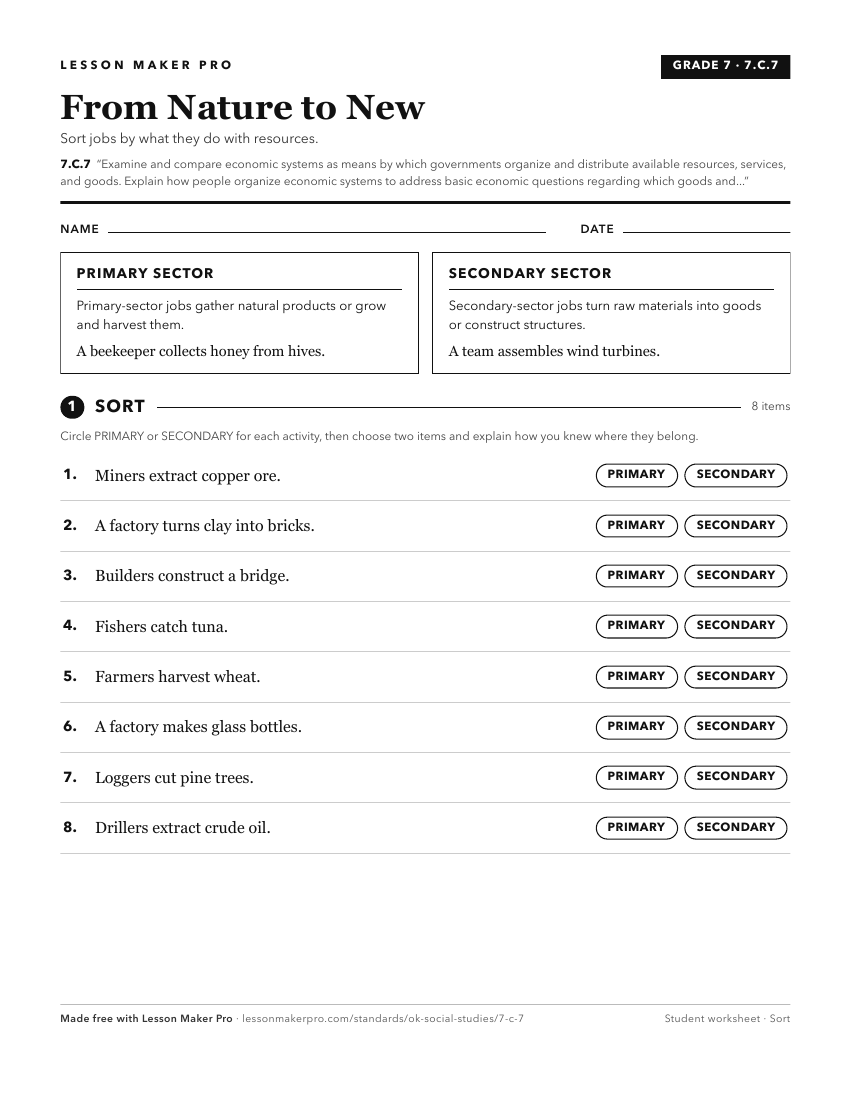
A ready-to-print activity worksheet aligned to 7.C.7, with an answer key for the teacher on its own page. No account needed.
PDF, US Letter, prints cleanly in black and white.
Download the worksheetKeep exploring
Related Standards
- 6.P.2.4.B
Identify different types of economic systems, comparing advantages and disadvantages for citizens and the growth of a nation’s economy.
- 7.P.2.4.B
Identify different types of economic systems, comparing advantages and disadvantages for citizens and the growth of a nation’s economy.
- 6.C.6.1
Explain how people organize economic systems to address basic economic questions regarding which goods and services will be produced, how they will be distribut...
Turn this cluster into a lesson
Grade, subject, topic, and the complete cluster are prefilled. Create one free, no account needed.
Also for this cluster:Make a WorksheetMake a QuizMake a Sub Lesson