Oklahoma Social Studies 7.C.3.3
The Standard
- 7.C.3
- Identify the distribution and demographic patterns of human populations of the Eastern Hemisphere.
Describe the challenges of urbanization and urban sprawl (e.g., access to public services, affordability of housing, gentrification, pollution, transportation).
Oklahoma Academic Standards for Social Studies (2026) · 7.C.3
Teacher's field guide
What This Standard Means
What Students Need to Do
- Students explain how city growth can affect housing, transportation, public services, and pollution. They describe how growth at the city’s edge differs from changes in older neighborhoods.
What Mastery Looks Like
- Given a city map, students can show how new housing far from bus routes creates longer trips. They can explain how rising rents in an older neighborhood may force longtime residents to move.
Common Misconceptions
- Students may think urban sprawl means any city growth, rather than growth across more land. They may assume new shops always help longtime residents, even when rents rise.
How to Assess It
- Exit ticket: Expensive apartments replace older homes downtown, while new houses open beyond the bus routes. Name two problems and explain who each affects.
Lesson moves
Ways to Teach It
Give pairs a printed city map and sticky notes for homes, schools, and bus stops; have them mark service gaps after adding a suburb.
Ask students to write two sentences: If new shops open but rents rise nearby, who benefits and who might have to move?
Have groups match cause-and-effect cards labeled new suburb, longer commute, more car exhaust, higher rent, and displaced tenants.
Print a city bus map and two apartment listings; compare the rent and travel time to a marked job site.
Free download
Printable 7.C.3.3 Worksheet
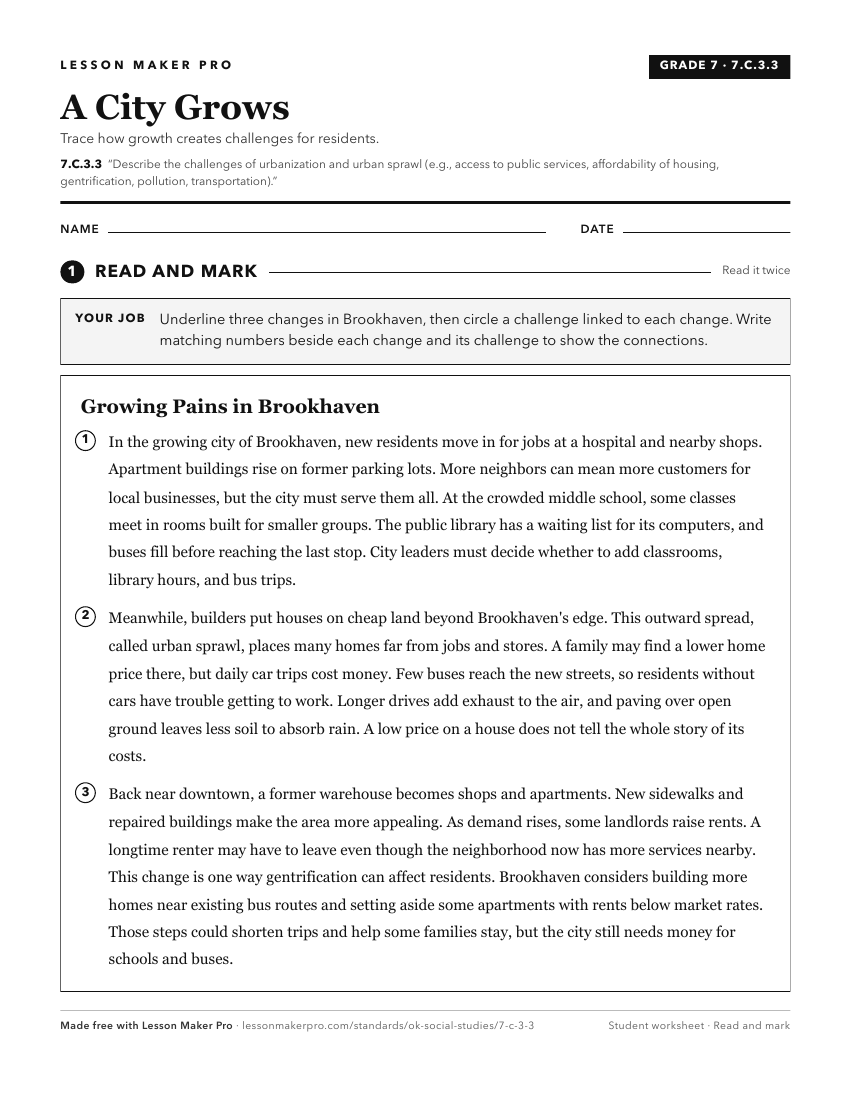
A ready-to-print activity worksheet aligned to 7.C.3.3, with an answer key for the teacher on its own page. No account needed.
PDF, US Letter, prints cleanly in black and white.
Download the worksheetKeep exploring
Related Standards
- MWH.C.5.1.C
Describe the social and economic consequences of industrialization, such as population growth, increased life expectancy, rural to urban migration, harsh living...
- 6.C.4.4
Identify environmental challenges (e.g., air pollution, acid rain, deforestation) and explain how they can impact a region (e.g., oil spills, Amazonia’s ranchin...
- WG.C.2.2
Examine common characteristics of urban versus rural communities, including the patterns and impact of modern migration to urban centers and megacities.
- OKH.C.8.2.G
Identify the causes and consequences of rural to urban to suburban migration, as well as urban renewal efforts (e.g., Oklahoma City’s MAPS Project).
Turn this exact standard into a lesson
Grade, subject, topic, and the complete standard are prefilled. Create one free, no account needed.
Also for this standard:Make a WorksheetMake a QuizMake a Sub Lesson