Oklahoma Social Studies 5.C.6
Standard Cluster
Describe the structure and responsibilities of the United States of America’s system of government and the role of the individual citizen, as provided in the Constitution of the United States of America. Explain that the United States of America’s government was established through a written Constitution, establishing the supreme law of the land. Examine the Preamble of the Constitution of the United States of America and identify the major purposes of government. Explain how the people are the ultimate source of government power in a constitutional republic.. Summarize the rights and liberties protected by the Bill of Rights. Draw connections to colonial conditions which prompted the adoption of particular amendments. Identify contemporary examples of rights, liberties, and due process protections guaranteed by the Bill of Rights. Analyze the structure and operations of government established in the Constitution of the United States of America. Explain why the Framers separated government’s powers into different branches, identify the three branches of the United States of America’s government (legislative, executive, judicial), and describe each branch’s basic function. Describe the system of checks and balances, explaining how each branch of government can limit the power of other branches. Examine the system of shared powers (federalism) between the federal and state levels of governments, explaining why the Framers assigned specific powers to each level. Explain how the Constitution of the United States of America establishes a process for making laws, including specific roles for Congress, the President, and the Supreme Court. Analyze the historical development of American Indian Citizenship and constitutional rights in the United States of America, including the passage of the Indian Citizenship Act of 1924. Examine how Tribal sovereignty and United States of America citizenship function within the United States of America. Describe how the Commerce Clause of the Constitution establishes a nation-to-nation relationship between the United States of America and Tribal governments. Explain that Tribal governments possess powers, including the authority to determine Tribal citizenship, make and enforce laws, manage lands and natural resources, and provide for the needs of Tribal citizens. Analyze the role and responsibilities of all United States of America citizens by explaining why voting in public elections is necessary to maintain a constitutional republic how becoming informed voters contributes to wise decisions how citizens exchange ideas through peaceful protest and civil discourse that service on a trial jury promotes fair justice for all citizens why payment of taxes is required to support projects for the common good that safety and order rely on respect for authority and laws how registration for military service ensures the nation is prepared to defend itself.
Oklahoma Academic Standards for Social Studies (2026)
Cluster contents
Standards in This Cluster
5.C.6 is a cluster heading. These are the individual standards under it.
- 5.C.6.1
Explain that the United States of America’s government was established through a written Constitution, establishing the supreme law of the land.
- 5.C.6.1.A
Examine the Preamble of the Constitution of the United States of America and identify the major purposes of government.
- 5.C.6.1.B
Explain how the people are the ultimate source of government power in a constitutional republic..
- 5.C.6.2
Summarize the rights and liberties protected by the Bill of Rights.
- 5.C.6.2.A
Draw connections to colonial conditions which prompted the adoption of particular amendments.
- 5.C.6.2.B
Identify contemporary examples of rights, liberties, and due process protections guaranteed by the Bill of Rights.
- 5.C.6.3
Analyze the structure and operations of government established in the Constitution of the United States of America.
- 5.C.6.3.A
Explain why the Framers separated government’s powers into different branches, identify the three branches of the United States of America’s government (legisla...
- 5.C.6.3.B
Describe the system of checks and balances, explaining how each branch of government can limit the power of other branches.
- 5.C.6.3.C
Examine the system of shared powers (federalism) between the federal and state levels of governments, explaining why the Framers assigned specific powers to eac...
- 5.C.6.3.D
Explain how the Constitution of the United States of America establishes a process for making laws, including specific roles for Congress, the President, and th...
- 5.C.6.4
Analyze the historical development of American Indian Citizenship and constitutional rights in the United States of America, including the passage of the Indian...
- 5.C.6.4.A
Describe how the Commerce Clause of the Constitution establishes a nation-to-nation relationship between the United States of America and Tribal governments.
- 5.C.6.4.B
Explain that Tribal governments possess powers, including the authority to determine Tribal citizenship, make and enforce laws, manage lands and natural resourc...
- 5.C.6.5
Analyze the role and responsibilities of all United States of America citizens by explaining
- 5.C.6.5.A
why voting in public elections is necessary to maintain a constitutional republic
- 5.C.6.5.B
how becoming informed voters contributes to wise decisions
- 5.C.6.5.C
how citizens exchange ideas through peaceful protest and civil discourse
- 5.C.6.5.D
that service on a trial jury promotes fair justice for all citizens
- 5.C.6.5.E
why payment of taxes is required to support projects for the common good
- 5.C.6.5.F
that safety and order rely on respect for authority and laws
- 5.C.6.5.G
how registration for military service ensures the nation is prepared to defend itself.
Teacher's field guide
What This Cluster Means
What Students Need to Do
- Students use the Preamble to name the goals of government. They explain why the Constitution is the highest law and how people give government its power. They trace rights, lawmaking, federal and state powers, Tribal sovereignty, and citizens' responsibilities.
What Mastery Looks Like
- Given a proposed law, students name Congress's role, the President's choices, and how courts could review it. They connect a colonial search to the Fourth Amendment and a present-day example. They explain that the 1924 citizenship law did not end Tribal self-government or the federal government's nation-to-nation relationship with Tribes.
Common Misconceptions
- Students may think the President makes laws alone or that federal and state governments have the same powers. Some think U.S. citizenship replaced Tribal citizenship and Tribal governments' authority. Others confuse voting, a civic responsibility, with jury service and Selective Service registration, which are legal requirements for eligible people.
How to Assess It
- Exit ticket: Congress approves a bill banning peaceful protest. Name the right involved, the President's next choice, and what the Supreme Court could do if someone challenges the law.
Lesson moves
Ways to Teach It
Hand groups a mock bill, a veto card, and a court ruling card; have students place each under its branch.
Ask students to write how British searches of colonists' homes connect to the Fourth Amendment and a present-day police search.
Play a power-match game with cards for passing bills, vetoing bills, issuing driver's licenses, and setting Tribal citizenship rules.
Use a sample ballot and local budget page; have students choose a project and explain how voting and taxes affect it.
Free download
Printable 5.C.6 Worksheet
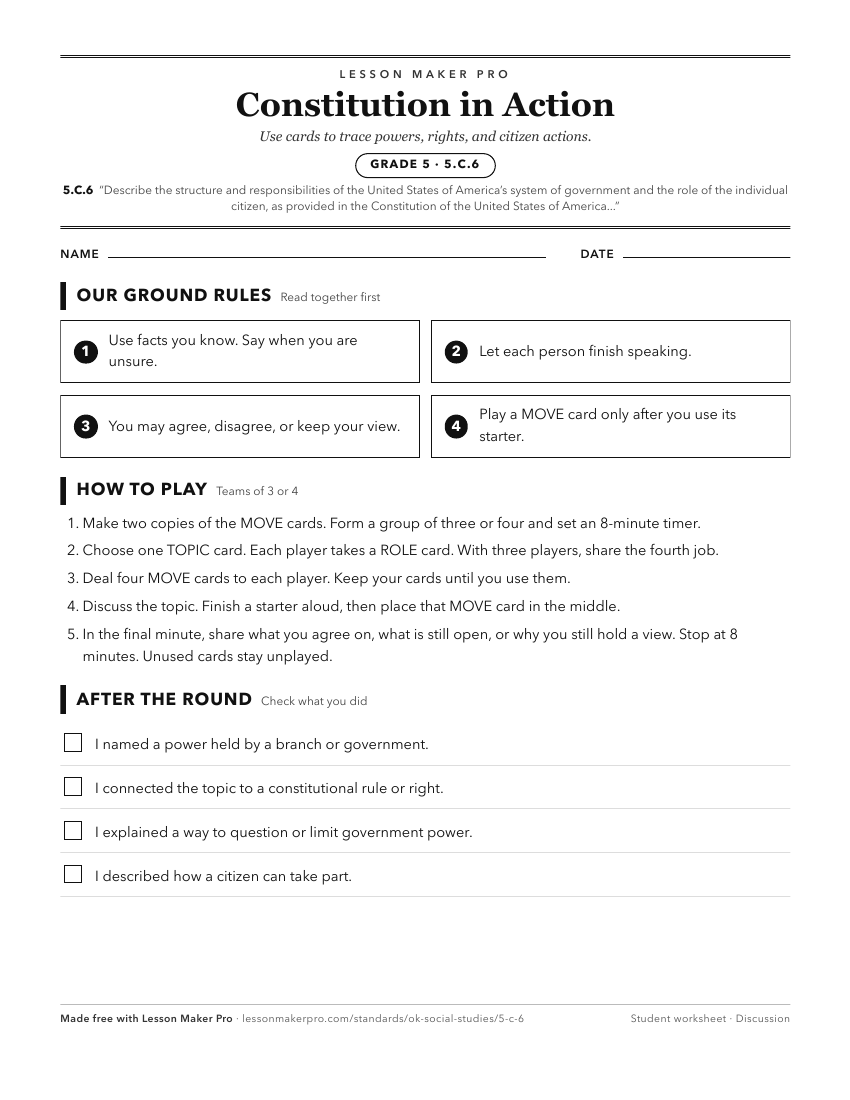
A ready-to-print activity worksheet aligned to 5.C.6, with an answer key for the teacher on its own page. No account needed.
PDF, US Letter, prints cleanly in black and white.
Download the worksheetKeep exploring
Related Standards
- 7.P.2.1.B
Compare the powers and responsibilities of the United States of America’s government to other forms of government, including the roles and rights of citizens.
- 6.P.2.1.B
Compare the powers and responsibilities of the United States of America’s government to other forms of government, including the roles and rights of citizens.
- 8.P.2.1.B
Compare the powers and responsibilities of the United States of America’s government to other forms of government, including the roles and rights of citizens.
Turn this cluster into a lesson
Grade, subject, topic, and the complete cluster are prefilled. Create one free, no account needed.
Also for this cluster:Make a WorksheetMake a QuizMake a Sub Lesson