Oklahoma Social Studies 3.P.2.2
Standard Cluster
- 3.P.2
- Use interdisciplinary tools to acquire, apply, and evaluate content understanding of the four strands of social studies.
Develop skills which demonstrate an understanding of historical events and the people who shaped our history. Explain the difference between a primary and secondary source of information; gather basic information (i.e., author, date, facts). Define point of view and give examples relevant to the student’s experiences. Generate possible reasons for an event and draw conclusions from simple timelines by identifying immediate cause and effect relationships.
Oklahoma Academic Standards for Social Studies (2026) · 3.P.2
Cluster contents
Standards in This Cluster
3.P.2.2 is a cluster heading. These are the individual standards under it.
- 3.P.2.2.A
Explain the difference between a primary and secondary source of information; gather basic information (i.e., author, date, facts).
- 3.P.2.2.B
Define point of view and give examples relevant to the student’s experiences.
- 3.P.2.2.C
Generate possible reasons for an event and draw conclusions from simple timelines by identifying immediate cause and effect relationships.
Teacher's field guide
What This Cluster Means
What Students Need to Do
- Students tell firsthand records from later accounts. They find who made each source, when it was made, and what facts it gives. They describe different views of an event and use a timeline to explain what caused an event and what happened next.
What Mastery Looks Like
- Given a moon landing photo and a later account, a student labels each source and records its creator, date, and a fact. They explain how an astronaut and a child watching on TV might describe the event differently. They use a timeline to explain how landing made the first step on the Moon possible.
Common Misconceptions
- Students may call any old-looking picture a firsthand source, even if it was made years later. They may think point of view means someone is right or wrong. They may assume the event listed just before another on a timeline caused it.
How to Assess It
- Show a 1969 NASA photo of an astronaut on the Moon and a dated article written years later. Ask students to label each source, record who made it and when, and write one fact they found.
Lesson moves
Ways to Teach It
Give pairs a dated moon landing photo and a later article; have them label source type, creator, date, and one fact.
Write two sentences about rainy recess, one from a student hoping to play soccer and one from a student tending class plants.
Shuffle cards for launch, landing, first step, and return; partners order them and explain how landing led to the first step.
Compare a photo from a school event with a newsletter recap, noting who made each and how each tells the story.
Free download
Printable 3.P.2.2 Worksheet
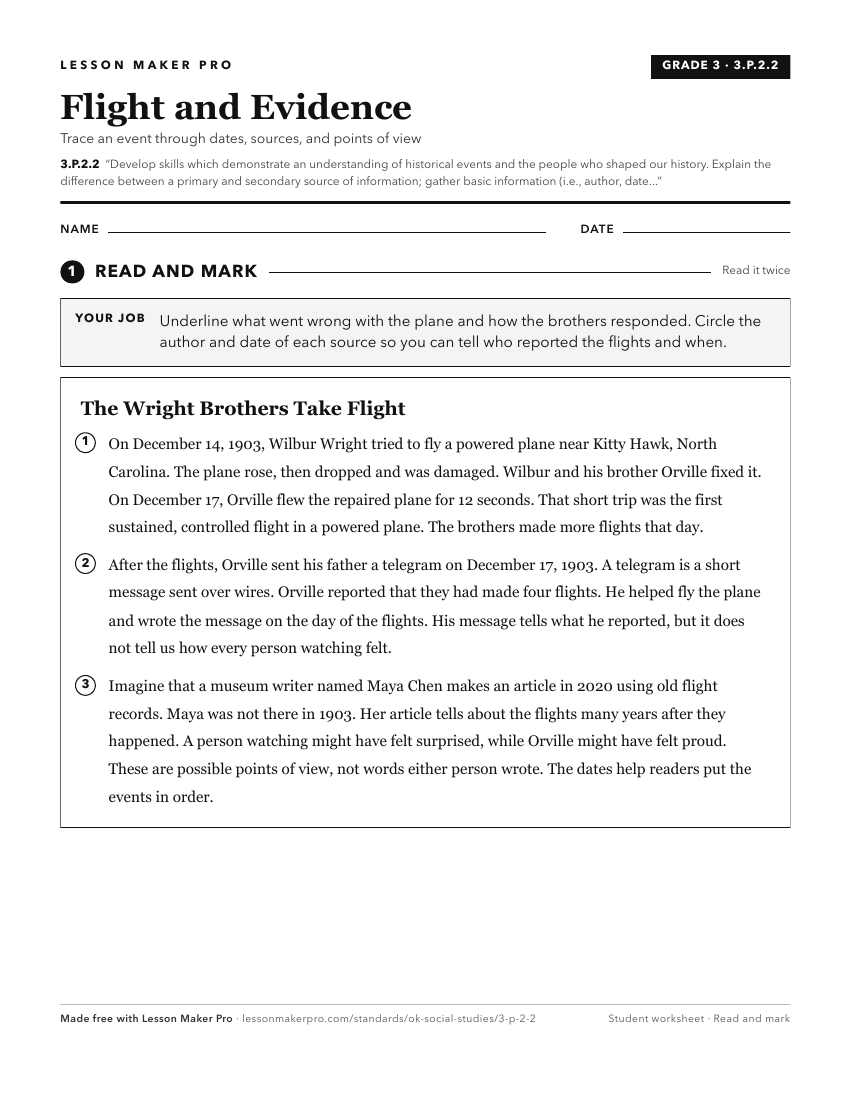
A ready-to-print activity worksheet aligned to 3.P.2.2, with an answer key for the teacher on its own page. No account needed.
PDF, US Letter, prints cleanly in black and white.
Download the worksheetKeep exploring
Related Standards
Turn this cluster into a lesson
Grade, subject, topic, and the complete cluster are prefilled. Create one free, no account needed.
Also for this cluster:Make a WorksheetMake a QuizMake a Sub Lesson