Oklahoma Social Studies 3.C.4
Standard Cluster
Identify and describe basic economic activities creating prosperity for the state. Describe the features of a market economic system. Explain how citizens make their own decisions about what goods or services are produced, and what is purchased, using examples from the local community. Describe how the laws of supply and demand impact people's choices about producing and consuming goods and services. Examine how entrepreneurs have contributed to the state’s economy. Explain how labor (human effort), land (natural resources), and capital (tools, machinery, technology) are used to produce goods and services. Describe how notable Oklahoma entrepreneurs (e.g., Gordon and May Lillie, O.W. Gurley, Frank Philips, Tom and Judy Love, Bill Braum) used their labor, land, and capital to build businesses and make a difference in their communities and the state. Describe the importance of Oklahoma’s goods and services to the state’s economic growth. Explain how Oklahoma’s oil and gas discoveries (e.g., the Glenn Pool and Oklahoma City Oil Field), affected the economic well-being of many Oklahomans and continue to be a significant economic sector. Examine how the development of recent economic activities has contributed to the state’s economy, identifying examples of goods and services provided by local businesses and industries (e.g., commercial agriculture, manufacturing, tourism, Tribal enterprises, and military installations). Describe how the state’s economy is connected to national and international trade by identifying major exports originating from Oklahoma (e.g., oil, aircraft, beef, wheat).
Oklahoma Academic Standards for Social Studies (2026)
Cluster contents
Standards in This Cluster
3.C.4 is a cluster heading. These are the individual standards under it.
- 3.C.4.1
Describe the features of a market economic system.
- 3.C.4.1.A
Explain how citizens make their own decisions about what goods or services are produced, and what is purchased, using examples from the local community.
- 3.C.4.1.B
Describe how the laws of supply and demand impact people's choices about producing and consuming goods and services.
- 3.C.4.2
Examine how entrepreneurs have contributed to the state’s economy.
- 3.C.4.2.A
Explain how labor (human effort), land (natural resources), and capital (tools, machinery, technology) are used to produce goods and services.
- 3.C.4.2.B
Describe how notable Oklahoma entrepreneurs (e.g., Gordon and May Lillie, O.W. Gurley, Frank Philips, Tom and Judy Love, Bill Braum) used their labor, land, and...
- 3.C.4.3
Describe the importance of Oklahoma’s goods and services to the state’s economic growth.
- 3.C.4.3.A
Explain how Oklahoma’s oil and gas discoveries (e.g., the Glenn Pool and Oklahoma City Oil Field), affected the economic well-being of many Oklahomans and conti...
- 3.C.4.3.B
Examine how the development of recent economic activities has contributed to the state’s economy, identifying examples of goods and services provided by local b...
- 3.C.4.3.C
Describe how the state’s economy is connected to national and international trade by identifying major exports originating from Oklahoma (e.g., oil, aircraft, b...
Teacher's field guide
What This Cluster Means
What Students Need to Do
- Students explain how local businesses choose what to make and how customers choose what to buy. They identify workers, natural resources, and tools used to make goods or provide services. They connect Oklahoma businesses, oil, farms, and trade to jobs and income.
What Mastery Looks Like
- A student can trace Oklahoma wheat from farm workers, soil, and tractors to a buyer in another state. They can explain why a bakery might make more bread when customers want more. They can describe how O.W. Gurley's businesses gave Tulsa residents places to work and shop.
Common Misconceptions
- Students may think a business owner decides what customers must buy. They may call a tractor a natural resource or overlook services because no object is sold. They may assume oil discoveries helped every Oklahoman equally or that Oklahoma products are sold only in Oklahoma.
How to Assess It
- Exit ticket: A Tulsa bakery sells out of bread made with Oklahoma wheat. Name the labor, land, and capital used to make it, then explain what the owner might do if more customers want bread.
Lesson moves
Ways to Teach It
Give groups wheat kernels, toy tractors, and paper ovens; have students play bakers and label land, labor, and capital.
Write 'O.W. Gurley opened businesses in Greenwood' on the board; ask how those businesses gave neighbors jobs and places to shop.
Give 15 buyers play money and auction 10 bread cards, then auction 20; compare prices and explain the change.
Check an Oklahoma beef seller's shipping page for an out-of-state destination, then name two Oklahoma jobs supported by a beef sale.
Free download
Printable 3.C.4 Worksheet
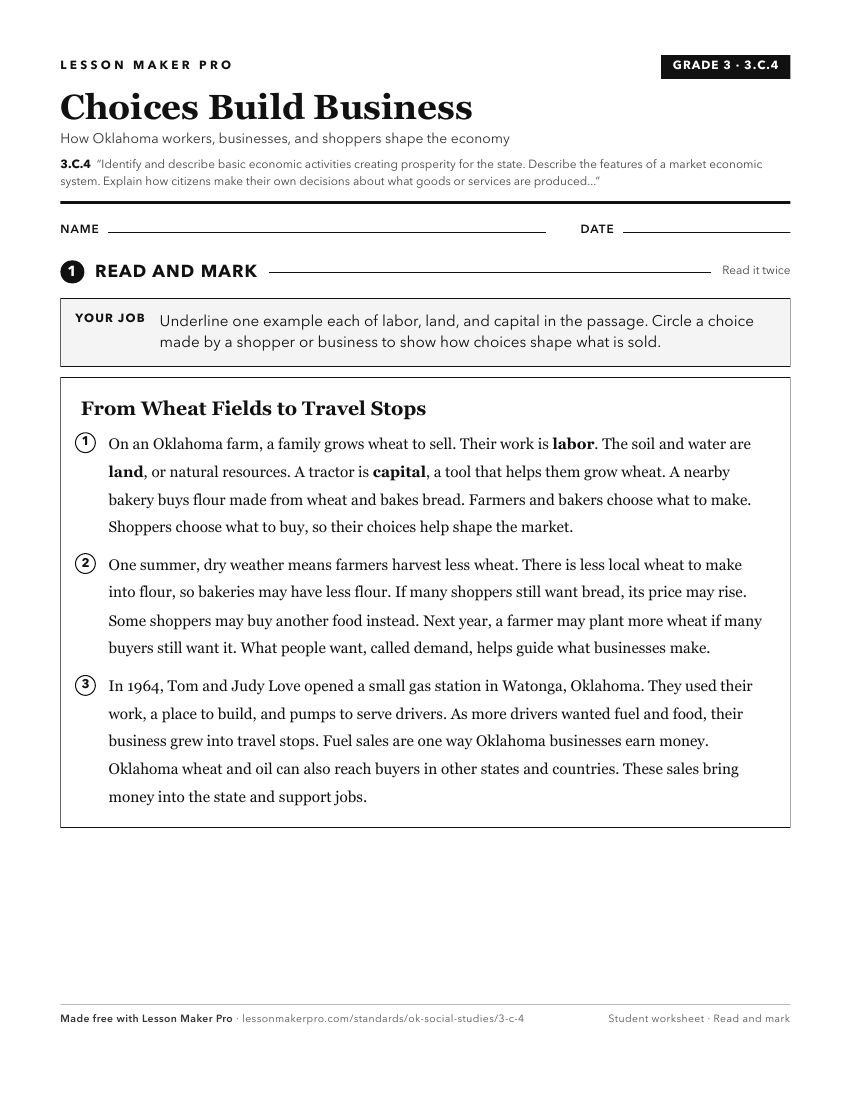
A ready-to-print activity worksheet aligned to 3.C.4, with an answer key for the teacher on its own page. No account needed.
PDF, US Letter, prints cleanly in black and white.
Download the worksheetKeep exploring
Related Standards
Turn this cluster into a lesson
Grade, subject, topic, and the complete cluster are prefilled. Create one free, no account needed.
Also for this cluster:Make a WorksheetMake a QuizMake a Sub Lesson