Oklahoma Science EN.ESS2.4
The Standard
Analyze and interpret data to explore how variations in the flow of energy into and out of Earth’s systems cause changes to the atmosphere and climate.
Oklahoma Academic Standards for Science (2026)
Teacher's field guide
What This Standard Means
What Students Need to Do
- Students read tables and graphs of incoming sunlight, reflected sunlight, outgoing infrared radiation, and temperature. They calculate when Earth gains or loses energy and connect that change to warming or cooling over time.
What Mastery Looks Like
- Given energy measurements, students subtract total outgoing energy from incoming energy and predict a temperature trend. They use graph evidence to explain how more reflection or less outgoing infrared changes that trend.
Common Misconceptions
- Students may count reflected sunlight as energy Earth keeps, or think greenhouse gases create heat rather than reduce the energy escaping to space. They may treat one cold day as proof that the climate is cooling.
How to Assess It
- Exit ticket: A satellite records 340 W/m² incoming and 339 W/m² outgoing, including reflected sunlight and infrared radiation. Does Earth gain or lose energy, by how much, and what long-term temperature change would you expect?
Lesson moves
Ways to Teach It
Give pairs 100 counters for incoming sunlight; move 30 to reflected, 65 to outgoing heat, and 5 to stored energy.
Ask: 'If snow cover shrinks, what happens to reflected sunlight and stored energy?' Have students explain with an energy-budget sketch.
Give groups incoming/outgoing energy cards marked 340/339, 340/341, and 340/340 W/m²; sort them into warming, cooling, and balanced piles.
Plot NOAA temperature anomalies from 1990 to 1994 and mark the 1991 Mount Pinatubo eruption; discuss how volcanic particles reflect sunlight.
Free download
Printable EN.ESS2.4 Worksheet
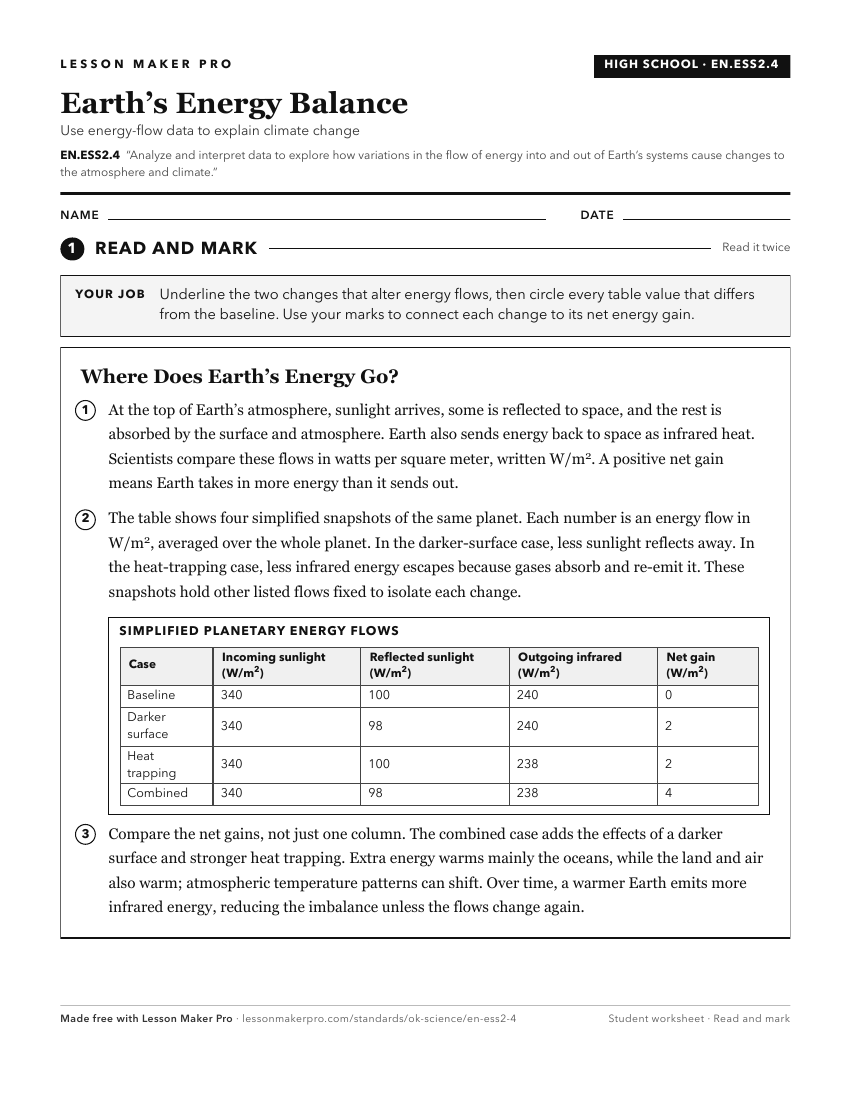
A ready-to-print activity worksheet aligned to EN.ESS2.4, with an answer key for the teacher on its own page. No account needed.
PDF, US Letter, prints cleanly in black and white.
Download the worksheetKeep exploring
Related Standards
- 6.ESS2.6
Develop or modify a model to describe how unequal heating and rotation of the Earth causes patterns of atmospheric and oceanic circulation that determine region...
- EN.ESS2.2
Analyze geoscience data to make the claim that one change to Earth’s surface can create feedback and interactions that cause changes to other Earth systems.
- ES.ESS2.2
Analyze geoscience data to make the claim that one change to Earth’s surface can create feedback and interactions that cause changes to other Earth systems.
- ES.ESS2.4
Analyze and interpret data to explore how variations in the flow of energy into and out of Earth’s systems cause changes to the atmosphere and climate.
Turn this exact standard into a lesson
Grade, subject, topic, and the complete standard are prefilled. Create one free, no account needed.
Also for this standard:Make a WorksheetMake a QuizMake a Sub Lesson