Oklahoma Science 6.ESS2.6
The Standard
Develop or modify a model to describe how unequal heating and rotation of the Earth causes patterns of atmospheric and oceanic circulation that determine regional climates.
Oklahoma Academic Standards for Science (2026)
Teacher's field guide
What This Standard Means
What Students Need to Do
- Students build or revise a diagram showing how stronger sunlight near the equator warms air and makes it rise. They show Earth's rotation bending winds and wind-driven surface currents. They use the diagram to explain regional temperature or rainfall.
What Mastery Looks Like
- A student can label rising and sinking air, curved wind paths, and wind-driven surface currents on a globe sketch. They can explain why a coast beside a warm current tends to be warmer than one beside a cold current.
Common Misconceptions
- Students may think the equator is warmer because it is closer to the Sun, rather than because sunlight hits it more directly. They may draw winds and currents moving straight north or south, leaving out the effect of Earth's rotation. Some show surface currents with no link to wind.
How to Assess It
- Give students a blank globe sketch. Ask them to draw and label how uneven sunlight and Earth's rotation affect wind and a surface current, then explain how the current affects a nearby coast.
Lesson moves
Ways to Teach It
Shine a flashlight on a globe at the equator and near a pole; compare the light patches, then add rising and sinking air arrows.
Ask, 'Why might two coasts at the same latitude have different temperatures?' Have students use a current map to support their answers.
Race pairs to place wind and surface-current arrows on a globe map; award points for showing curved paths and wind pushing water.
Check a map of the California Current and Gulf Stream, then mark which nearby coast each current tends to cool or warm.
Free download
Printable 6.ESS2.6 Worksheet
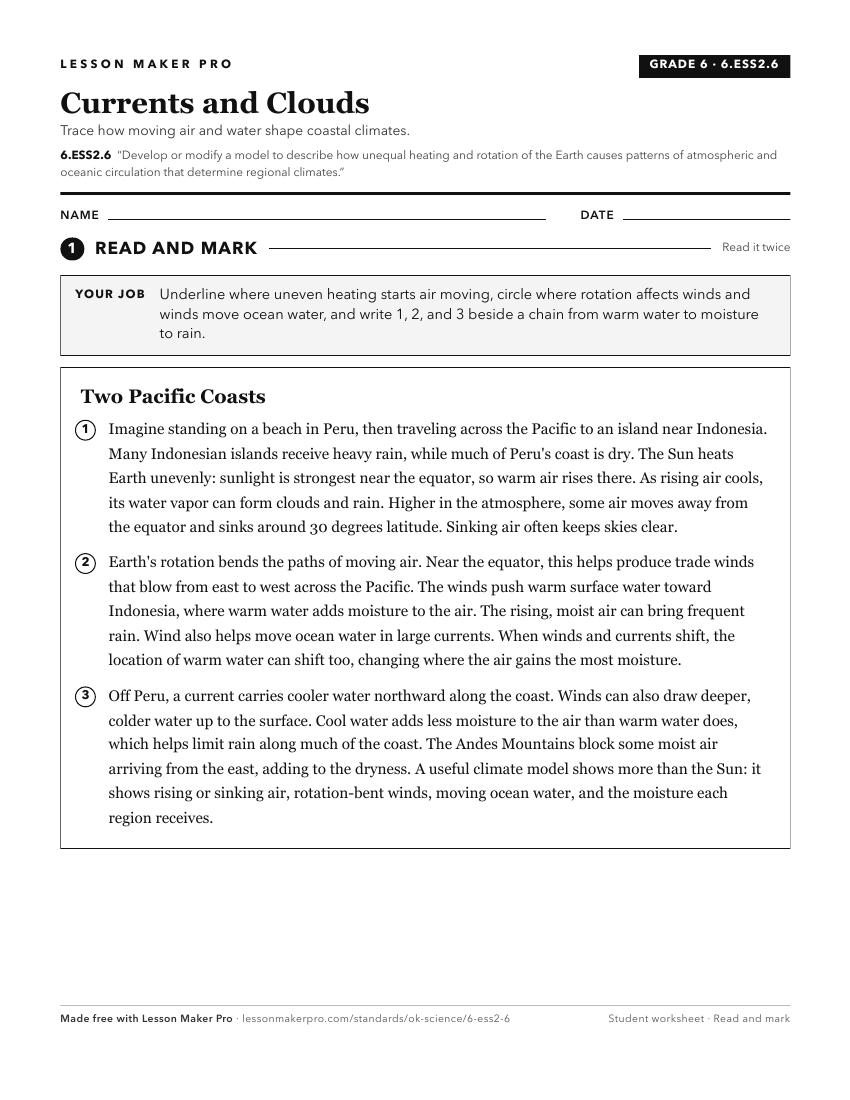
A ready-to-print activity worksheet aligned to 6.ESS2.6, with an answer key for the teacher on its own page. No account needed.
PDF, US Letter, prints cleanly in black and white.
Download the worksheetKeep exploring
Related Standards
- EN.ESS2.4
Analyze and interpret data to explore how variations in the flow of energy into and out of Earth’s systems cause changes to the atmosphere and climate.
- 6.ESS2.1
Develop and revise a model to describe the cycling of Earth’s materials and the flow of energy that drives these processes within and among Earth’s systems.
- ES.ESS2.4
Analyze and interpret data to explore how variations in the flow of energy into and out of Earth’s systems cause changes to the atmosphere and climate.
Turn this exact standard into a lesson
Grade, subject, topic, and the complete standard are prefilled. Create one free, no account needed.
Also for this standard:Make a WorksheetMake a QuizMake a Sub Lesson