Oklahoma Math PC.T.1
Standard Cluster
Make sense of the unit circle and its relationship to the graphs of trigonometric functions. Draw and recognize angles in standard position using radian measure, and determine the quadrant of the terminal side. Convert radian measure to degree measure and vice-versa. Find the length of an arc and the area of a sector on a circle. Use special triangles to determine geometrically the values of sine, cosine, tangent for π/3, π/4, and π/6, and use the unit circle to express the values of sine, cosine, and tangent for π − x, π + x, and 2π − x in terms of their values for x, where x is any real number. Use reference angles to determine the terminal point P (x, y) on the unit circle for a given angle. Estimate trigonometric values of any angle. Apply the properties of a unit circle to explain symmetry (odd and even) and periodicity of trigonometric functions. Graph all six trigonometric functions, identifying key features. Describe and analyze the relationships of the properties of a unit circle.
Oklahoma Academic Standards for Mathematics (2022)
Cluster contents
Standards in This Cluster
PC.T.1 is a cluster heading. These are the individual standards under it.
- PC.T.1.1
Draw and recognize angles in standard position using radian measure, and determine the quadrant of the terminal side.
- PC.T.1.2
Convert radian measure to degree measure and vice-versa.
- PC.T.1.5
Use reference angles to determine the terminal point P(x, y) on the unit circle for a given angle.
- PC.T.1.6
Estimate trigonometric values of any angle.
- PC.T.1.8
Graph all six trigonometric functions, identifying key features.
- PC.T.1.9
Describe and analyze the relationships of the properties of a unit circle.
Teacher's field guide
What This Cluster Means
What Students Need to Do
- Students draw angles in standard position, name their quadrants, and convert between degrees and radians. They use reference angles to find unit-circle points, estimate trig values, and calculate arc lengths and sector areas. They connect the circle to all six trig graphs, including symmetry, repeats, and undefined values.
What Mastery Looks Like
- Given 5π/6, a student finds the reference angle and the unit-circle point (−√3/2, 1/2). They use circle values to sketch all six trig graphs with correct periods, symmetry, zeros, and asymptotes where needed. They calculate arc length and sector area from a radius and radian angle.
Common Misconceptions
- Students use degrees in arc-length formulas that need radians, or put 5π/6 in the first quadrant. They swap x and y when reading cosine and sine. They draw tangent through angles where cosine is zero instead of marking an asymptote.
How to Assess It
- Exit ticket: Mark 5π/6 on the unit circle, give its coordinates, and plot the matching point on y = sin x. For a circle of radius 6, find the arc length and sector area for that angle.
Lesson moves
Ways to Teach It
Wrap string around a paper circle, mark quarter turns in radians, and plot each marked point’s y-coordinate on a sine graph.
Ask: Why do sin(−θ) and sin(θ) have opposite signs, while cos(−θ) and cos(θ) match? Use reflected unit-circle points.
Hand out angle cards such as 5π/6 and 7π/6; students race to place terminal points and name reference angles.
Use a Ferris wheel diagram with a 10-meter radius; find the arc traveled through π/3 radians and the matching sector area.
Free download
Printable PC.T.1 Worksheet
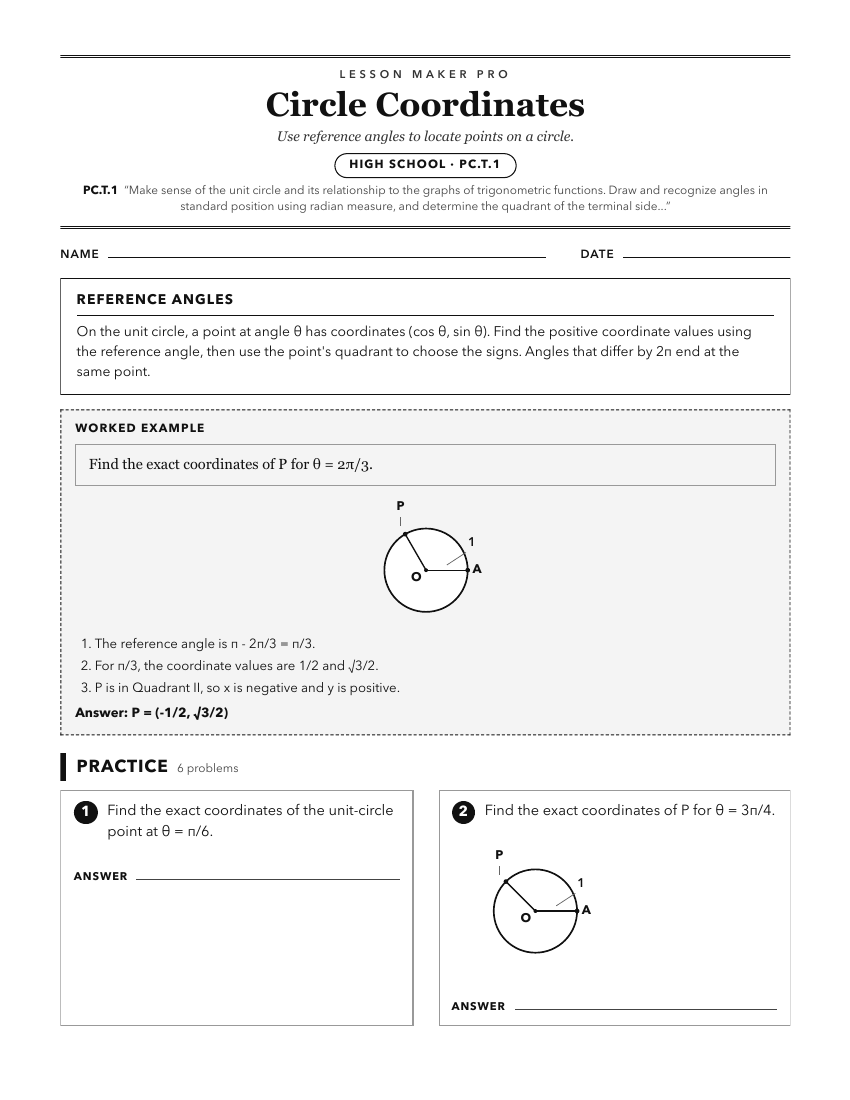
A ready-to-print activity worksheet aligned to PC.T.1, with an answer key for the teacher on its own page. No account needed.
PDF, US Letter, prints cleanly in black and white.
Download the worksheetKeep exploring
Related Standards
Turn this cluster into a lesson
Grade, subject, topic, and the complete cluster are prefilled. Create one free, no account needed.
Also for this cluster:Make a WorksheetMake a QuizMake a Sub Lesson