Oklahoma Math PC.T.1.1
The Standard
- PC.T.1
- Make sense of the unit circle and its relationship to the graphs of trigonometric functions.
Draw and recognize angles in standard position using radian measure, and determine the quadrant of the terminal side.
Oklahoma Academic Standards for Mathematics (2022)
Teacher's field guide
What This Standard Means
What Students Need to Do
- Students draw angles starting on the positive x-axis. They turn counterclockwise for positive radians and clockwise for negative radians, then name the quadrant where the angle ends. They also recognize when an angle ends on an axis.
What Mastery Looks Like
- Given 7π/6 or -π/4, a student sketches the angle and names quadrant III or IV. They can read a sketch and give a matching radian angle. They know a side on an axis is not in any quadrant.
Common Misconceptions
- Some students start on the positive y-axis instead of the positive x-axis. Others turn negative angles counterclockwise or place a side that lands on an axis in a quadrant. They may stop at 2π instead of continuing past one full turn.
How to Assess It
- Ask students to sketch -5π/4, show the direction of rotation, and name the quadrant where the angle ends.
Lesson moves
Ways to Teach It
Mark π/2, π, and 3π/2 on a paper circle, then rotate a fastened paper arrow from the positive x-axis to each mark.
Ask, “Why is the terminal side of -π/2 on an axis rather than in a quadrant?” Have partners sketch and explain.
Give pairs cards labeled π/4, 5π/4, -π/4, and 2π, and have them sort by quadrant or axis.
Draw coordinate axes on a clock face; start at 3 o’clock and trace -π/2 to show a quarter-turn clockwise.
Free download
Printable PC.T.1.1 Worksheet
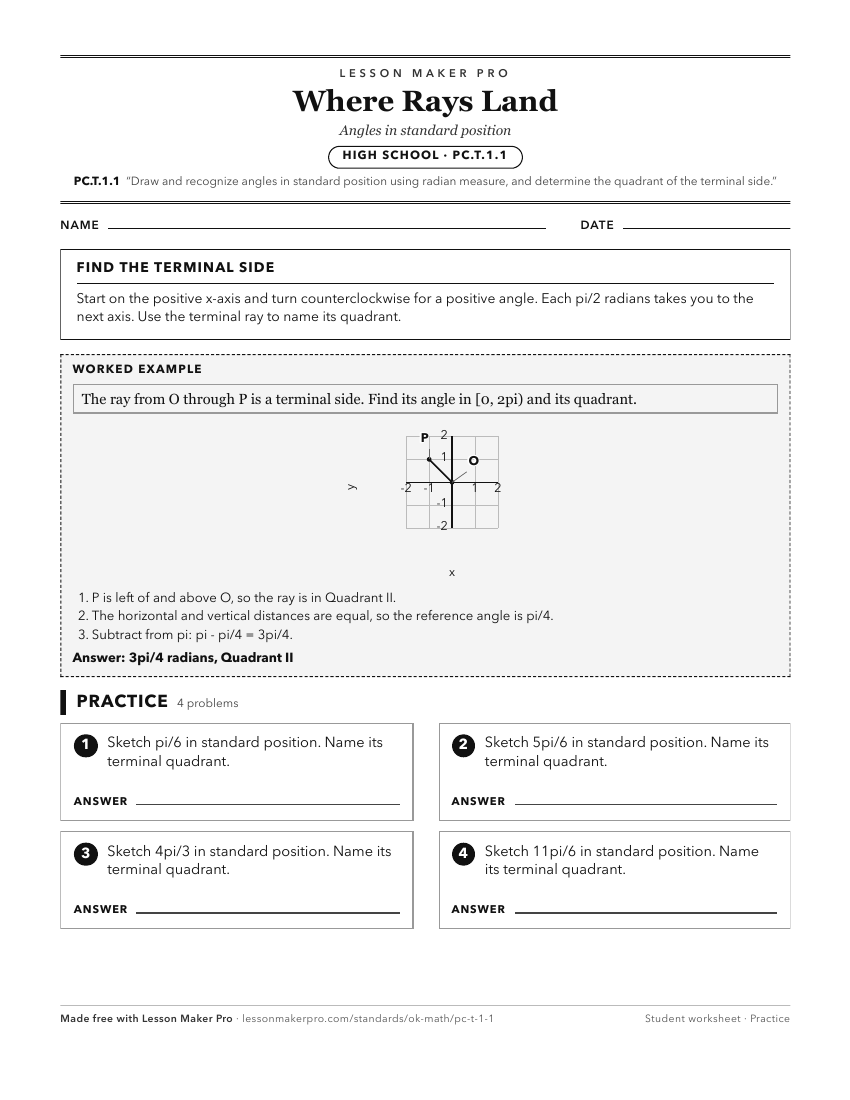
A ready-to-print activity worksheet aligned to PC.T.1.1, with an answer key for the teacher on its own page. No account needed.
PDF, US Letter, prints cleanly in black and white.
Download the worksheetKeep exploring
Related Standards
- PC.T.1.2
Convert radian measure to degree measure and vice-versa.
- PC.T.1.5
Use reference angles to determine the terminal point P(x, y) on the unit circle for a given angle.
- 4.GM.2.1
Measure angles in geometric figures and real-world objects with a protractor or angle ruler.
- 6.GM.3
Understand and use relationships between angles in geometric figures.
Turn this exact standard into a lesson
Grade, subject, topic, and the complete standard are prefilled. Create one free, no account needed.
Also for this standard:Make a WorksheetMake a QuizMake a Sub Lesson