Oklahoma Math PC.T.1.9
The Standard
- PC.T.1
- Make sense of the unit circle and its relationship to the graphs of trigonometric functions.
Describe and analyze the relationships of the properties of a unit circle.
Oklahoma Academic Standards for Mathematics (2022)
Teacher's field guide
What This Standard Means
What Students Need to Do
- Students locate angles on a circle with radius 1 and read the point's x and y coordinates. They use those coordinates to find cosine and sine values and connect them to the graphs.
What Mastery Looks Like
- Given 5π/6, a student finds the point (−√3/2, 1/2) and explains why its x-coordinate is negative. They can plot the matching values on sine and cosine graphs.
Common Misconceptions
- Students may swap sine and cosine, or assume both coordinates are positive in every quadrant. Some think a full turn gives a new value instead of returning to the same point.
How to Assess It
- Exit ticket: Mark 2π/3 on a unit circle, give its coordinates, and plot the matching point on each of the sine and cosine graphs.
Lesson moves
Ways to Teach It
Give pairs a unit circle drawn on graph paper and a protractor; have them mark 60° and estimate its x and y coordinates.
Ask: Why do 30° and 150° have the same sine value but different cosine values? Use a circle sketch to explain.
Play a matching game with cards showing angles, unit circle coordinates, and points on sine and cosine graphs.
Sketch a Ferris wheel with a 1-meter radius and center 2 meters high; calculate seat height at 0°, 90°, 180°, and 270°.
Free download
Printable PC.T.1.9 Worksheet
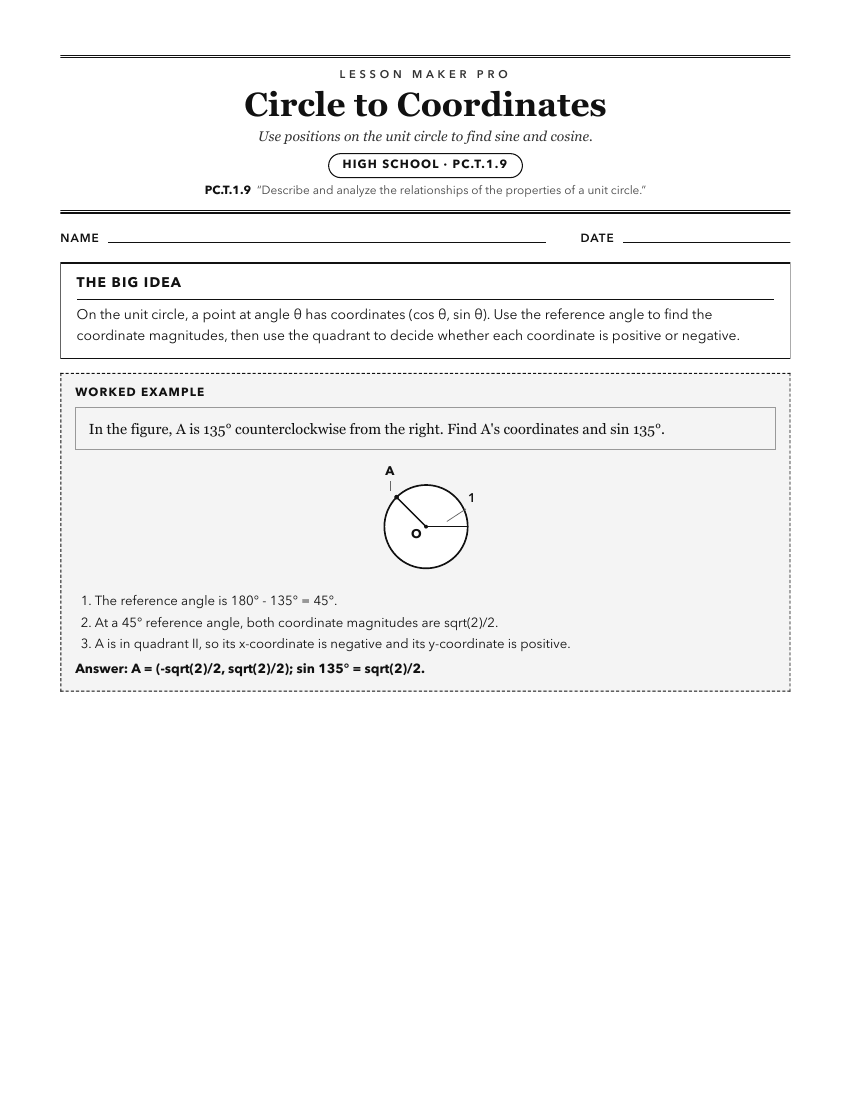
A ready-to-print activity worksheet aligned to PC.T.1.9, with an answer key for the teacher on its own page. No account needed.
PDF, US Letter, prints cleanly in black and white.
Download the worksheetKeep exploring
Related Standards
- PC.T.1
Make sense of the unit circle and its relationship to the graphs of trigonometric functions.
- G.C.1
Solve real-world and mathematical problems using the properties of circles.
- G.C.1.3
Apply the properties of circles and relationships among angles; arcs; and distances in a circle among radii, chords, secants, and tangents to solve problems usi...
Turn this exact standard into a lesson
Grade, subject, topic, and the complete standard are prefilled. Create one free, no account needed.
Also for this standard:Make a WorksheetMake a QuizMake a Sub Lesson