Oklahoma Math G.C.1
Standard Cluster
Solve real-world and mathematical problems using the properties of circles. Apply the properties of circles to solve problems involving circumference and area, using approximate values and in terms of pi, using algebraic and logical reasoning. Use the distance and midpoint formula, where appropriate, to recognize and write the radius r, center (h, k), and standard form of the equation of a circle (x − h)² + (y − k)² = r² with and without graphs. Apply the properties of circles and relationships among angles, arcs, and distances in a circle among radii, chords, secants, and tangents to solve problems using algebraic and logical reasoning.
Oklahoma Academic Standards for Mathematics (2022)
Cluster contents
Standards in This Cluster
G.C.1 is a cluster heading. These are the individual standards under it.
- G.C.1.1
Apply the properties of circles to solve problems involving circumference and area, using approximate values and in terms of pi, using algebraic and logical rea...
- G.C.1.2
Use the distance and midpoint formula, where appropriate, to recognize and write the radius r, center (h,k), and standard form of the equation of a circle (x - ...
- G.C.1.3
Apply the properties of circles and relationships among angles; arcs; and distances in a circle among radii, chords, secants, and tangents to solve problems usi...
Teacher's field guide
What This Cluster Means
What Students Need to Do
- Students calculate circumference and area, both with π and as decimals. They use coordinates to find a circle’s center and radius and write its equation. They use angles, arcs, chords, secants, and tangents to find missing measures.
What Mastery Looks Like
- Given diameter endpoints, a student finds the midpoint and radius, then writes the circle’s equation. They solve for an unknown angle or segment in a labeled diagram and explain the relationship they used. They give circumference and area in terms of π and as rounded decimals.
Common Misconceptions
- Students use the diameter as the radius or square the radius when finding circumference. They use the wrong signs for the center in a circle equation or write r instead of r². They confuse central and inscribed angles or miss that a tangent is perpendicular to the radius at the point of contact.
How to Assess It
- Exit ticket: A circle has diameter endpoints (-2, 1) and (4, 9). Find its center, radius, equation, and circumference in terms of π.
Lesson moves
Ways to Teach It
Measure the circumference and diameter of three round lids with string and a ruler, then divide each circumference by its diameter.
Ask students why a circle centered at (2, -3) through (5, 1) has 25, not 5, on the equation’s right side.
Pairs solve cards showing an inscribed angle intercepting a 100° arc, intersecting chords labeled 3, 4, 6, x, and a tangent-radius angle.
Give students a park map with a circular pond of radius 12 m; have them find the fencing length and surface area.
Free download
Printable G.C.1 Worksheet
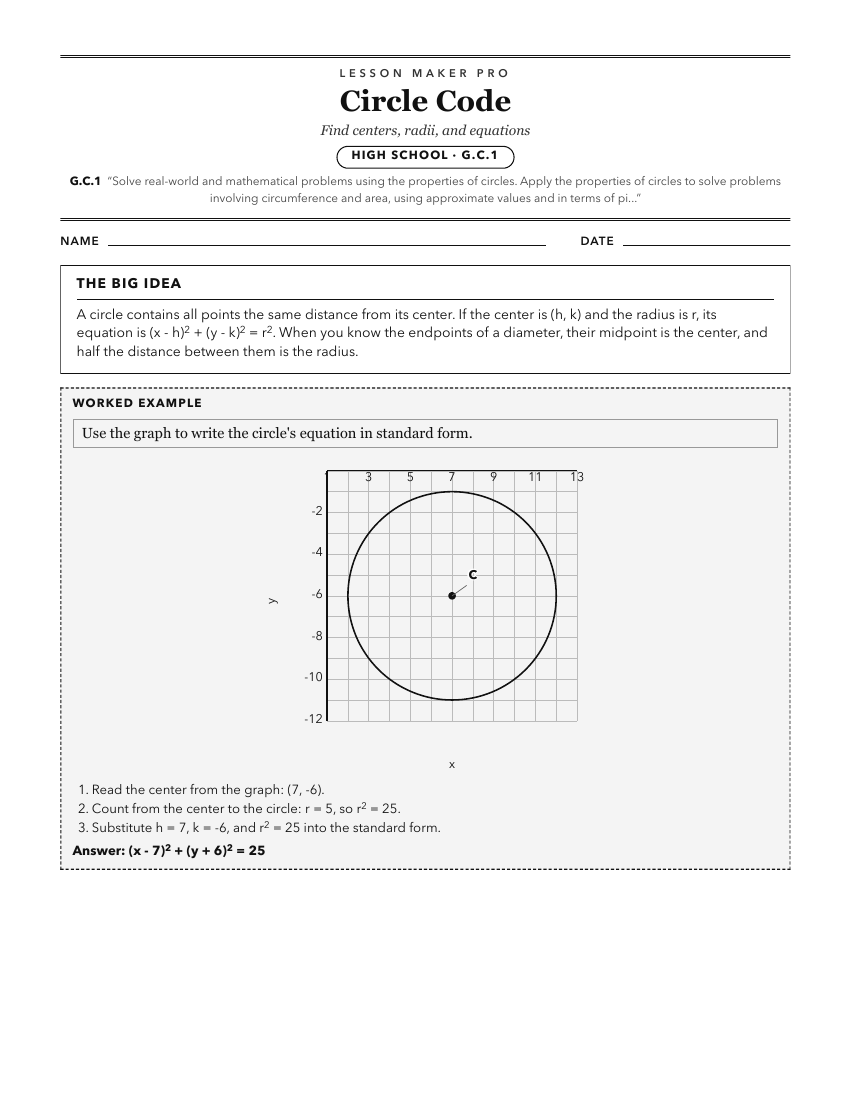
A ready-to-print activity worksheet aligned to G.C.1, with an answer key for the teacher on its own page. No account needed.
PDF, US Letter, prints cleanly in black and white.
Download the worksheetKeep exploring
Related Standards
Turn this cluster into a lesson
Grade, subject, topic, and the complete cluster are prefilled. Create one free, no account needed.
Also for this cluster:Make a WorksheetMake a QuizMake a Sub Lesson