Oklahoma Math G.3D.1
Standard Cluster
Solve real-world and mathematical problems involving three-dimensional figures. Represent, use, and apply mathematical models and other tools (e.g., nets, measuring devices, formulas) to solve problems involving surface area and volume of three-dimensional figures (prisms, cylinders, pyramids, cones, spheres, composites of these figures). Use ratios derived from similar three-dimensional figures to make conjectures, generalize, and to solve for unknown values such as angles, side lengths, perimeter, and circumference of a face, area of a face, and volume.
Oklahoma Academic Standards for Mathematics (2022)
Cluster contents
Standards in This Cluster
G.3D.1 is a cluster heading. These are the individual standards under it.
- G.3D.1.1
Represent, use, and apply mathematical models and other tools (e.g., nets, measuring devices, formulas) to solve problems involving surface area and volume of t...
- G.3D.1.2
Use ratios derived from similar three-dimensional figures to make conjectures, generalize, and to solve for unknown values such as angles, side lengths, perimet...
Teacher's field guide
What This Cluster Means
What Students Need to Do
- Students use nets, measurements, and formulas to find surface area and volume for prisms, cylinders, pyramids, cones, spheres, and combined solids. They use similarity to find missing lengths, face perimeters, circumferences, face areas, and volumes. They recognize that matching angles stay equal.
What Mastery Looks Like
- For a cylinder topped with a cone, a student adds the volumes but leaves the shared circle out of the outside surface area. Given a scale factor of 3, they multiply lengths and circumferences by 3, areas by 9, and volumes by 27. They keep matching angles equal.
Common Misconceptions
- Students may use diameter as radius or slant height as the height in a volume formula. They may count a shared face as outside surface. They may scale areas and volumes like lengths, or think angles change when a solid is enlarged.
How to Assess It
- Exit ticket: A cylinder with radius 3 cm and height 4 cm has a cone with the same radius and height on top. Find its outside surface area and volume, then tell how each changes if every length doubles.
Lesson moves
Ways to Teach It
Cut and fold paper nets of a rectangular prism and cylinder, measure them, and calculate each figure's surface area and volume.
Ask: Two similar cones have radii of 2 cm and 6 cm. How do their surface areas and volumes compare? Explain.
Give pairs cards showing solids and their dimensions; have them match each card to a surface area or volume calculation.
Measure a cereal box and soup can with a ruler, then estimate the material needed to make each and how much each holds.
Free download
Printable G.3D.1 Worksheet
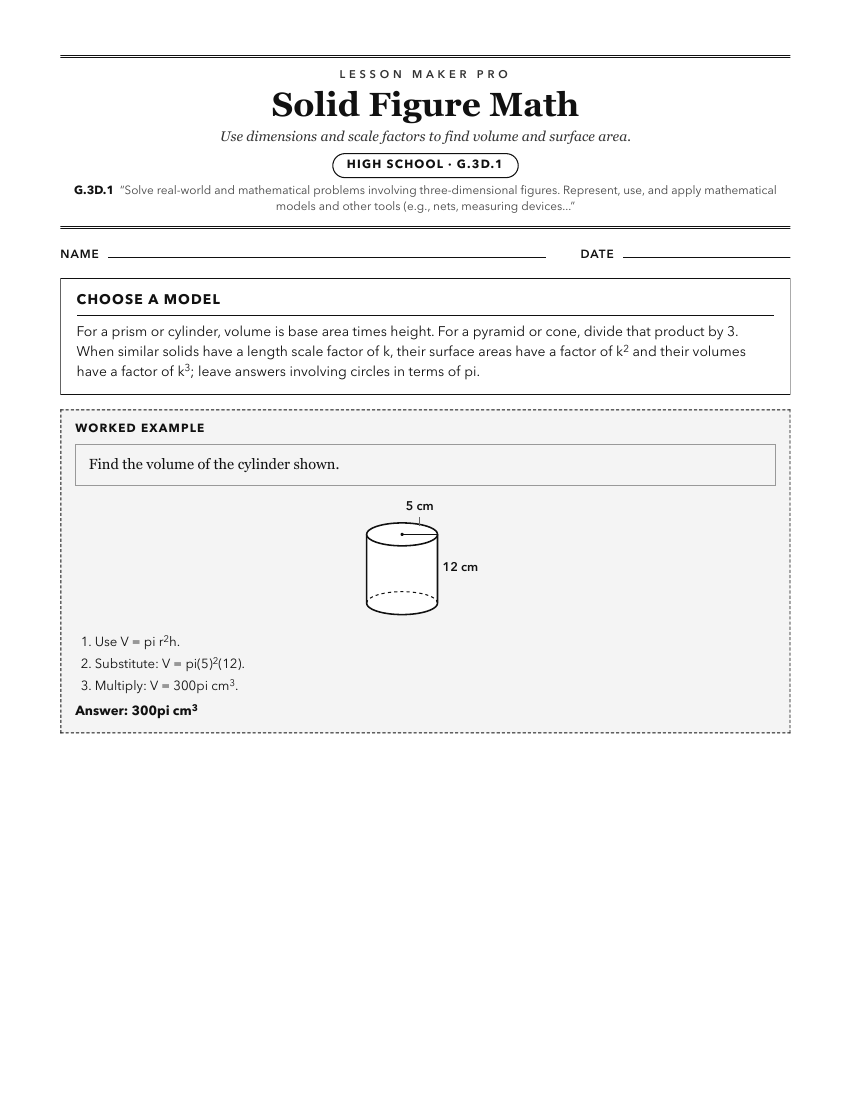
A ready-to-print activity worksheet aligned to G.3D.1, with an answer key for the teacher on its own page. No account needed.
PDF, US Letter, prints cleanly in black and white.
Download the worksheetKeep exploring
Related Standards
- 3.N.2
Solve real-world and mathematical problems using addition, subtraction, multiplication, and division.
- 2.GM.1
Analyze attributes of two- and three-dimensional figures and develop generalizations about their properties.
- PA.GM.2
Justify and use formulas to calculate surface area and volume of three-dimensional figures.
Turn this cluster into a lesson
Grade, subject, topic, and the complete cluster are prefilled. Create one free, no account needed.
Also for this cluster:Make a WorksheetMake a QuizMake a Sub Lesson