Oklahoma Math 2.GM.1
Standard Cluster
Analyze attributes of two- and three-dimensional figures and develop generalizations about their properties. Recognize regular and irregular trapezoids and hexagons. Describe, compare, and classify two-dimensional figures according to their geometric attributes. Compose and decompose two-dimensional shapes using triangles, squares, hexagons, trapezoids, and rhombi. Sort three-dimensional shapes based on attributes such as number of faces, vertices, and edges. Recognize right angles and classify angles as smaller or larger than a right angle.
Oklahoma Academic Standards for Mathematics (2022)
Cluster contents
Standards in This Cluster
2.GM.1 is a cluster heading. These are the individual standards under it.
- 2.GM.1.1
Recognize regular and irregular trapezoids and hexagons.
- 2.GM.1.2
Describe, compare, and classify two-dimensional figures according to their geometric attributes.
- 2.GM.1.3
Compose and decompose two-dimensional shapes using triangles, squares, hexagons, trapezoids, and rhombi.
- 2.GM.1.4
Sort three-dimensional shapes based on attributes such as number of faces, vertices, and edges.
- 2.GM.1.5
Recognize right angles and classify angles as smaller or larger than a right angle.
Teacher's field guide
What This Cluster Means
What Students Need to Do
- Students name and sort flat shapes by their sides and corners, including trapezoids and hexagons that do not look alike. They put flat shapes together and take them apart. They sort solid shapes by faces, edges, and vertices, and compare angles with a right angle.
What Mastery Looks Like
- A student can identify a sideways trapezoid and tell an even hexagon from one with unequal sides. They can build a hexagon from triangles, then show another way to make it. They can count a cube's faces, edges, and vertices and use a square corner to compare angles.
Common Misconceptions
- Students may think turning a trapezoid changes its name or that every hexagon has equal sides. They may count a solid's face as an edge. Some judge an angle by the length of its lines instead of how wide it opens.
How to Assess It
- Give students a sheet with a sideways trapezoid, an uneven hexagon split into triangles, a cube, and an angle narrower than a square corner. Ask them to name the flat shapes, count the triangles and the cube's faces, edges, and vertices, then compare the angle with a right angle.
Lesson moves
Ways to Teach It
Give pairs pattern blocks; build a hexagon from triangles, then make the same outline using two trapezoids or three rhombi.
Show a sideways trapezoid and an uneven hexagon; ask, "How do you know what each shape is?"
Play mystery solid with cube and prism models; give the number of faces, edges, and vertices as clues.
Use a square paper corner to check whether open scissors and a partly open door make angles smaller or larger than a right angle.
Free download
Printable 2.GM.1 Worksheet
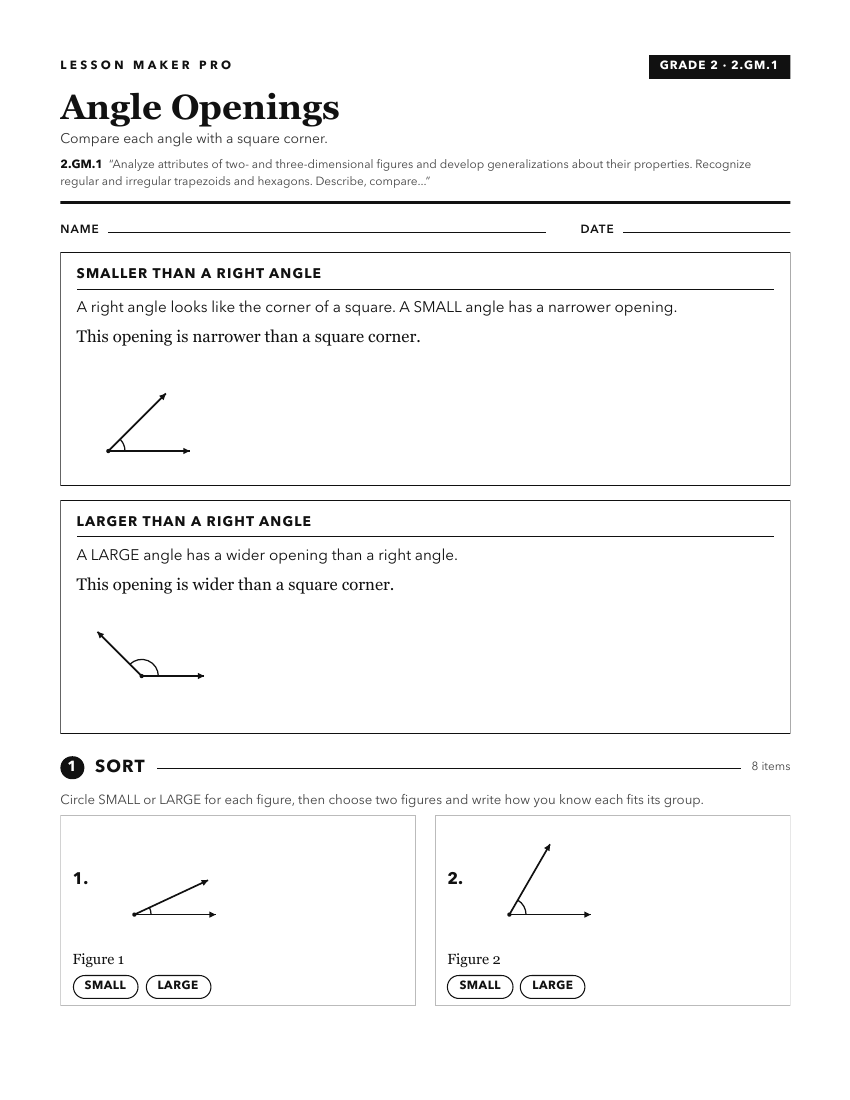
A ready-to-print activity worksheet aligned to 2.GM.1, with an answer key for the teacher on its own page. No account needed.
PDF, US Letter, prints cleanly in black and white.
Download the worksheetKeep exploring
Related Standards
- 5.GM.1
Describe, identify, classify, and construct two- and three-dimensional figures using their geometric attributes.
- 3.GM.1
Analyze and use geometric attributes to describe and create polygons and three-dimensional figures in various contexts.
- 4.GM.1.3
Given two three-dimensional shapes, identify each shape. Compare and contrast their similarities and differences based on their attributes.
Turn this cluster into a lesson
Grade, subject, topic, and the complete cluster are prefilled. Create one free, no account needed.
Also for this cluster:Make a WorksheetMake a QuizMake a Sub Lesson