Oklahoma Math 5.GM.1
Standard Cluster
Describe, identify, classify, and construct two- and three-dimensional figures using their geometric attributes. Describe, identify, classify, and construct triangles (equilateral, right, scalene, isosceles) by their attributes using various mathematical models. Describe, identify, and classify three-dimensional figures (cubes, rectangular prisms, and pyramids) and their attributes (number of edges, faces, vertices, shapes of faces), given various mathematical models. Recognize and draw a net for a three-dimensional figure (cube, rectangular prism, pyramid).
Oklahoma Academic Standards for Mathematics (2022)
Cluster contents
Standards in This Cluster
5.GM.1 is a cluster heading. These are the individual standards under it.
- 5.GM.1.1
Describe, identify, classify, and construct triangles (equilateral, right, scalene, isosceles) by their attributes using various mathematical models.
- 5.GM.1.2
Describe, identify, and classify three-dimensional figures (cubes, rectangular prisms, and pyramids) and their attributes (number of edges, faces, vertices, sha...
- 5.GM.1.3
Recognize and draw a net for a three-dimensional figure (cube, rectangular prism, pyramid).
Teacher's field guide
What This Cluster Means
What Students Need to Do
- Students draw and sort triangles by their sides and angles. They identify cubes, rectangular prisms, and pyramids by their faces, edges, and vertices. They draw flat nets that fold into these solids.
What Mastery Looks Like
- A student can draw a right isosceles triangle and explain both names. They can count a cube's 6 faces, 12 edges, and 8 vertices. They can draw a net that folds into a cube without overlapping faces.
Common Misconceptions
- Students may think a triangle can have only one name, so they miss right isosceles triangles. They may confuse faces with edges or count the same edge twice. They may think any six connected squares will fold into a cube.
How to Assess It
- Exit ticket: Draw a right isosceles triangle and mark the equal sides and right angle. Draw a cube net, then write how many faces, edges, and vertices the folded cube has.
Lesson moves
Ways to Teach It
Tape six paper squares into a cube, then tape a square and four triangles into a pyramid; count each solid's faces, edges, and vertices.
Show a right isosceles triangle on dot paper and ask, “Which two names fit, and what marks prove each name?”
Deal triangle cards with side lengths and marked angles; students place each card under every matching name and explain one double match.
Cut open a small empty cereal box along its edges, lay it flat, and sketch where its six faces meet.
Free download
Printable 5.GM.1 Worksheet
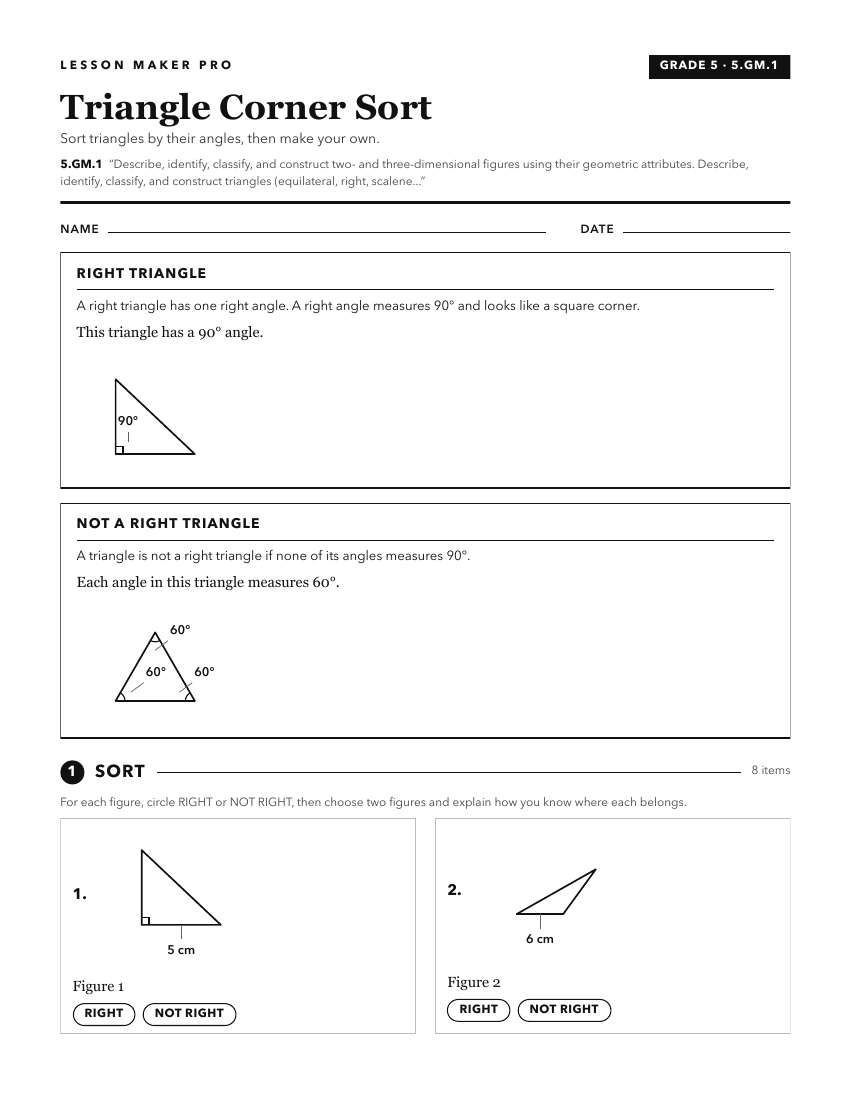
A ready-to-print activity worksheet aligned to 5.GM.1, with an answer key for the teacher on its own page. No account needed.
PDF, US Letter, prints cleanly in black and white.
Download the worksheetKeep exploring
Related Standards
- 2.GM.1.2
Describe, compare, and classify two-dimensional figures according to their geometric attributes.
- 4.GM.1
Name, describe, classify, and construct polygons and three-dimensional figures based on their attributes; recognize polygons and three-dimensional figures in re...
- 2.GM.1
Analyze attributes of two- and three-dimensional figures and develop generalizations about their properties.
Turn this cluster into a lesson
Grade, subject, topic, and the complete cluster are prefilled. Create one free, no account needed.
Also for this cluster:Make a WorksheetMake a QuizMake a Sub Lesson