Oklahoma Math 5.GM.1.2
The Standard
- 5.GM.1
- Describe, identify, classify, and construct two- and three-dimensional figures using their geometric attributes.
Describe, identify, and classify three-dimensional figures (cubes, rectangular prisms, and pyramids) and their attributes (number of edges, faces, vertices, shapes of faces), given various mathematical models.
Oklahoma Academic Standards for Mathematics (2022)
Teacher's field guide
What This Standard Means
What Students Need to Do
- Students use models to tell cubes, rectangular prisms, and pyramids apart. They count faces, edges, and vertices, then name the shapes of the faces.
What Mastery Looks Like
- A student finds 6 faces, 12 edges, and 8 vertices on a cube or rectangular prism. They find 5 faces, 8 edges, and 5 vertices on a square pyramid. They can explain that a cube is a rectangular prism with square faces.
Common Misconceptions
- Students may miss faces or edges hidden at the back or bottom of a drawing. They may assume every pyramid has a square base. Some think a cube cannot also be a rectangular prism.
How to Assess It
- Set out a die, a cereal box, and a square pyramid model. Ask students to name each solid, count its faces, edges, and vertices, and list its face shapes.
Lesson moves
Ways to Teach It
Pairs put sticky notes on the faces of a cube, cereal box, and square pyramid model, then tally edges and vertices.
Ask, "Why is a cube also a rectangular prism? What is special about its faces?"
Play Name That Solid: read face-shape clues while students hold up cube, cereal-box, or square-pyramid cards.
Compare a game die and a cereal box; students count their edges and vertices, then describe how their faces differ.
Free download
Printable 5.GM.1.2 Worksheet
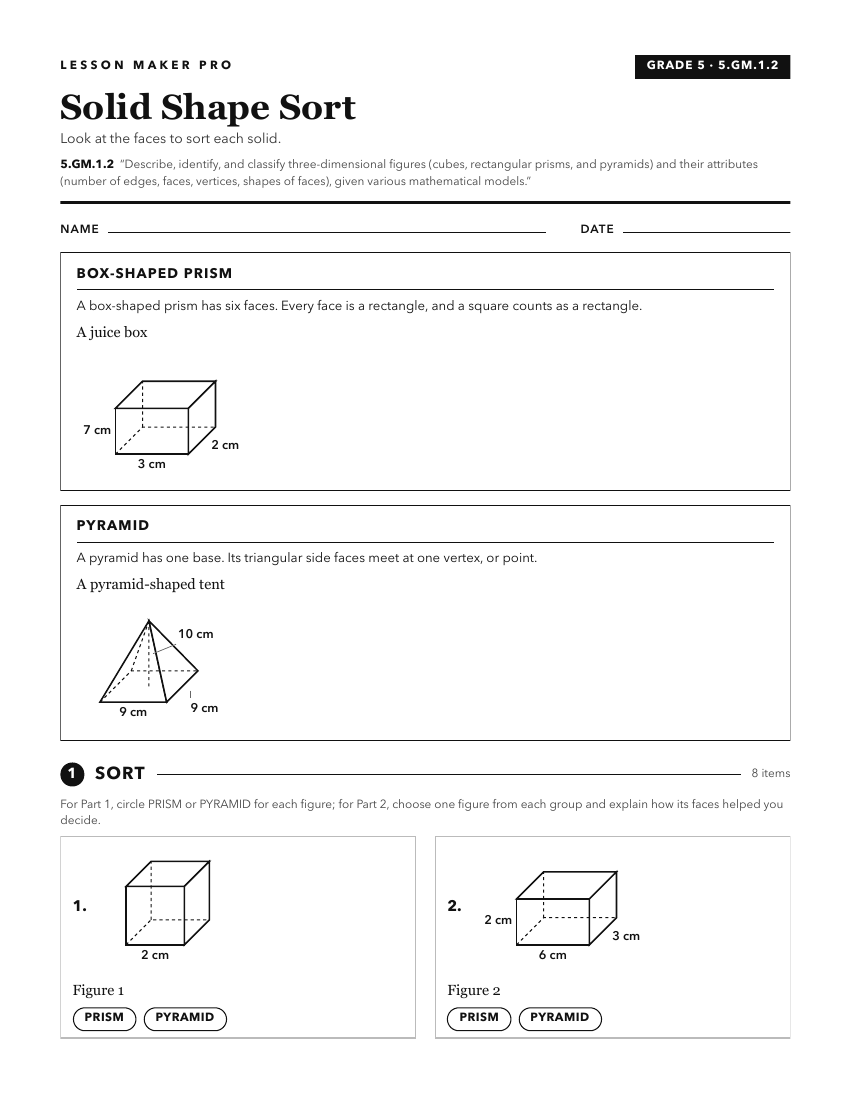
A ready-to-print activity worksheet aligned to 5.GM.1.2, with an answer key for the teacher on its own page. No account needed.
PDF, US Letter, prints cleanly in black and white.
Download the worksheetKeep exploring
Related Standards
- 5.GM.1
Describe, identify, classify, and construct two- and three-dimensional figures using their geometric attributes.
- 1.GM.1.4
Recognize three-dimensional shapes such as cubes, cones, cylinders, pyramids, and spheres.
- 4.GM.1
Name, describe, classify, and construct polygons and three-dimensional figures based on their attributes; recognize polygons and three-dimensional figures in re...
- 5.GM.1.1
Describe, identify, classify, and construct triangles (equilateral, right, scalene, isosceles) by their attributes using various mathematical models.
Turn this exact standard into a lesson
Grade, subject, topic, and the complete standard are prefilled. Create one free, no account needed.
Also for this standard:Make a WorksheetMake a QuizMake a Sub Lesson